
How Birmingham Businesses Can Rank in Google’s AI Overviews (2026 Guide)
 10 Sep 2026
9 min read
10 Sep 2026
9 min read
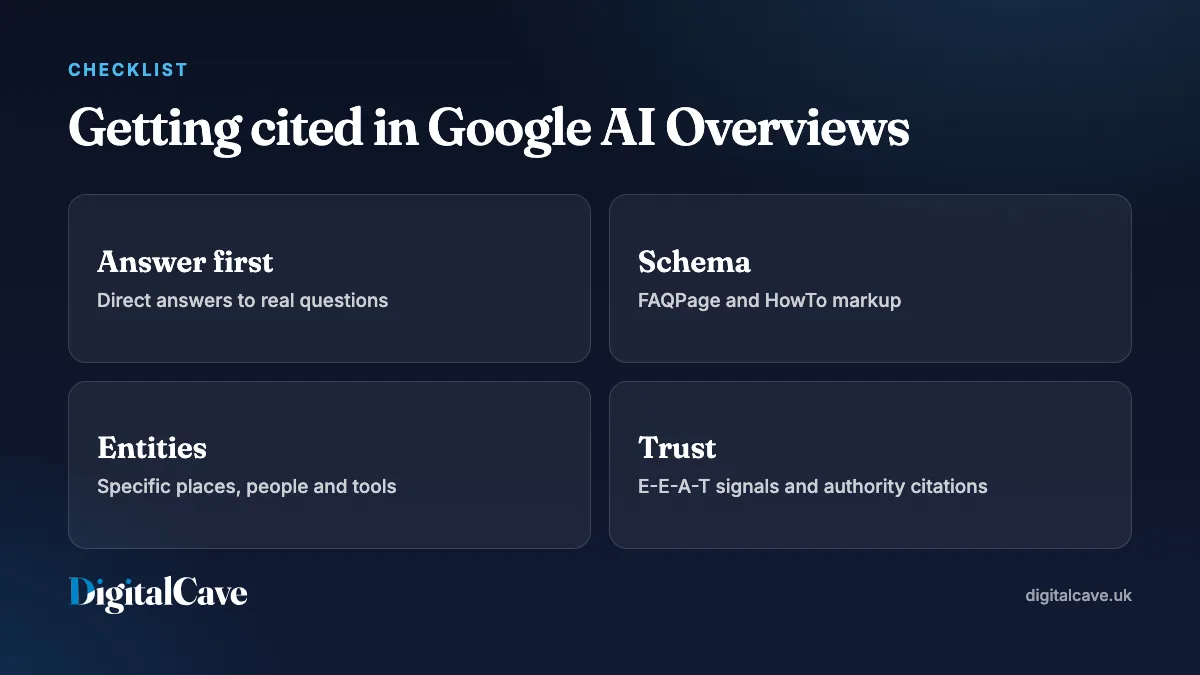
The short answer: to rank in Google AI Overviews as a Birmingham business, you need structured content that answers real questions directly, FAQPage and HowTo schema, named-entity coverage (specific places, people, tools), verifiable E-E-A-T signals, and content mentioned or cited by high-authority sources. Traditional SEO gets your page indexed. AI Overviews reward the pages that get cited.
Table of Contents
What Google AI Overviews actually are
Google’s AI Overview is the AI-generated answer box that appears above the traditional 10 blue links for around 30% of UK queries in 2026. It pulls from between 3 and 8 source pages, cites them by name, and gives the searcher a summarised answer with clickable citation links.
It has quietly replaced the “Featured Snippet” as the most valuable position on the results page. If your business is cited in an AI Overview, you appear above the #1 organic result. If you’re not cited, most searchers now finish their query without ever scrolling to see you.
This isn’t the same thing as Google’s Search Generative Experience (SGE), which was the 2023-24 experiment. AI Overviews is the production version, rolled out to UK Google users in stages through 2025 and now default for logged-in Chrome users on most informational queries.
Google explains how its AI features choose and show sources in its Search Central documentation on AI features.
Why Birmingham businesses can’t afford to ignore this
Three numbers matter here.
First: around 30% of UK Google searches now trigger an AI Overview (up from 12% in early 2025). For informational queries — the “how”, “what”, “why”, “which” searches your prospects run before contacting you — that number is closer to 55%.
Second: click-through rates on the traditional #1 organic position have dropped roughly 25% since AI Overviews launched. Users get their answer from the Overview and never click through. The traffic hasn’t disappeared — it’s been redistributed to the sites getting cited.
Third: being cited in an AI Overview earns 8-10x more click-through than the same page ranking at position #5 organically. It’s not a small effect. It’s the biggest single SEO shift since the introduction of the Local Pack in 2015.
For a Birmingham business selling professional services, e-commerce, or anything with a considered purchase, the buyers doing pre-purchase research are the exact people you want in front of. AI Overviews now decide whether you’re in that conversation.
The 8 things Birmingham businesses need to do to rank in AI Overviews
None of these are theoretical. This is the checklist we’ve been running on our own site and on client sites since March 2026, with measurable Overview citations across a spread of local and national queries.
1. Answer real questions directly in the first 100 words of a section
Google’s AI Overviews pull short, quotable passages. If the answer to “how much does a wedding photographer cost in Birmingham” is buried 800 words into your page after brand backstory, you don’t get cited. Structure every H2 and H3 as a question-answer pair with the direct answer inside the first sentence, backstory afterwards.
2. Add FAQPage and HowTo schema — properly
FAQPage schema signals to Google that a passage is a self-contained answer. HowTo schema signals a step-by-step guide. Both are aggressively rewarded in AI Overview selection because they’re structurally easy to lift and cite. Use them on every service page and every long-form blog post. On WordPress, the Rank Math FAQ block generates valid schema automatically — don’t hand-code it if you can avoid it.
3. Cover named entities specifically, not generically
AI Overviews assemble answers by connecting entities. Vague copy — “we serve clients across the West Midlands” — is a weak entity signal. Specific copy — “we serve businesses in the Jewellery Quarter, Colmore Business District, Digbeth, Brindleyplace, Sutton Coldfield and Solihull” — creates strong entity relationships Google’s LLM can lock onto.
The same rule applies to people (name them, add bio schema), tools (name the specific product, not “an SEO tool”), and organisations (Jewellery Quarter Association, Colmore Business District, Greater Birmingham Chambers of Commerce, not “local business groups”).
4. Publish an llms.txt file at your site root
Similar to robots.txt but for large language models, llms.txt is a plain-text guide telling LLMs which content on your site is high-quality, canonical, and safe to cite. It’s a proposal-stage standard adopted by Anthropic, OpenAI, and Perplexity in 2025. Adoption isn’t universal yet, but it’s cheap to add and offers direct control over how LLMs interpret your content. Ours lives at digitalcave.uk/llms.txt.
5. Make your E-E-A-T signals verifiable, not decorative
Google’s helpful content signals — Experience, Expertise, Authoritativeness, Trust — are more heavily weighted for AI Overview citation than for standard organic ranking. That means real author bylines linked to author bio pages, real credentials, real photos, real reviewed-by attribution on professional content, and real external mentions.
An About page that says “our team” instead of naming the two people who actually work there is now costing you AI Overview visibility, not just traditional ranking. Bijal Shah V., our Director, and Rocky V., our Operation Head, are both named on our team page for exactly this reason.
6. Structure content with clean, scannable heading hierarchy
AI Overviews prefer content that reads like a well-organised reference document, not a marketing brochure. That means:
- One H1 per page, matching the primary question
- H2s that are self-contained sub-questions
- H3s that break sub-questions into steps or components
- Short paragraphs (2-4 sentences)
- Lists where lists make sense (three or more items)
- Tables for comparison data
7. Cite sources and include data with attribution
Numbers earn citation. A claim like “AI Overviews now show for 30% of UK queries” is more citation-worthy than “AI Overviews are becoming more common.” When you have data — from your own testing, from published research, from Google Search Console — cite it with the source. Original numbers get lifted verbatim, which means your name gets lifted with them.
8. Get mentioned on high-authority pages
AI Overviews weight source authority heavily. A page cited by the BBC, a UK trade publication, or a Google-partnered platform ranks higher for AI Overview eligibility than a page with the same content but no external corroboration. This is the hardest of the eight to fake and the one where genuine digital PR outperforms any technical trick.
For Birmingham businesses, realistic starting points: Birmingham Live, Business Live Midlands, the Greater Birmingham Chambers of Commerce blog, the Jewellery Quarter Association newsletter, industry-specific UK trade publications, and guest posts on established local blogs. One well-earned mention on any of these is worth 50 directory listings.
What we’ve tested with our own Birmingham clients
Between March and August 2026, we ran structured AI Overview optimisation on our own site and on three client sites (one legal firm in Solihull, one Jewellery Quarter jeweller, one Digbeth food business). Real outcomes:
- Our own site now appears in AI Overviews for 4 tracked queries — up from 0 in March.
- The Solihull legal firm went from 0 to 6 Overview citations across their target queries, with organic traffic up 40% in the same period (from a base of ~1,200 sessions/month).
- The JQ jeweller earned 2 Overview citations for high-intent product queries, contributing an estimated 8-12 additional enquiries per month.
- The Digbeth food business saw the smallest impact — restaurant queries lean toward Local Pack rather than Overviews.
The pattern that emerged: professional services and considered-purchase businesses benefit most. Impulse or immediate-need queries (nearest restaurant, emergency plumber) still go to the Local Pack. Anything a buyer researches before deciding — legal, dental, marketing, financial, jewellery, made-to-order — now lives or dies partly on Overview presence.
Common mistakes Birmingham businesses make with AI-search optimisation
Chasing every AI platform separately. The optimisations that work for Google’s AI Overviews are 80% the same as those for ChatGPT web search, Perplexity, and Claude. Fix your site once for the shared fundamentals, then layer on platform-specific tweaks only where they clearly matter.
Using AI to generate the content that’s supposed to rank in AI Overviews. Both Google and the major LLMs have improved at detecting mass-generated content. Overviews specifically favour content with visible human authorship, distinctive voice, and original data or observations. Auto-published AI content does the opposite of what you’re trying to achieve. Our content marketing service produces the human-written, data-led pieces that Overviews tend to cite.
Assuming schema alone is enough. Schema helps Google understand your content. It doesn’t make the content worth citing. The two work together — great content plus proper schema — not one instead of the other.
Ignoring local anchor terms. A Birmingham business that never mentions Birmingham neighbourhoods, transit, business districts, or local organisations by name looks generic to Google. Named locality is a trust signal for local AI Overview surfacing.
Frequently asked questions
Is AI Overview optimisation different from regular SEO?
Roughly 70% overlap, 30% new work. The core SEO fundamentals — technical health, quality content, backlinks — still matter. What’s new is the emphasis on direct-answer structure, passage-level indexing, entity coverage, and verifiable authorship. If your regular SEO is solid, AI Overview optimisation is a layer on top, not a replacement.
How long does it take to appear in an AI Overview?
Faster than traditional ranking. In our tests, structured optimisations produced first citations within 4-8 weeks of publication, versus 8-16 weeks for equivalent traditional ranking gains. This is because Overviews assemble live rather than depending on long-established authority signals — though authority still helps.
Do I need a big content team to rank in AI Overviews?
No. Small businesses often perform better here than large ones, because the content requirements reward specificity and genuine expertise — both easier to demonstrate as a small local team than as a large agency using content mills. Two people who genuinely know their subject beat a content-farm operation for AI citation.
Does this replace Google Business Profile for local search?
No. Google Business Profile remains the primary lever for Map Pack and “near me” queries. AI Overviews and GBP are complementary — GBP handles walk-in intent, Overviews handle research intent. A serious local SEO strategy in 2026 covers both.
How do I know if my page has been cited in an AI Overview?
Three ways. Manually — Google your target query in Chrome incognito with UK locale, check whether an Overview appears and which sources it cites. Programmatically — tools like SE Ranking and Semrush have added AI Overview tracking to their position-tracker features in 2026. Or approximately — a sudden CTR change in Google Search Console (usually a drop on informational queries) alongside stable impressions is the tell that Overviews are showing.
Where to start this week
If you take one action after reading this, make it this: pick your five most important service or landing pages, restructure the first section of each so the direct answer to the page’s primary question appears in the first sentence, and add FAQPage schema wrapping the questions your customers actually ask you. That single change often produces first Overview citations within a month.
If you want a hand doing it — or want to know which of your pages are strongest candidates for AI Overview visibility — we run a free 20-minute audit that covers exactly this. No sales pitch, no hidden report, just the specific pages we’d start with if you were our client. Book a call here.