
How to Get Your Business Recommended by ChatGPT, Perplexity and Copilot
 16 Oct 2026
11 min read
16 Oct 2026
11 min read
The short answer: there is no form, feed or paid listing that will get your business on ChatGPT, Perplexity, Copilot or Gemini. Asked for a supplier, each assistant searches the web and names the businesses its sources support. You earn recommendations by being easy to verify: a clear website, identical facts on Bing, Google and Apple, reviews on more than one platform, and an open robots.txt.
Table of Contents
Key takeaways
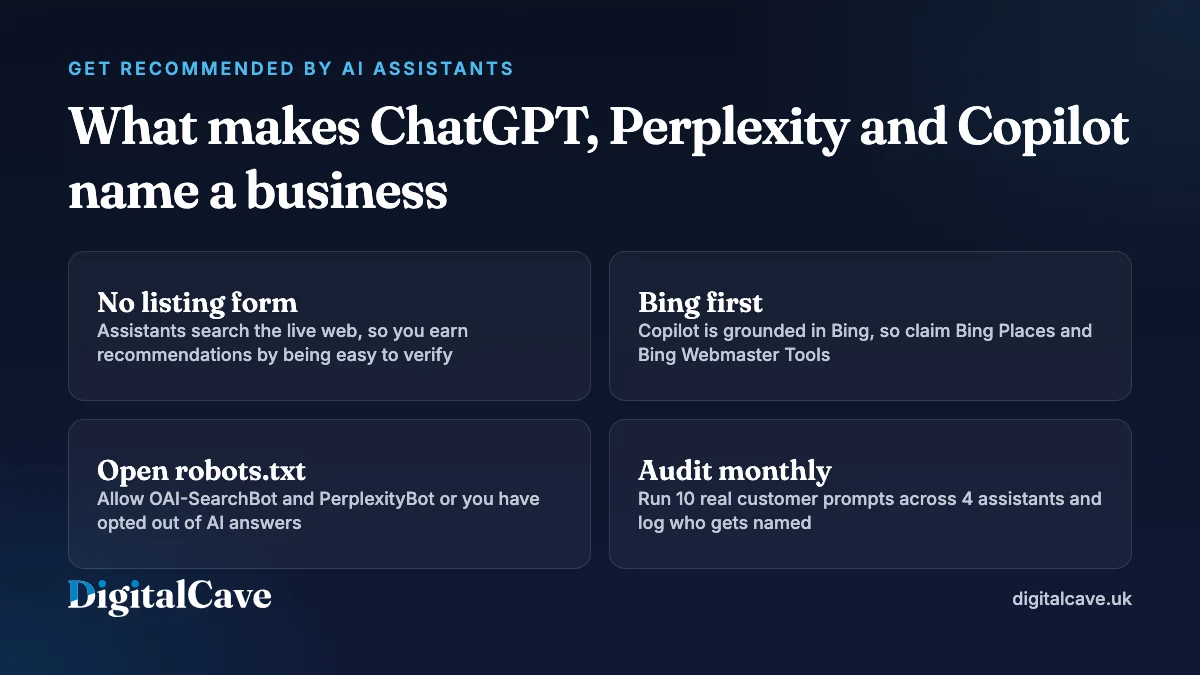
- AI assistants do not keep a directory you can join. They search the live web, so they can only recommend businesses the web describes clearly and consistently.
- As of October 2026, Microsoft documents Copilot Chat as grounded in the public web from the Bing search service, so a free Bing Places listing and Bing Webmaster Tools matter more than most UK owners realise.
- OpenAI and Perplexity both publish the crawlers that feed their answers. Check your robots.txt allows OAI-SearchBot and PerplexityBot.
- Run the 10 prompt audit below once a month, log who each assistant names and which sources it cites, and fix the sources rather than chasing the assistant.
- You cannot pay for a place in organic AI answers. Anyone selling guaranteed ChatGPT rankings is selling something they do not control.
How do ChatGPT, Perplexity, Copilot and Gemini decide which businesses to name?
Asked for a recommendation, ChatGPT, Perplexity, Copilot and Gemini usually search the live web while you wait, then summarise what the sources say. If directories, review platforms and your own site all agree on who you are, where you are and what you do, an assistant can name you with confidence. If the record is thin or contradictory, it names a competitor instead.
A definition first: generative engine optimisation (GEO) is the work of making your business easy for AI assistants to find, verify and cite. It overlaps heavily with ordinary SEO, because every major assistant leans on a search index built by crawling the same web Google and Bing crawl.
Each assistant has its own supply chain, and knowing it tells you where to spend your time:
| Assistant | Run by | Where its answers come from (October 2026) | What to focus on |
|---|---|---|---|
| ChatGPT | OpenAI | Its own search crawler, OAI-SearchBot, which OpenAI says is used to surface websites in ChatGPT search results | Allow OAI-SearchBot in robots.txt; keep your site indexable and factual |
| Copilot | Microsoft | Microsoft documents Copilot as grounded in data from the public web from the Bing search service | Bing Webmaster Tools and a verified Bing Places listing |
| Perplexity | Perplexity AI | Its own index, built by PerplexityBot, which Perplexity says surfaces and links websites in its search results | Allow PerplexityBot; publish pages with clear, quotable facts |
| Gemini | Google Search, so normal Google indexing applies | Standard Google SEO: indexable, snippet-eligible pages |
Sources for the crawler and grounding facts: OpenAI’s crawler documentation, Perplexity’s crawler documentation and Microsoft’s Copilot privacy and protections page, all checked in October 2026. These details change, so re-check them before you rely on them.
How do I check whether ChatGPT recommends my business?
Ask ChatGPT, Perplexity, Copilot and Gemini the questions your customers ask, and log who each one names and which sources it cites. Do this before you spend a penny trying to get your business on ChatGPT, because twenty minutes a month gives you a dated record of whether you are visible and, more usefully, which sources the assistants trust.
- Open ChatGPT, Perplexity, Copilot and Gemini in a browser where you are not signed in to your business accounts.
- Run the 10 prompts below, swapping in your own service and town.
- For each answer, log three things: were you named, who was named instead, and which websites the assistant cited.
- Date the log and repeat it monthly. Answers vary between runs, so treat one appearance as a signal, not a ranking.
The 10 prompts, using a Birmingham plumber as the example:
- Best emergency plumber in Birmingham
- Who should I use for a boiler repair near the Jewellery Quarter?
- Recommend a plumber in Birmingham for a small landlord
- Which Birmingham plumbers have the best reviews?
- I need a plumber in the West Midlands who works weekends. Who do you suggest?
- Compare the top rated plumbing firms in Birmingham
- Is [your business name] any good?
- What does [your business name] do and where is it based?
- Plumber near B1
- What is the difference between the cheapest and the best value plumber in Birmingham?
Prompts 7 and 8 matter most. If an assistant cannot say what your business does and where it is, the public record about you is too thin, and no amount of clever wording on your homepage fixes that on its own.
How do you get your business on ChatGPT and the other assistants?
You make your business the easiest one to verify. Every fix below is free apart from your time, and each one strengthens the sources the assistants read.
1. Set up Bing Places and Bing Webmaster Tools
Copilot is grounded in Bing, so if Bing barely knows you exist, Copilot has little to work with. Bing Places is Microsoft’s free equivalent of a Google Business Profile, and Microsoft’s help pages describe a sync option that imports an existing verified Google Business Profile, so set up rarely takes more than half an hour. Then add your site to Bing Webmaster Tools, submit your sitemap and check your key pages are indexed. Most UK small businesses have done this work for Google and never for Bing, which is exactly why it is an easy win.
2. Claim your Apple place card
Apple Maps listings feed Siri, Spotlight, CarPlay and Apple’s other apps. During 2026 Apple folded Business Connect into its single Apple Business platform, and that is where you claim your place card, verify your business and keep your details current; claiming and managing the place card is free. It is another independent record that says the same thing about you, which is precisely what assistants look for.
3. Make every mention of your business agree
Name, address, opening hours, services and spelling should be identical on your website, Google Business Profile, Bing Places, Apple place card and every directory you appear in. Contradictions read as risk, and an assistant that cannot resolve them will skip you. Our complete local SEO guide has a citation clean-up checklist that covers this in detail, and our walkthrough of getting more from your Google Business Profile covers the Google side.
4. Collect reviews on more than one platform
Google reviews are the obvious start, and our guide on how to get more Google reviews without breaking the rules gives you ask scripts that stay inside Google policy and UK law. But assistants read widely, so a presence on a second platform, such as Trustpilot or an established trade directory, corroborates the first. Reviews that name the service and the town are worth more than bare star ratings, because they give a model quotable evidence. If old, misleading reviews are the problem rather than the lack of them, that is a reputation management job, not a visibility one.
5. Earn honest mentions in lists other people write
When an assistant answers “best accountant in Birmingham”, it usually cites round-up articles, local news and directories rather than the accountants’ own websites. Getting into those sources honestly, through chamber of commerce membership, trade body listings, local press and genuine “best of” lists, puts you inside the material assistants quote. Never pay for inclusion dressed up as editorial, and never fake a mention; the same web that makes you visible makes fakes easy to spot.
6. Write pages that state plain facts
Assistants extract facts, so give them facts to extract. Every service page should say, in ordinary sentences, what the service is, who it is for, where you deliver it and what it costs or how pricing works. One page per service and per area you genuinely serve beats a single vague services page. Answer real questions under question-shaped headings, and put the answer in the first sentence. This is the same structure that wins featured snippets, which is why good local SEO and good GEO are mostly the same work.
7. Check your robots.txt lets AI search crawlers in
If your robots.txt blocks the crawlers that feed AI search, you have opted out of being recommended. Check yours at yourdomain.co.uk/robots.txt. To allow the two most important search crawlers explicitly, you can add:
User-agent: OAI-SearchBot
Allow: /

User-agent: PerplexityBot
Allow: /
One distinction saves a lot of confusion: OpenAI uses GPTBot to gather training data and OAI-SearchBot to surface websites in ChatGPT search. They are separate crawlers with separate robots.txt rules, so you can block GPTBot for training reasons and still allow OAI-SearchBot so ChatGPT search can recommend you. Perplexity similarly states that PerplexityBot is not used for training. Check the vendor documentation linked above before changing anything, because names and behaviour do change.
Should you publish an llms.txt file?
Treat it as optional, not a ranking tactic. llms.txt is a proposed convention: a plain text file at your site root that lists your key pages for AI tools. Google’s Search Central documentation says plainly that you do not need to create new machine readable files, AI text files or markup to appear in its AI features; a page only needs to be indexed and eligible to show in Search with a snippet.
No major assistant documents llms.txt as a ranking input either. Some smaller AI tools may read it, and it costs ten minutes to publish, so it is a harmless extra. Just never let it displace the work above: publishing llms.txt alone will not get your business on ChatGPT, Perplexity or Copilot.
Can you pay to get recommended by ChatGPT?
No. There is no paid placement in the organic answers of ChatGPT, Perplexity, Copilot or Gemini, and no supplier can guarantee you a slot, because recommendation answers are typically assembled from live search results at the moment of the question. Advertising is arriving on some of these platforms, but ads are labelled and separate from the recommendation itself, exactly as they are on Google.
If an agency promises to get your business on ChatGPT for a guaranteed monthly fee, ask them to show you the mechanism. There is not one. What a good agency can honestly sell is the verification work in this guide, done thoroughly and measured with a dated prompt log.
What about Google AI Overviews and AI Mode?
Google’s AI features are a separate job with their own guide. The one-line version: there is no special file or trick, because Google says a page only needs to be indexed and eligible to show in Search with a snippet, so the work is classic SEO plus content structured for extraction. We cover it fully in our guide to ranking in Google AI Overviews, which pairs with this post: that one covers Google, this one covers everything else people now ask instead of Google.
Where DigitalCave fits
DigitalCave is an SEO and web design studio in Birmingham’s Jewellery Quarter, and visibility in AI assistants is now part of how we approach SEO rather than a bolt-on. If you would rather have the audit, the Bing and Apple set up, the citation clean-up and the content work done for you, our Birmingham SEO team runs retainers from £750 per month with a fixed-price quote and no lock-in, and every engagement starts with a dated baseline of where you stand in the four assistants. Request a quote and we usually reply within 2 working hours.
Frequently asked questions
Is there a form to submit my business to ChatGPT?
No. OpenAI publishes no sign-up, feed or owner portal for businesses. ChatGPT finds businesses by searching the web, so the only way in is to improve what the web says about you: your site, Bing, Google, Apple, directories and reviews.
Does ChatGPT use Google or Bing for its answers?
OpenAI documents its own crawler, OAI-SearchBot, as the agent that surfaces websites in ChatGPT search, and it does not publish a full list of any search providers it uses alongside it. The practical answer is to be visible everywhere: indexed in Google, indexed in Bing, and open to OAI-SearchBot in robots.txt.
How long does it take to show up in AI assistant answers?
There is no fixed timetable, and anyone quoting one is guessing. New Bing Places listings typically take days to publish, crawlers revisit sites on their own schedules, and assistants answer from whatever the index holds that day. Run the monthly prompt audit and judge progress over three to six months, as you would with SEO.
Do I need an llms.txt file to appear in AI search?
No. Google states that its AI features need no special AI text files, and no major assistant documents llms.txt as a ranking input. Publishing one is cheap and harmless, so do it if you like, but treat it as housekeeping rather than a tactic.
Can AI assistants see my Google reviews?
Assistants read the public web their crawlers and search providers can reach, which includes review content that appears on crawlable pages, plus the many articles and directories that quote review scores. In practice a strong, consistent review record shapes the sources assistants cite, which is why reviews on more than one platform matter.
Should I block AI crawlers to protect my content?
For most small service businesses the trade-off favours access: blocking OAI-SearchBot or PerplexityBot removes you from answers your customers are reading, which costs more than the content is worth to protect. If training use worries you, block GPTBot specifically and leave the search crawlers open, since OpenAI documents them as separate.
In one line
You cannot buy or submit your way into ChatGPT’s recommendations; you become the business every assistant can verify, starting with Bing Places, an Apple place card, consistent facts, multi-platform reviews and an open robots.txt.