
Fake Google Review on Your Business? How to Get It Removed (UK Guide)
 11 Nov 2026
11 min read
The short answer: How to remove fake Google reviews in the UK: report the review in your Business Profile under the policy it actually breaks, track it in Google’s reviews management tool, spend your single appeal on your strongest evidence, then escalate to support or Google’s legal removal route. Reporting is free at every stage. Removal is never guaranteed, so write a calm public reply too.
Table of Contents
Key takeaways
- Google removes reviews that break a policy, not reviews that are unfair. Name the policy first.
- Reporting and appealing cost nothing, so “guaranteed removal for a fee” is a warning sign.
- You get one appeal per review. Gather the evidence before you spend it.
- Since 6 April 2025 the Digital Markets, Competition and Consumers Act 2024 has banned traders from submitting or commissioning fake reviews, and reviews that hide an incentive.
- Defamation is a real route, but section 1(2) of the Defamation Act 2013 makes a trading company show serious financial loss.
Is it actually a fake review, or just a bad one?
A fake review does not describe a real experience of your business. A bad review describes a real experience badly. Knowing how to remove fake Google reviews starts there, because Google acts on the first kind and on reviews that break its other content rules.
Four signs it is fake rather than painful: the name, email or postcode is nowhere in your records; the account is new or has reviewed dozens of unrelated places; it names a service or staff member you do not have; or several similar reviews landed within hours.
Then open Google’s prohibited and restricted content policy for Maps and find the rule it breaks. “This is unfair” goes nowhere. “Fake engagement, no record of this customer” gives Google something to check.
Which policy does your review break?
| What happened | Google’s policy | Report it? |
|---|---|---|
| Reviewer was never a customer, or names a service you do not offer | Fake engagement: content “not based on a real experience” | Yes, if you can show it |
| Ten one-star reviews in a day from accounts with no history | Fake engagement, coordinated | Yes, as a set |
| Left by a competitor, an ex-employee or your own staff | Conflict of interest: “current or former employment, a contractual or consultory relationship” | Yes, with evidence |
| Rant about politics, parking or a different branch | Off-topic | Often |
| Names a staff member in full, or posts their photo | Personal information | Usually |
| Threats or slurs | Harassment or hate speech | Yes, immediately |
| Sexual or adult content | Sexually explicit content | Yes, immediately |
| Accurate account of a genuinely bad visit | No policy breached | No. Reply instead |
How to remove fake Google reviews: the five-rung escalation ladder
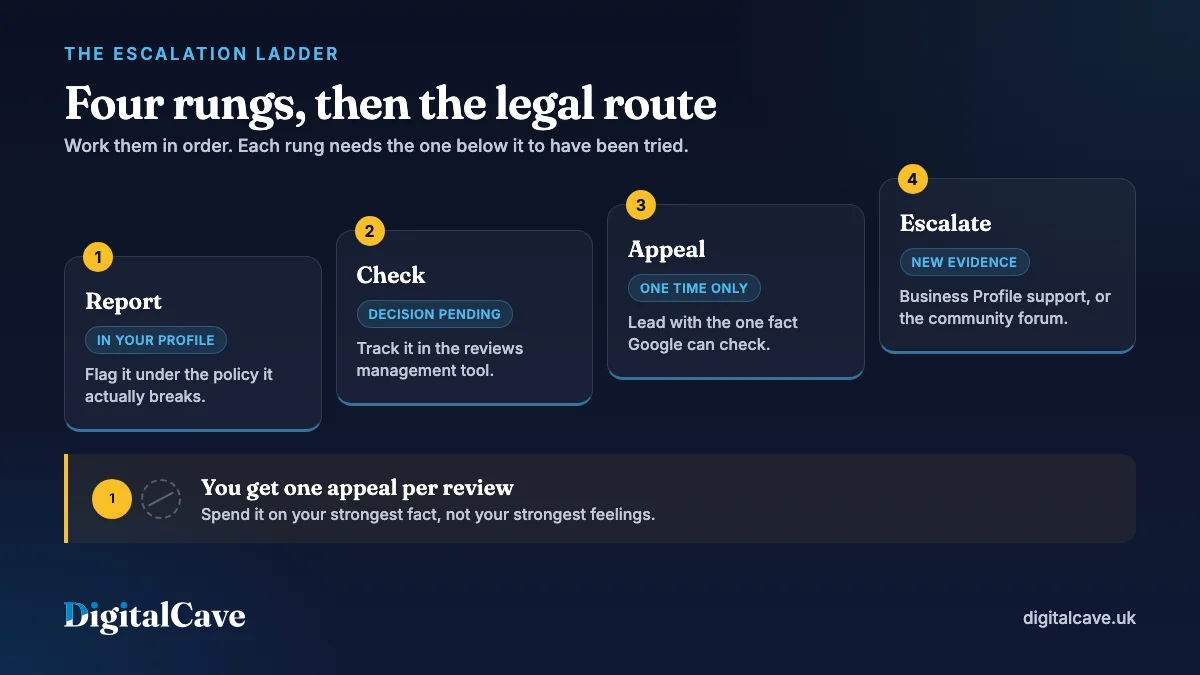
Work the rungs in order. Starting with a solicitor is expensive and almost always premature. All five are free as of November 2026.
| Rung | What you do | Cost | Use it when |
|---|---|---|---|
| 1 | Report it in your Business Profile | Free | Always, first move |
| 2 | Check the reviews management tool | Free | A few days later |
| 3 | Submit your one-time appeal | Free | Google says no violation |
| 4 | Business Profile support or forum | Free | Appeal failed, new evidence |
| 5 | Legal removal request | Free to file | Defamation, court order, personal data |
Rung 1: report the review in your Business Profile
Google’s help page on reporting inappropriate reviews gives five steps: go to your Business Profile, select Read reviews, select Report next to the review, choose the reason, then Send report. Pick the reason matching your row above, and report each review once.
Rung 2: check the status in the reviews management tool
Google’s reviews management tool, documented on the same help page, is where you confirm your email, select the business and read each report’s status: Decision pending, Report reviewed: no policy violation, or Escalated: check your email for updates.
On timing, Google says only that “review evaluation typically takes several days”. There is no service level beyond that and no published success rate, so a guaranteed turnaround is guesswork.
Rung 3: what if Google says there is no policy violation?
You get one appeal, and only one. Google’s guidance on appealing Business Profile content decisions says you “can submit a one-time appeal”, so write it like a case file: the exact policy, the one checkable fact that proves the breach, and the evidence.
Rung 4: Business Profile support and the community forum
If the appeal fails and you have found something new, for example that the reviewer is a director of a competing company at Companies House, contact Business Profile support through the help menu, or post the case in the Google Business Profile Community forum. New evidence is the price of entry.
Rung 5: how do you remove a defamatory Google review?
Through Google’s legal removal route, not the report button. Its legal removal troubleshooter covers Google Maps and lists defamation, personal data and court orders among the reasons. You give the review URL and explain why it is unlawful.
Be realistic about defamation. Under section 1 of the Defamation Act 2013, a statement is not defamatory unless it has caused or is likely to cause serious harm to reputation, and for “a body that trades for profit” that harm is not serious “unless it has caused or is likely to cause the body serious financial loss”. Opinion is not a false statement of fact.
Section 5 of the same Act, which most UK guides skip, gives a website operator a defence that it did not post the statement. That defence can fail where the claimant cannot identify the author, has served a notice of complaint and the operator did not respond as the regulations require. That notice is what puts a platform on the spot, and drafting it is solicitor work.
What should the report and the appeal actually say?
Five lines: policy, fact, evidence, pattern, ask. Google is deciding against a policy, not reading a grievance.
Policy: Fake engagement. This review is not based on a real experience of our business.
Fact: It describes a bathroom fit in March 2026. We do not fit bathrooms, and hold no booking in that name, email or postcode.
Evidence: Export of March 2026 jobs attached, plus a screenshot taken 11 November 2026.
Pattern: The same account reviewed three competitors in our postcode that day.
Ask: Please remove this review under the fake engagement policy.
For conflict of interest, swap the policy line and give the employment dates and role.
How much does it cost to remove a Google review?
Nothing, at Google’s end. Reporting, checking status, appealing, contacting support and filing a legal removal request are all free, and Google’s help pages describe no charge at any stage.
What costs money is a solicitor’s letter and the staff time gathering evidence. Treat “we guarantee removal for a fixed fee” with suspicion: the seller fills in the same free forms you can. Paying for help with the evidence and the appeal is reasonable. Paying for a promised outcome is not.
Someone is demanding money to delete the reviews. What now?
Do not pay. Google’s guidance on negative review extortion scams is blunt: “Do not engage with or pay the malicious individuals. This can encourage further attempts and doesn’t guarantee the removal of reviews.”
The pattern is a run of one-star reviews, then a message asking for money or free work to stop them. Google’s form asks for screenshots of the demand, links to every review involved, identifying details for the sender, and when you noticed the spike. Gather that first. Blackmail is a criminal offence under section 21 of the Theft Act 1968, so report the demand to the police as well.
Are fake reviews illegal in the UK?
Yes, where a business is behind them. The unfair commercial practices rules in the Digital Markets, Competition and Consumers Act 2024 came into force on 6 April 2025, and Schedule 20 bans, at paragraph 13, submitting or commissioning a fake consumer review, or one that conceals the fact it has been incentivised. A fake consumer review “purports to be, but is not, based on a person’s genuine experience”. The ban covers commercial practices, which the Act defines as acts by a trader, so a private grudge post is a Google policy problem, not a trading standards one.
The Competition and Markets Authority published its fake reviews guidance (CMA208) on 4 April 2025, alongside its wider guidance, CMA207. Two consequences matter to you:
- Whoever wrote it may be breaking the law, but the CMA enforces against traders and review platforms. It is not a removal service for your review.
- You must not answer fakes with fakes. Asking friends to post, or offering a discount for a review that does not disclose it, puts you on the wrong side of the same rules. Our guide to getting more Google reviews without breaking the rules covers the compliant ways to rebuild the count.
When a calm public reply beats removal
People reading your reviews are scanning for how you behave when something goes wrong. A short, factual reply under a fake review often does more for you than deletion would, because the reply is visible and a deletion is not. Google requires a verified business before you reply. Something like this:
Thanks for the feedback. We have checked our bookings and cannot find this visit, so we think it may have been left for another business. If we have got that wrong, please email us with the date and we will put it right.
Three rules: no sarcasm, no customer details, no argument. If the reviewer comes back with detail identifying a real visit, treat it as a real complaint.
What never to do
- Do not threaten the reviewer privately. It turns one bad review into a story, and can breach Google’s harassment policy.
- Do not bury it with bought or incentivised reviews. That breaks Google’s rules and, since April 2025, UK law.
- Do not open a second Business Profile. Google’s guidelines allow one per business, and breaking that risks the suspension our guide covers.
- Do not delete your profile. Google says user-generated content and reviews remain, and the business may still show on Search and Maps. You lose the ability to reply, not the reviews.
The evidence log to start on day one
Every rung asks for proof, and the day to collect it is the day the review appears. One row per review:
| Column | What goes in it | Why it matters |
|---|---|---|
| Date noticed | 11 Nov 2026, 09:15 | Shows a pattern when several land together |
| Review URL | Link to the individual review | Every Google form asks for it |
| Screenshots | The review, and the reviewer’s other reviews | Authors edit and delete both |
| Booking check | “No match for this name, email or postcode” | The fact your appeal turns on |
| Status and dates | Reported 11 Nov, refused 15 Nov, appealed 15 Nov | Proves you worked the ladder in order |
Screenshot the reviewer’s profile the same day. It is the evidence that most often vanishes before Google looks at the case.
When it has stopped being one review
One fake review is an admin task. A pattern is a different problem: a run of reviews after a dispute, an ex-employee working through your branches, or a rating that has slipped far enough to cost you map pack enquiries. Removal is then half the job, and rebuilding genuine volume is the other.
Our local SEO guide for UK small businesses explains how reviews feed visibility, and our breakdown of what local SEO costs covers the ongoing work.
Where DigitalCave fits
DigitalCave is a digital marketing agency in the Jewellery Quarter, Birmingham. We handle online reputation management for UK businesses: triaging which reviews are worth reporting, writing the reports and appeals, drafting the replies, and setting up a compliant review request process.
We work UK-wide and locally through our reputation management service in Birmingham and our local SEO team, and our case studies show the work. We will not promise removal, because nobody can. The fee is a flat monthly amount quoted up front, no lock-in, and we reply within two working hours. Request a fixed-price quote.
Frequently asked questions
How long does it take Google to remove a fake review?
Google’s help pages say review evaluation “typically takes several days”, with no published service level beyond that and no timescale at all for appeals. Vendor guides often quote three to fourteen days, but Google does not, so treat those figures as observation rather than policy.
Can you legally force Google to remove a fake review?
Not by filling in a form. Google removes reviews that break its policies and considers legal removal requests for unlawful content such as defamation. Forcing the issue means a court order, so a solicitor, and under the Defamation Act 2013 a company trading for profit must show serious financial loss.
How do I remove a Google review from a disgruntled ex-employee?
Report it under conflict of interest, which Google defines as covering current or former employment and contractual relationships. Say plainly that the reviewer worked for you, give the dates and role, and keep it factual. Do not name them in your reply, or you risk breaching the personal information policy.
Does replying to a fake review make it stay up longer?
Google publishes nothing to suggest it does. Reporting and replying are handled separately, and Google documents no ranking effect from a reply. What a reply does is put your side in front of every future reader. Reply once, briefly, then leave it.
Should I pay a company that guarantees fake review removal?
No. There is no paid route into Google’s review decisions, and every form is free to anyone with access to the Business Profile. A guarantee of removal is one nobody can give.
Who enforces the UK rules on fake reviews?
The Competition and Markets Authority. Schedule 20 of the Digital Markets, Competition and Consumers Act 2024 bans traders from submitting or commissioning fake consumer reviews, and reviews that conceal an incentive, from 6 April 2025. The CMA enforces against traders and review platforms rather than acting on individual complaints, so you still work Google’s ladder.
In one line
How to remove fake Google reviews, in short: test it against Google’s policy, report it with one checkable fact and a dated screenshot, save your single appeal for your strongest evidence, and reply calmly in public while you wait.