
How to Get More Google Reviews Without Breaking Google’s Rules or UK Law
 13 Oct 2026
11 min read
13 Oct 2026
11 min read
The short answer: How to get more Google reviews: ask every customer at the moment the work is finished, send them your own Google review link or QR code, and ask all of them, not only the ones you expect to be happy. Never offer a discount, prize or freebie in return. Since 6 April 2025, incentivised reviews that hide the incentive are unlawful in the UK.
Table of Contents
Key takeaways
- Asking is allowed: Google tells businesses to remind customers with a link or QR code.
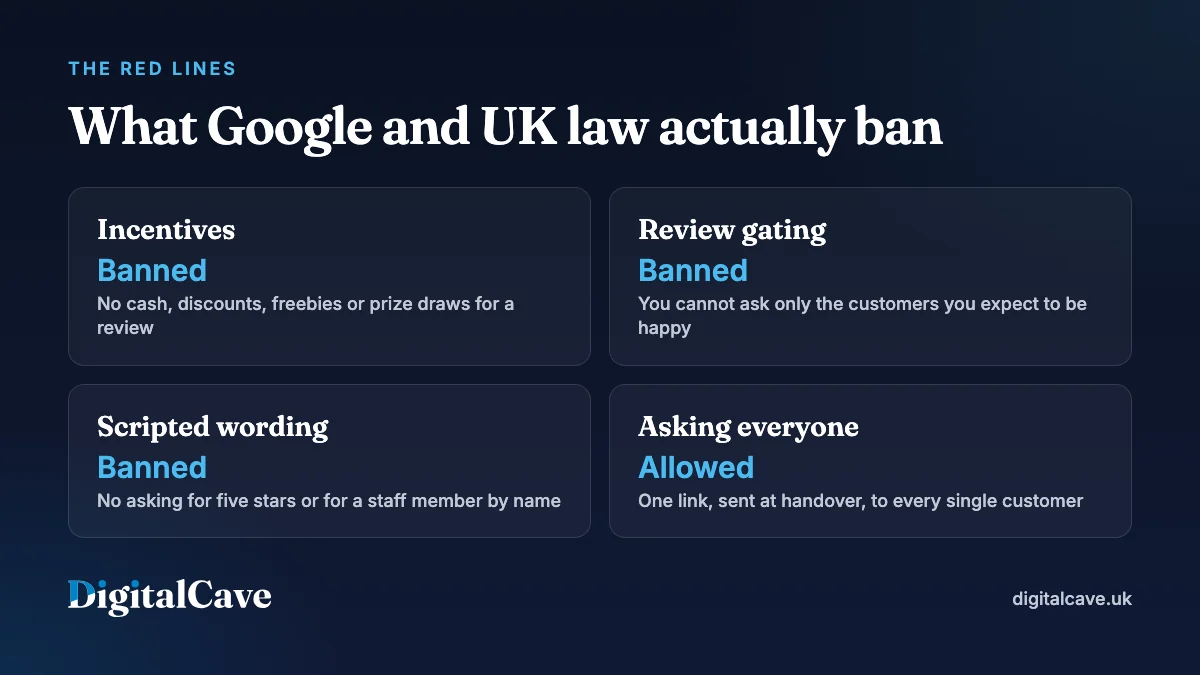
- Three things are banned outright: rewarding people for reviews, asking only the customers you expect to be happy, and telling them what to write.
- UK law caught up on 6 April 2025, when the Digital Markets, Competition and Consumers Act 2024 banned fake and concealed incentivised reviews.
- Email or text the request and the Information Commissioner’s Office (ICO) rules apply.
- The system that works is boring: one link, one script, one fixed moment in the job.
- You need a claimed and verified Business Profile before any of this works.
What counts as a legal, policy-safe review request?
A compliant request is a neutral invitation, sent to every customer, offering nothing in exchange and instructing nothing about what to write. Most advice on how to get more Google reviews stops there, skipping the two rulebooks below.
Google’s prohibited and restricted content policy is explicit. Merchants must not offer incentives, defined in the policy as “payment, discounts, free goods and/or services”, given “in exchange for posting any review or revision or removal of a negative review”. Nor may they “Discourage or prohibit negative reviews, or selectively solicit positive reviews from customers”.
It adds that merchants should not “require or pressure users to leave ratings or write reviews while on the premises, nor should they request that specific content be included”, naming content “that identifies a staff member”. Google does encourage asking, though: its Tips to get more reviews page tells businesses to remind customers using a Google link or QR code.
Chapter 1 of Part 4 of the Digital Markets, Competition and Consumers Act 2024 came into force on 6 April 2025. The Competition and Markets Authority (CMA) lists it as a banned practice to submit, or commission someone else to submit, “either a fake consumer review or a consumer review that conceals the fact it has been incentivised”. Its dedicated fake reviews guidance was published two days earlier, on 4 April 2025.
An incentivised review is one written in exchange for something of value: cash, a discount, a freebie, a prize draw entry. The law bans hiding the incentive, not the incentive itself, but that will not help you here, because Google bans it outright.
| What you want to do | Allowed? | Why |
|---|---|---|
| Ask every customer for an honest review | Yes | Google’s help pages recommend it |
| Hand out a QR card or review link | Yes | Google generates both for you |
| Offer 10% off for a review | No | Banned by Google; unlawful if hidden |
| Enter reviewers into a prize draw | No | An entry is an incentive |
| Survey first, ask only the happy ones | No | Selectively soliciting positives |
| Ask customers to name the fitter | No | Requesting content naming staff |
| Hand over a tablet and wait | No | Pressuring users on the premises |
| Write reviews yourself, or ask staff to | No | Not a genuine experience |
This is not theoretical. On 27 March 2026 the CMA opened investigations into five businesses over fake and misleading reviews. Two map onto the table: whether one “asked staff to write positive reviews”, and whether another offered “discounts on future orders in exchange for leaving 5-star reviews on delivery apps, without this being disclosed”. The CMA can fine up to 10% of global turnover.
What is review gating, and why does Google ban it?
Review gating is screening customers privately first, then inviting only the satisfied ones to post publicly. Google bans it because the rating stops reflecting what customers think.
It is easy to do by accident. The usual version is a feedback tool that asks “How did we do?” on a one-to-five scale, then routes fours and fives to Google and everyone else to a complaints form. Turn the branching off: send one link to everyone.
When is the best time to ask for a Google review?
The best time to ask for a Google review is the moment the customer has received what they paid for and is visibly pleased: the boiler fires up, the car is handed back, the keys go over. A request sent a fortnight later competes with everything else in the inbox.
Build it into the job, not your diary. Pick the one step that happens every time and attach the ask to it: the invoice, the handover, the aftercare sheet. One reminder is reasonable; two is pestering.
How do you get your Google review link and QR code?
Google generates your review link and QR code free from your Business Profile. According to Google’s help page Create a Google link or QR code to request reviews, you select Read Reviews, then Get more reviews, then Copy for the link, or right-click the QR code and save the image.
One catch before you order printed cards: Google states that “reviews QR codes can only be generated on a computer browser, not on mobile devices”.
Where should your review link go?
Your Google review link should go wherever a customer already looks, in more than one place. Most businesses set up one and stop, but adding the rest costs nothing once the link exists.
| Placement | Works best for | Note |
|---|---|---|
| Final invoice or receipt | Trades, garages, consultants | Pairs the ask with completion |
| Email signature, all staff | Every business | No ongoing effort |
| Thank-you page after a booking | Clinics, restaurants, salons | Returning customers only |
| SMS sent the same day | Mobile and on-site trades | Check the ICO rules below |
| Printed QR card at handover | Studios, barbers, takeaways | Hand it over, do not watch |
What should you say? Five scripts you can copy
Name the job so the customer knows what to write about, then stop. None of these ask for five stars, suggest wording or name staff, all of which breach Google’s policy.
Trades and builders
Hi Dave, the boiler service is done and the certificate is attached. If you have a minute, a Google review really helps people find us: [link].
Put it in the invoice template, not a separate message. See web design for tradespeople.
Clinics and healthcare
Hi Sarah, your aftercare notes are attached. If you would like to share how you found the appointment, you can review us here: [link]. Please do not include medical details you would rather keep private.
That privacy line is not politeness: patients do disclose conditions publicly, and you cannot delete it. See web design for clinics.
Restaurants and takeaways
Thanks for ordering tonight. If the food hit the mark, a Google review helps a lot: [link]. If anything was off, reply here and we will sort it.
Both routes go to everyone, so it is not gating. See web design for takeaways.
Solicitors and accountants
Dear Mr Patel, your year-end accounts have been filed. If you are happy with how the matter was handled, a short Google review would be appreciated: [link]. It is optional.
Check your regulator’s publicity rules first. See web design for solicitors and accountants.
Tattoo studios
Healed up nicely? If you are pleased with the piece, a Google review helps people find us: [link]. Send a healed photo too if we can share it.
Studios get a second contact point at the healed stage. See tattoo studio web design.
Can you email or text customers to ask for a review?
Usually yes, for your own customers. A review request is best treated as direct marketing, because it promotes the business rather than servicing the contract, so work on the basis that the Privacy and Electronic Communications Regulations (PECR) apply.
The ICO’s electronic mail marketing guidance sets out the soft opt-in conditions: you obtained the contact details yourself while selling or negotiating to sell, you are only marketing similar products and services, and you gave a simple way to opt out both when you collected the details and in every message since.
Three things follow, and they are what businesses get wrong:
- The details must be ones you collected. The ICO says the soft opt-in does not apply to details obtained for you by someone else, and that no bought-in list is compliant with it.
- Every message needs a working opt-out: reply-to-stop by SMS, an unsubscribe link by email. One buried in a privacy policy does not count.
- Enquiries can count. The ICO says a person “doesn’t need to actually buy anything from you”, and gives an online enquiry as something that could constitute negotiations for a sale. Someone who only browsed is not covered.
If a platform sends the messages for you, you stay responsible for the data and opt-outs. None of this is legal advice: check your own position.
How should you reply to reviews?
Reply to every Google review, positive and negative, within a few days and in your own voice. A reply is addressed to the reviewer but written for the next person reading the profile.
Thank positive reviewers by naming the job, not by repeating keywords. Answer negative ones with a correction and an offline route to fix it. Never reveal customer details.
Google’s Manage customer reviews page says replies usually take up to 10 minutes to review, but that a review can sometimes take up to 30 days, so do not assume yours has failed. It is also where you flag a review that breaks Google’s content policies.
How to get more Google reviews in 30 days: the plan
- Day 1. Generate your review link and QR code on a desktop, where the team can find them.
- Day 2. Count your reviews, then those of the business above you in the map pack, the local block Google shows above the normal results. That gap is your target.
- Day 3. Add the link to every email signature and invoice template.
- Day 4. Pick the step that always happens and write the ask into it, using a script above.
- Day 5. Audit any feedback tool you use. If it routes people by score, switch that off.
- Days 6 to 30. Ask everyone, reply to every review, recount on day 30.
Here is the arithmetic, with assumptions labelled so you can swap in your own. The figures are illustrative, not measured response rates.
| Assumption (illustrative) | Value |
|---|---|
| Jobs completed per month | 40 |
| Assumed response rate | 1 in 5 |
| New reviews per month | 8 |
| Gap to the business above you | 47 (their 58, your 11) |
| Months to close the gap | About 6 |
Reviews are one input into local ranking. If the profile is incomplete or the site has no service and area pages, more reviews will not fix visibility. Our complete local SEO guide for UK small businesses covers the rest, the local SEO mistakes we see most often is worth ten minutes, and boosting local sales with your Business Profile covers the profile.
Where DigitalCave fits
DigitalCave is a digital marketing studio in Birmingham, at 47 Jewel Court, 29 Legge Lane in the Jewellery Quarter. We ask every client exactly as described above: one link, sent once the work is signed off, nothing attached.
Most businesses should not pay anyone to learn how to get more Google reviews: the plan above is a free afternoon.
We help when reviews are a symptom of a bigger problem, such as a profile that will not rank or a competitor two years ahead in the map pack. That is our local SEO service in Birmingham, and the same work in Coventry. SEO retainers start at £750 a month, with no lock-in. If the problem is a run of reviews you did not deserve, online reputation management is the better start.
If you are unsure which you need, request a quote. We usually reply within two working hours, and we are open every day, 9:00 to 17:00.
Frequently asked questions
Is it illegal to offer a discount for a Google review in the UK?
It is unlawful if the incentive is concealed. Since 6 April 2025, the Digital Markets, Competition and Consumers Act 2024 has banned commissioning a review that hides the incentive. Google goes further and bans offering payment, discounts or free goods for a review at all.
How many Google reviews does my business need?
There is no published threshold. Google does not state a number, so the only useful benchmark is the businesses ranking above you in the map pack for your main service. Count theirs and treat the gap as the target. A steady trickle of recent reviews is more convincing than a batch that arrived in one week.
Can I ask a customer to mention a particular service or member of staff?
No. Google’s prohibited and restricted content policy says merchants should not request that specific content be included, naming content that identifies a staff member as an example. Ask for an honest review of the job and leave the wording to the customer.
Why do my Google reviews disappear?
Google removes content that breaks its policies, including content not based on a real experience and content posted because of an incentive. Reviews can also vanish for reasons unconnected to you, such as the account being removed. Flag a policy-breaking review rather than replying angrily.
Can I put a tablet on the counter for customers to leave reviews?
Not in the way most shops do it. Google’s policy says merchants should not require or pressure users to leave reviews while on the premises, and standing over someone while they type is pressure. A QR card they scan at home is not.
Are review request apps and QR cards allowed by Google?
Yes, provided they send the same request to every customer and offer nothing in return. The tool is not the problem; the filtering is. Ask the supplier one question before you buy: does it ever route customers differently based on a score collected first? If so, that is review gating.
In one line
How to get more Google reviews: ask every customer, the moment the job is done, with your own Google link and nothing attached.