
SEO Packages for Small Businesses: What Should Be Included (and What to Avoid)
 28 Nov 2026
11 min read
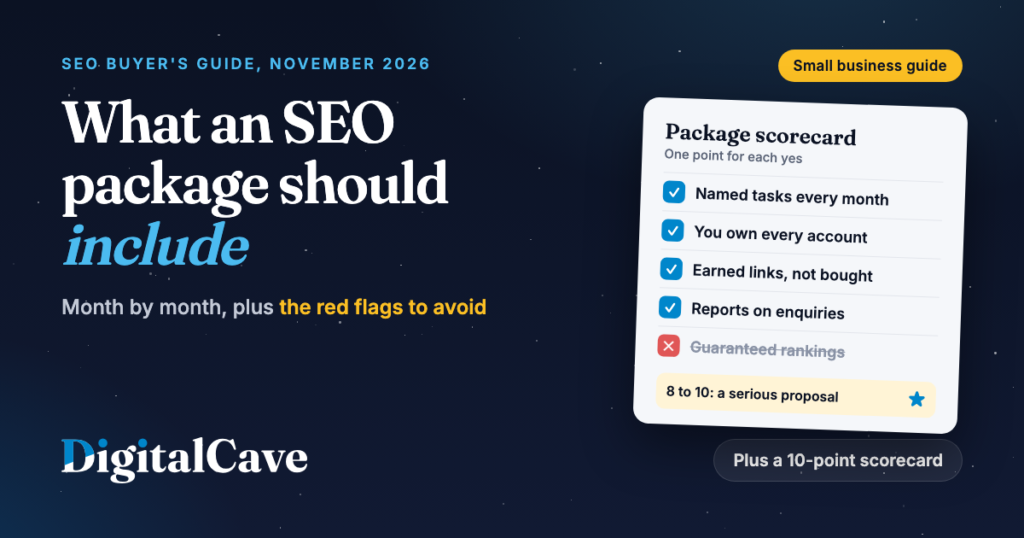
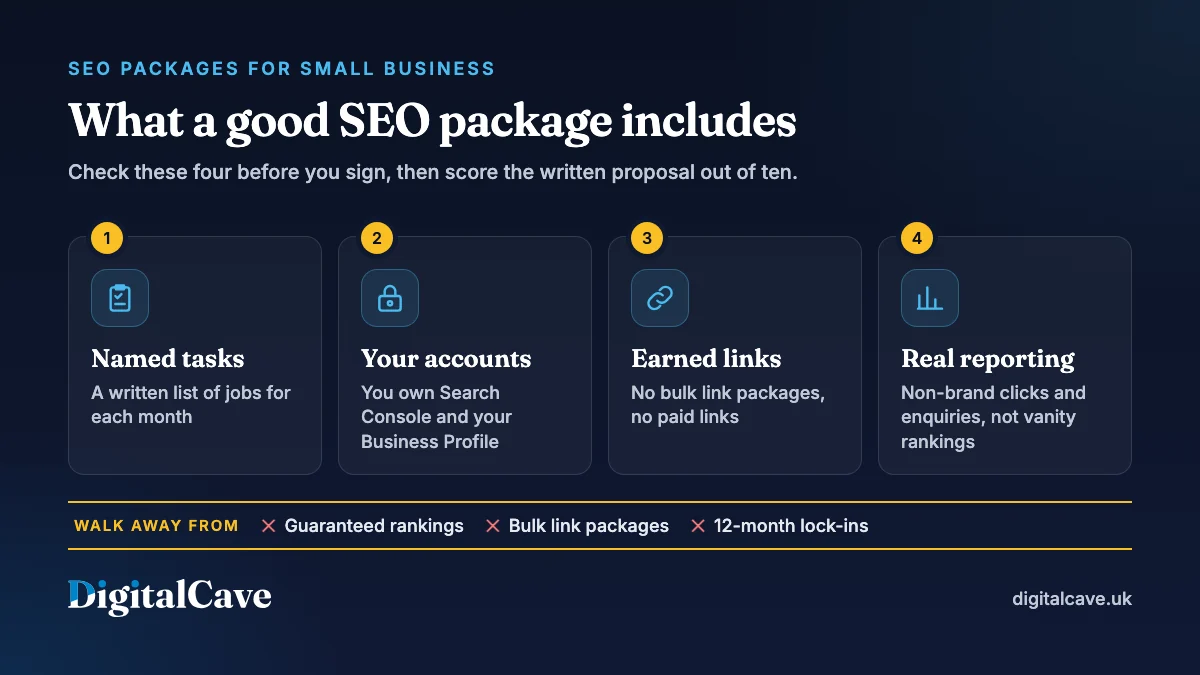
The short answer: SEO packages for small business should be a monthly scope of named work: a technical audit and fixes, keyword research mapped to pages, on-page improvements, Google Business Profile upkeep, new or improved content, genuine links and mentions, and a report tied to enquiries. Avoid any package that guarantees rankings, sells links in bulk or locks you in for a year.
Table of Contents
Key takeaways
- An SEO package is a list of jobs, not a ranking promise. No named monthly jobs means you are buying hope.
- Google says plainly that “no one can guarantee a #1 ranking on Google”.
- Local, national and ecommerce packages should look different. A local package that ignores your Google Business Profile is the wrong package.
- Stay the owner of Search Console and your Business Profile, and the administrator of Google Analytics. The agency gets user access, not ownership.
- Judge results on non-brand clicks (searches that do not include your business name) and enquiries, not on rankings for phrases nobody searches.
What is an SEO package?
An SEO package is a fixed monthly service in which an agency or freelancer carries out an agreed list of search engine optimisation tasks for your website and Google listings. Search engine optimisation (SEO) is the work of helping your site appear in Google’s unpaid results for the searches your customers make.
Most SEO packages for small business are sold as a monthly retainer, meaning a set fee for a set scope each month. The package name (“Starter”, “Growth”, “Pro”) tells you nothing; the deliverables list tells you everything.
Google’s own page on whether you need an SEO (last updated 5 June 2026) lists useful services a provider can offer, including a review of your content and site structure, technical advice, content development, keyword research, training and optimising for generative AI.
What is included in an SEO package?
A complete package covers eight areas: technical fixes, keyword research, on-page work, your Business Profile, citations, content, links and reporting. Content and links take the most skilled time, so they are the first things a low fee leaves out.
| Area | What you should get | How often | How to check it was done |
|---|---|---|---|
| Technical audit and fixes | A prioritised fix list (speed, indexing, broken pages, redirects, mobile issues), then the fixes themselves | Audit at the start, checks monthly | Search Console page indexing report shows fewer unintended “not indexed” pages |
| Keyword research and mapping | A list of searches your customers use, each matched to one page on your site | Month 1, reviewed quarterly | You receive a spreadsheet of keyword to page |
| On-page optimisation | Better titles, headings, internal links and copy on your service pages | A set number of pages a month | The report names the pages changed |
| Google Business Profile | Correct categories, services, photos, posts and review replies | Monthly | Profile edits are visible; calls and direction requests reported |
| Citations | Your name, address and phone consistent on the main directories | Month 1 to 3, then as needed | A list of listings fixed, with links |
| Content | New or rewritten service, area or guide pages written for real questions | A stated number of pages a month | The pages exist and are indexed |
| Links and mentions | Earned links from local press, suppliers, associations and partners | Ongoing | A list of each link with the site it is on |
| Reporting | Clicks, enquiries, work done and next month’s plan | Monthly | A short report plus a call, not just a PDF of charts |
Many small business SEO packages now also mention AI search, meaning visibility in Google AI Overviews, ChatGPT and Perplexity. For its own AI features, Google says SEO best practices still apply and there are no additional requirements, so treat AI search as part of the content work rather than a costly separate add-on.
What does a good SEO package look like month by month?
Good monthly SEO packages front-load fixes and research, then shift their hours to content and authority. If month six looks exactly like month one, you are paying for a checklist, not a strategy.
Worked example (illustrative, not a client): a plumber with one location in Solihull, a 15-page WordPress site, a claimed but neglected Google Business Profile and about 20 reviews. Assumptions: the owner approves pages within a week and wants local call-outs, not national traffic. Budget: an assumed £750 a month, so each month has one main focus.
- Month 1, set-up: access granted (owner keeps ownership), technical audit, keyword research, one page per service mapped, Business Profile categories and services corrected, tracking for calls and form enquiries checked.
- Month 2, fixes: technical fixes done, titles and headings rewritten on the main service pages, citations cleaned up, a simple routine set up to ask every customer for a review.
- Month 3, gaps: two new service pages written (for example boiler repair and emergency call-outs), internal links added, first Business Profile posts.
- Months 4 to 6, authority: area pages only where the business genuinely works, answers to common customer questions, links earned from local suppliers and trade associations, monthly review of what is getting clicks.
- Every month: a one-page report of work done, non-brand clicks, calls and forms, and what happens next.
Google’s hiring guidance also says a good provider asks about your business, competitors and how customers find you. If nobody asks those questions in month one, the plan was written before they met you.
How do local, national and ecommerce SEO packages differ?
Local SEO packages centre on your Google Business Profile and nearby searches; national packages centre on content and links; ecommerce packages centre on product and category pages. Pick by where your customers are and how they buy.
| Local SEO package | National SEO package | Ecommerce SEO package | |
|---|---|---|---|
| Typical business | Trades, clinics, salons, restaurants, local services | Online services, B2B firms, consultancies | Online shops on Shopify or WooCommerce |
| Main target | The map results and “near me” searches | Ordinary results for topic and service searches | Category and product searches |
| Biggest share of work | Business Profile, reviews, service and area pages | Content and earned links | Technical fixes, category pages, product data |
| Key report metric | Calls, direction requests, form enquiries | Non-brand clicks and leads | Organic revenue and orders |
| Warning sign | No mention of your Business Profile | No content or links in the scope | No plan for duplicate or out-of-stock pages |
What are the red flags in an SEO package?
The biggest red flags in SEO packages for small business are ranking guarantees, bulk link packages, long lock-ins and the agency owning your accounts. Each one either breaks Google’s rules or leaves you stuck when results do not come.
- Guaranteed rankings. Google says no one can guarantee a #1 ranking and warns against anyone claiming a “special relationship” with Google or “priority submit”.
- “500 backlinks a month”. Google’s spam policies list buying links for ranking purposes, automated link building and low-quality directory links as link spam.
- Hundreds of AI-written pages. The same policies class mass-produced pages made mainly to manipulate rankings as scaled content abuse, however they are made.
- Keywords in your Business Profile name. Google’s Business Profile guidelines say unnecessary information in a business name is not permitted and could get the profile suspended.
- Bought reviews, or reviews requested only from happy customers. Since April 2025, UK law has banned fake reviews, concealed incentivised reviews and publishing reviews in a misleading way. The CMA’s fake reviews guidance explains what businesses must not do.
- A 12-month minimum term with no exit. Early fixes can be judged within months. A long lock-in protects the provider, not you.
- Vanity reports. Rankings for phrases nobody searches, or “impressions” with no clicks or enquiries. Our post on why most agency reports are useless shows what to ask for instead.
- Secrecy. Google warns against providers who will not explain what they intend to do, and reminds you that you are responsible for the actions of companies you hire.
What should you ask before you sign an SEO package?
Ask for the monthly deliverables in writing, who owns the accounts, how success is measured and how you can leave. Copy the scorecard below, send it with your enquiry and score each provider’s written answers.
SEO package scorecard (one point for each “yes”):
- Does the proposal list named tasks for each of the first three months?
- Does it state how many pages will be written or improved each month?
- Does it say where links will come from, without a fixed number of links for sale?
- Will I stay the owner of Search Console and my Business Profile, and the administrator of Analytics?
- Will every change to my site be listed, with the reason for it?
- Is success measured in enquiries or sales, not only rankings?
- Is the fee fixed and quoted up front, with VAT stated?
- Can I leave on 30 days’ notice, or after a short initial term?
- Do I keep the content, pages and reports if I leave?
- Will reports use my own Search Console and Analytics data?
How to read the score: 8 to 10 is a serious proposal. 5 to 7 means ask follow-up questions before you sign. Under 5, or any ranking guarantee, keep looking. For a wider comparison, see how to choose an SEO agency in Birmingham.
On access, Google’s Search Console permissions help describes three user levels: owner, full user and restricted user. Google’s hiring guidance suggests giving only read access during an audit. On your Business Profile, stay the primary owner and add the agency as a manager, because managers cannot add or remove users or delete the profile.
Our comparison of an SEO consultant versus an SEO agency shows when each suits a small business.
How do you know if an SEO package is working?
Look at non-brand clicks in Search Console and the number of enquiries from organic search and your Business Profile. Rankings alone can rise while enquiries stay flat.
Google’s SEO Starter Guide says some changes take effect in a few hours and others take several months, and suggests waiting a few weeks before judging a change. In practice, judge any package in three stages:
- By month 3: the fixes and new pages promised are live and indexed, and your Business Profile is complete.
- By month 6: non-brand clicks and impressions are trending up for the pages that were worked on.
- By month 12: organic enquiries or sales have grown enough to cover the fee. If not, change the scope or the provider.
How much do SEO packages for small business cost?
There is no standard UK price, so work out how many skilled hours a monthly fee buys. Divide the fee by the provider’s hourly rate: assuming £75 an hour, a £750 monthly fee buys about 10 hours. If two go on reporting and calls, eight are left for content, technical work or links, rarely all three.
Read how much SEO costs in the UK for the full arithmetic, and how much local SEO costs if you serve one town or city.
When is an SEO package not the right buy?
An SEO package is the wrong purchase if your website is broken, you need leads this month, or a one-off fix would do.
- Your site does not work properly. Fix or rebuild it first; SEO on a broken site wastes the fee.
- You need leads this month. SEO builds over months. Paid search can bring calls faster while SEO grows.
- You are a small local business with time to spare. Google itself says you can probably do much of the work yourself, starting with its SEO Starter Guide.
- Your competitors are not active. A one-off audit and fix project may be enough, with a check-up every six months.
Where DigitalCave fits
DigitalCave is an all-in-one web design, SEO and digital marketing agency in the Jewellery Quarter, Birmingham. Our SEO services for Birmingham businesses start with an audit, and our local SEO service covers Business Profiles, reviews and area pages for businesses that serve nearby customers.
We give a fixed-price quote, a flat monthly fee set up front, with no lock-in, and our reports come from your own Search Console and Google Analytics 4 accounts. Because we also build custom WordPress and Shopify sites, technical fixes do not need a third party. We reply within 2 working hours.
If you want to see where you stand first, ask for a free SEO audit, or request a quote and send us your scorecard questions.
Frequently asked questions
What is included in an SEO package?
A complete SEO package includes a technical audit and fixes, keyword research mapped to pages, on-page improvements, Google Business Profile upkeep for local firms, new or improved content, earned links and a monthly report on clicks and enquiries. Ask for each item to be listed in writing.
Are cheap SEO packages for small business worth it?
Sometimes, if the scope is small and honest, such as a one-off audit or Business Profile clean-up. A cheap monthly package that promises rankings, hundreds of links or dozens of pages is usually cutting corners that can breach Google’s spam policies.
How long should an SEO contract be?
A short initial term followed by 30 days’ notice is reasonable for most small businesses. Avoid 12-month lock-ins with no exit. You should be able to judge whether the promised fixes and pages have been delivered within about three months.
What is the difference between local and national SEO packages?
A local SEO package focuses on your Google Business Profile, reviews, citations and pages for the areas you serve. A national package focuses on content and earned links to compete for searches across the country, with little or no map pack element.
Can an SEO company guarantee first page rankings?
No. Google states that no one can guarantee a #1 ranking on Google, and warns against providers who claim a special relationship with Google. A trustworthy provider promises specific work and honest reporting, not positions.
Should I give my SEO agency ownership of my Google accounts?
No. Stay the owner of Search Console and your Google Business Profile, and the administrator of Google Analytics, and add the agency as a user or manager. That way you keep your data and listings if you change provider.
In one line
Buy an SEO package for the named monthly work, the accounts you keep and the enquiries it brings, never for a ranking promise.