
What Is SEO in Marketing? A Clear Guide for Small Businesses
 13 Nov 2026
9 min read
The short answer: SEO in marketing means search engine optimisation: improving your website and online presence so search engines show your business, without paying per click, when people search for what you sell. It is the marketing channel that earns organic visibility. It is slower to build than paid ads, but traffic does not stop the moment you stop paying.
Table of Contents
Key takeaways
- SEO stands for search engine optimisation. In marketing terms it is how a business earns unpaid listings in Google, Bing and AI-powered search.
- It has four working parts: technical SEO, on-page content, off-page reputation (links and mentions) and, for local businesses, local SEO.
- Google says it does not accept payment to rank a site higher, and that no one can guarantee a number one ranking.
- SEO works best alongside other channels: ads for speed, email for repeat customers, social for awareness, SEO for steady demand.
- Measure it in enquiries and sales, not just rankings. Search Console shows impressions and clicks; your analytics and inbox show whether they turned into business.
What is SEO in marketing?
SEO in marketing is the practice of getting a business found in search results for the searches its customers make, by improving the website, its content and its reputation rather than buying ads. Google’s own SEO Starter Guide describes SEO as helping search engines understand your content, and helping users find your site and decide whether to visit it.
The marketing part matters. SEO is not a technical project that ends when a box is ticked. It is a channel, like advertising or email, with a goal (more customers), an audience (people actively searching), and a budget of time and money. A search for “emergency plumber near me” or “accountant for small business” is someone telling you exactly what they want. SEO is how you make sure they find you rather than a competitor.
SEO defined in one sentence
Search engine optimisation is the ongoing work of making a website the most useful, trustworthy and accessible answer to the searches that matter to a business, so search engines choose to show it.
How does SEO fit with other marketing channels?
SEO is the long-term, compounding channel in a marketing mix. Paid ads buy attention now, social media builds awareness, email keeps existing customers coming back, and SEO captures people who are already searching. Most small businesses need a mix, weighted by budget and urgency.
| Channel | How you pay | Speed | When you stop | Best for |
|---|---|---|---|---|
| SEO | Time, content and expertise | Slow to build | Rankings fade gradually | Steady demand from people already searching |
| Pay-per-click ads | Per click | Same day | Traffic stops at once | Launches, offers, testing keywords |
| Social media | Time, or per impression for ads | Medium | Reach drops quickly | Awareness, trust, community |
| Email marketing | Platform and content time | Fast once you have a list | List stays yours | Repeat customers and nurturing leads |
For a fuller view of how these channels work together, read our beginner’s guide to what digital marketing is.
How does SEO work?
SEO works by improving the signals search engines use to decide which pages to show. Google explains in how Search works that it operates in three stages: crawling (discovering pages), indexing (understanding and storing them) and serving results (choosing what to show for each search).
SEO influences each stage. You help Google find your pages with a clean site structure and a sitemap. You help it understand them with clear headings, descriptive titles and structured data. And you give it reasons to choose you: content that answers the search better than anyone else, a fast and usable website, and a reputation other sites vouch for.
Google is also clear about what does not work. It says it does not accept payment to crawl a site more often or rank it higher. Its guidance on creating helpful content says its ranking systems are designed to prioritise helpful, reliable information created to benefit people, not content made to manipulate rankings. Google uses the idea of E-E-A-T (experience, expertise, authoritativeness and trustworthiness) to describe what that looks like, while noting that E-E-A-T itself is not a specific ranking factor.
What are the main types of SEO?
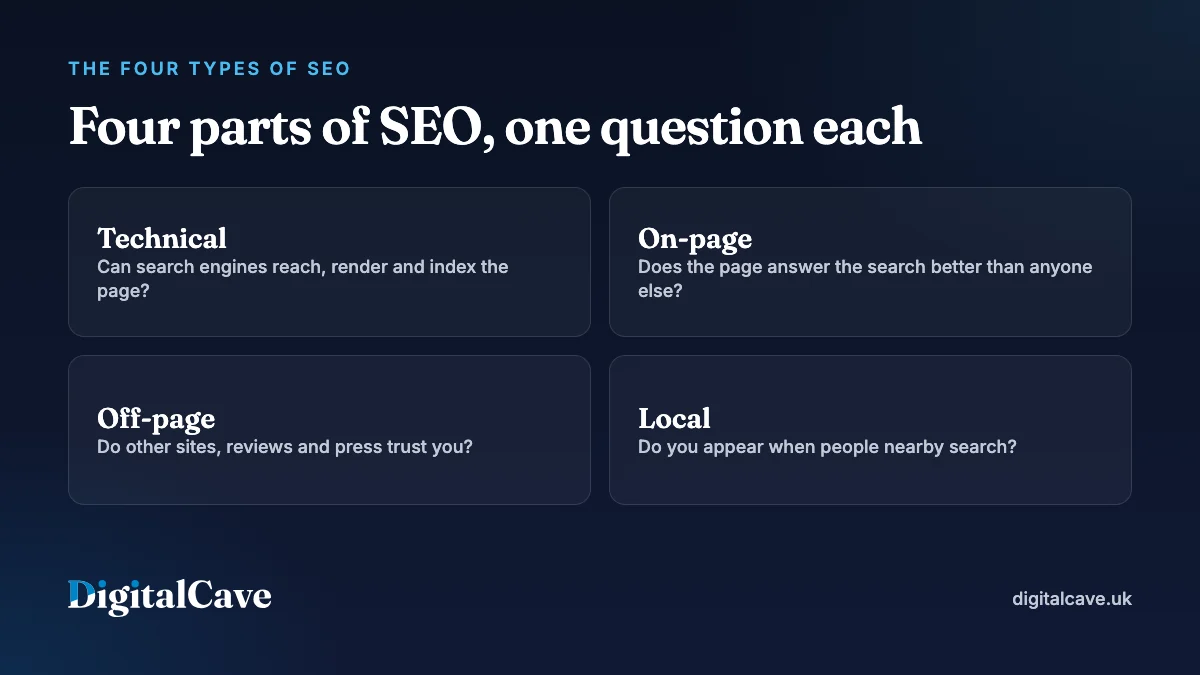
There are four main types of SEO, and each answers a different question.
- Technical SEO: can search engines crawl, render and index your pages? This covers speed, mobile pages, redirects, duplicate URLs and structured data. Our technical SEO guide and checklist goes through it step by step.
- On-page and content SEO: does each page answer a real search well? This covers keyword research, page titles, headings, copy, images and internal links.
- Off-page SEO: do other people trust you? This covers links from relevant websites, press mentions, reviews and consistent business listings.
- Local SEO: do you appear when people nearby search? This covers your Google Business Profile, reviews, location pages and the map results. Our local SEO service in Birmingham focuses on exactly this.
AI search is now part of the picture as well. Google’s list of services an SEO might provide now includes optimising for generative AI. AI Overviews and assistants such as ChatGPT tend to draw on the same well-structured, trustworthy content.
What does SEO marketing look like in practice?
Here is a worked example. Assumptions: a fictional independent accountancy practice in the West Midlands, a 10-page website, no blog, a Google Business Profile with a handful of reviews. It is an illustration of the process, not a client result.
- Research: list the services clients actually buy, then find the searches behind them, such as “small business accountant”, “self assessment help” and “bookkeeping for sole traders”.
- Map pages to searches: one page per service, so each search has one clear answer on the site. Avoid two pages chasing the same phrase.
- Fix the foundations: make sure every page is indexed, loads quickly on a phone and has a unique title and meta description.
- Strengthen the local signals: complete the Google Business Profile, ask happy clients for reviews, and make the practice’s name and contact details consistent everywhere.
- Publish useful content: answer the questions clients ask every year, such as deadlines and what records to keep, linking each article to the matching service page.
- Earn mentions: local business groups, professional bodies and genuine partnerships are worth more than any number of low-quality directory links.
- Measure and adjust: track enquiries by source every month and put effort into the pages that bring in the right clients.
How long does SEO take to work?
SEO usually takes months, not weeks. Google’s starter guide says some changes might take effect in a few hours and others could take several months. In practice, fixes to technical problems can show quickly, while new content and reputation build more slowly.
Be wary of anyone who promises a timeline to the top spot. Google’s page on hiring an SEO states plainly that no one can guarantee a number one ranking on Google. A good provider will talk about the work they will do, how they will measure it, and what to expect at each stage.
How do you measure SEO in marketing?
Measure SEO on three levels: visibility, traffic and business results.
| Level | What to track | Where to find it |
|---|---|---|
| Visibility | Impressions and average position for your key searches | Google Search Console, Performance report |
| Traffic | Organic clicks and click-through rate to your important pages | Search Console and your analytics tool |
| Business results | Enquiries, calls, bookings and sales from organic search | Analytics conversions, form submissions, your CRM or inbox |
Rankings on their own can mislead. A page that ranks first for a phrase nobody searches, or a phrase that attracts the wrong customers, does nothing for the business. Ask which searches bring in work you want.
How do you get started with SEO?
Start with the free foundations, then decide what to do yourself and what to hand over.
- Set up Google Search Console and submit your sitemap.
- Claim and complete your Google Business Profile if you serve customers locally.
- Write a unique title and meta description for each important page.
- Make sure each service has its own page with plain, specific copy.
- Ask every happy customer for a review, and reply to all reviews.
- Fix slow pages and broken links you find along the way.
Hiring help makes sense when you do not have the time, when the site has technical problems, or when competitors are clearly investing. Our guides to what SEO costs in the UK and how to choose an SEO agency explain what to ask before you sign anything.
Where DigitalCave fits
DigitalCave is an all-in-one web design, SEO and digital marketing agency, based in the West Midlands and serving Birmingham, Coventry and the UK. Because we design and build websites too, SEO is planned into the site rather than added on later.
You can see how we approach it on our SEO services page, or our SEO company in Birmingham page if you are local. If you would like to know where your site stands first, ask for a free SEO analysis, or request a fixed-price quote with no lock-in.
Frequently asked questions
What does SEO stand for in marketing?
SEO stands for search engine optimisation. In marketing, SEO (sometimes called marketing SEO) refers to improving a website and its online reputation so it appears in unpaid search results for the searches customers make. It is one channel within digital marketing, alongside paid ads, social media, email and content.
Is SEO part of digital marketing?
Yes. SEO is one of the core digital marketing channels. It focuses on organic search visibility, while other channels such as pay-per-click ads, social media and email reach people in different ways. Most businesses get the best results when SEO and the other channels support each other.
What is the difference between SEO and SEM?
SEO earns unpaid visibility in search results. SEM, search engine marketing, is usually used to mean paid search ads, though some people use it to cover both paid and organic search. Paid ads appear straight away and stop when the budget stops; SEO takes longer but keeps working.
Can I do SEO myself?
Yes, many small businesses handle the basics themselves: Search Console, a complete Google Business Profile, clear service pages and regular reviews. It is worth getting help for technical problems, competitive markets, site migrations or when you simply do not have the time to do it consistently.
Is SEO worth it for a small business?
It usually is when customers search for what you sell, because SEO puts you in front of people who are already looking. It is less useful for products nobody searches for yet, where awareness channels such as social media may work better. Judge it on enquiries and sales over time.
Does SEO still matter with AI search?
Yes. Google’s AI Overviews and assistants such as ChatGPT and Copilot draw on web content that is crawlable, clear and trustworthy. The same work that helps you rank, such as helpful content, clean technical foundations and a strong reputation, also makes your business more likely to be cited in AI answers.
In one line
SEO in marketing is how a business earns unpaid visibility in search: make your website the clearest, most trustworthy answer to your customers’ searches, and measure it in enquiries rather than rankings.