
What Is Digital Marketing? A Beginner’s Guide for UK Small Businesses
 13 Nov 2026
10 min read
The short answer: Digital marketing is promoting a business through online channels: your website, search engines, social media, email, online ads and content. It works by reaching people where they already spend time online, then turning that attention into enquiries and sales. Its big advantage over traditional marketing is that almost everything can be targeted, measured and adjusted as you go.
Table of Contents
Key takeaways
- Digital marketing covers every way a business reaches customers online, from a Google search result to a follow-up email.
- The main channels are your website, SEO, pay-per-click ads, social media, email and content. Most small businesses focus on three or four.
- Online buying is mainstream: the ONS reports that internet sales were 28.3% of all retail sales in Great Britain in September 2026.
- Your website is the hub. Every other channel sends people there, so a slow or unclear site wastes the rest of your budget.
- UK rules apply: the ICO enforces consent rules for marketing emails and texts, and the ASA’s CAP Code covers non-broadcast advertising.
What is digital marketing?
Digital marketing is the use of online channels and digital technology to attract, convert and keep customers. It includes being found on Google, running ads on search and social platforms, posting on social media, sending emails, publishing useful content, and the website that ties it all together.
The idea is the same as any marketing: get the right message in front of the right people at the right time. What changes is the toolkit. A leaflet drop reaches every house on a street; a search ad reaches only the people who typed “boiler repair” in your area this morning. And you can see, usually within days, what that ad cost and what it brought in.
| Digital marketing | Traditional marketing | |
|---|---|---|
| Examples | Search ads, SEO, social media, email, websites | Print, radio, TV, leaflets, billboards |
| Targeting | By search, location, interest, past behaviour | By area, publication or time slot |
| Measurement | Clicks, enquiries and sales tracked per channel | Mostly estimated reach |
| Changes | Can be edited or paused the same day | Fixed once printed or booked |
| Minimum spend | Many channels can start small or free | Often a significant upfront booking |
Traditional marketing still works for some businesses, and the best plans often use both. But for most small businesses in the UK, digital channels are where customers look first.
Why does digital marketing matter for UK businesses?
Digital marketing matters because that is where buying decisions now start. The Office for National Statistics tracks internet sales as a percentage of total retail sales: in September 2026 (the latest figure at the time of writing) it was 28.3% in Great Britain. And that figure only counts goods bought online. It does not include the people who research a plumber, an accountant or a restaurant online and then pick up the phone or walk in.
Three practical reasons stand out for small businesses:
- You can start small. A Google Business Profile, a well-built website and an email list cost little to run, and paid channels let you set your own daily budget.
- You can target precisely. Reach people by what they search for, where they are and what they are interested in, rather than paying to reach everyone.
- You can measure what works. Each channel reports results, so you can move budget away from what does not perform.
What are the main digital marketing channels?
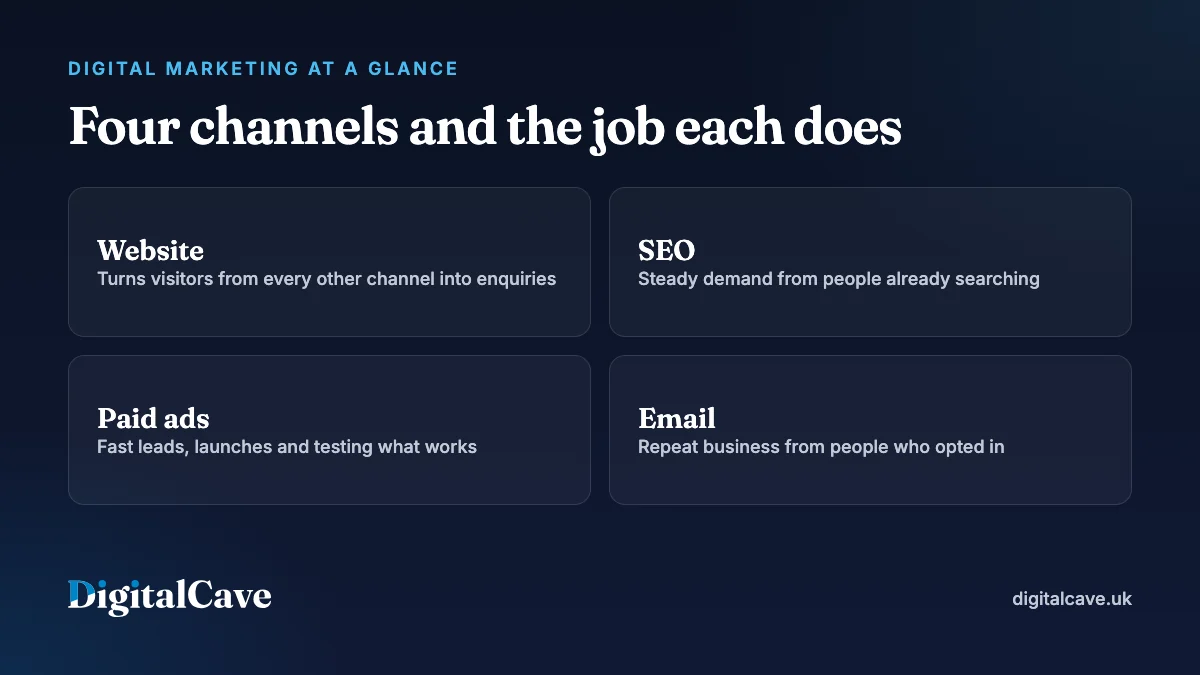
There are six core digital marketing channels. Each has a different job, and they work best in combination.
| Channel | What it is | Best for | Speed |
|---|---|---|---|
| Website | Your own site, where enquiries and sales happen | Converting visitors from every other channel | Foundation |
| SEO | Earning unpaid visibility in search results | Steady demand from people already searching | Months |
| Pay-per-click ads | Paying for placement on search or social, usually per click | Fast leads, launches and testing | Days |
| Social media | Organic posts and paid ads on Facebook, Instagram, LinkedIn and others | Awareness, trust and community | Weeks |
| Email marketing | Newsletters and automated emails to people who opted in | Repeat business and nurturing leads | Fast once you have a list |
| Content marketing | Guides, videos and posts that answer customer questions | Fuelling SEO, social and email | Months |
Your website comes first because every other channel sends people there. If it is slow, unclear or hard to use on a phone, you pay for traffic that leaves. That is why web design belongs in any digital marketing plan. SEO then builds visibility you do not pay for per click, and PPC management buys visibility straight away while SEO grows. If you want to understand the search side in more depth, our guide to what SEO means in marketing explains it step by step.
Owned, paid and earned media
A useful way to group the channels is by who controls them. Owned media is what you control: your website, email list and social profiles. Paid media is attention you buy: search and social ads. Earned media is what others give you: reviews, press coverage, shares and links. Paid media gets results fastest, earned media carries the most trust, and owned media is the only one you keep if a platform changes its rules.
How does digital marketing work?
Digital marketing works by guiding people through the stages of a buying decision, using the channel that fits each stage.
- Awareness: someone first comes across your business, often through social media, a video or a local search.
- Consideration: they compare options, read reviews, look at your website and maybe read a guide you have written.
- Decision: they search your name or service, see an ad or a strong search listing, and get in touch or buy.
- Loyalty: emails, good service and review requests turn one sale into repeat business and referrals.
Most customers touch several channels before they buy. That is why the channels need to tell the same story, and why judging one channel in isolation can be misleading.
What does digital marketing look like for a small business?
Here is a worked example. Assumptions: a fictional independent café in the West Midlands, with an existing website, an Instagram account and no marketing budget beyond a few hours a week. It shows how channels connect; it is not a client result.
- Website: menu, opening hours and location on the home page, fast on a phone, with a booking or contact option.
- Local SEO: a complete Google Business Profile with photos, current hours and replies to every review.
- Social media: three posts a week showing new dishes and events, with the website link in the profile.
- Email: a simple sign-up for a monthly update, with clear consent, sent to people who opted in.
- Paid ads (optional): a small, local social ad for a new menu launch, tracked by bookings.
Nothing here needs a big budget. It needs consistency, a website that works, and a way to measure what brings people through the door.
How do you start digital marketing on a small budget?
Start with the channels you own, then add paid channels once the basics convert.
- Define the goal. More calls, more bookings or more online sales. One main goal keeps decisions simple.
- Fix the website. Clear services, fast pages, obvious contact options and working forms.
- Get found locally. Claim your Google Business Profile and ask happy customers for reviews.
- Pick one or two social platforms where your customers actually are, and post consistently.
- Start an email list with proper consent from day one.
- Set up measurement with Google Search Console and an analytics tool so you can see which channels bring enquiries.
- Test paid ads with a small daily budget on one clear offer, and stop what does not pay back.
Our digital marketing strategy guide for small businesses takes this further, with how to set goals, choose channels and plan a year.
How do you measure digital marketing?
Measure each channel against the business goal, not just against its own platform’s numbers.
| Channel | Useful measures | Watch out for |
|---|---|---|
| Website | Enquiry or sale conversion rate, top landing pages | Traffic that never converts |
| SEO | Organic clicks, impressions, enquiries from organic search | Rankings for phrases nobody buys from |
| PPC | Cost per enquiry or sale, return on ad spend | Clicks that look cheap but do not convert |
| Social media | Profile visits, website clicks, messages | Likes and followers as the only measure |
| Clicks, replies, sales from campaigns | Open rates alone, which privacy features can distort |
What rules apply to digital marketing in the UK?
Two sets of rules matter most for small businesses. First, marketing emails and texts. The ICO’s guidance on electronic mail marketing says you must not send marketing emails or texts to individuals without specific consent, with a “soft opt-in” exception for existing customers who bought (or negotiated to buy) something similar, and who were given a simple way to opt out when their details were collected and in every message. The ICO notes this guidance is under review after the Data (Use and Access) Act, so check it before a big campaign.
Second, advertising claims. The CAP Code is the rule book for non-broadcast advertisements, sales promotions and direct marketing, and it must be followed by all advertisers, agencies and media. In plain terms: do not make claims you cannot back up.
Should you do digital marketing yourself or hire an agency?
Do it yourself when you have time, a small number of channels and a clear goal. Many owners run their own social media and Google Business Profile well. Bring in help when the website needs rebuilding, when paid ads are spending money without clear returns, when SEO needs technical work, or when you simply cannot do it consistently. A good agency should explain what it will do, how it will measure it, and what you will own at the end.
Where DigitalCave fits
DigitalCave is an all-in-one web design, SEO and digital marketing agency, based in the West Midlands and serving Birmingham, Coventry and the UK. We build the website and run the channels that feed it, so the pieces work as one plan rather than separate suppliers.
See how we approach it on our digital marketing services page, or our digital marketing agency in Birmingham page if you are local. When you are ready, request a fixed-price quote: no lock-in, and a reply within two working hours.
Frequently asked questions
What is digital marketing in simple words?
Digital marketing is promoting your business online. It means using your website, Google, social media, email and online ads to reach people who might buy from you, then turning their interest into enquiries and sales. Almost everything can be measured, so you can see what works.
What are the main types of digital marketing?
The main types are search engine optimisation (SEO), pay-per-click advertising, social media marketing, email marketing and content marketing, all built around your website. Some lists also include affiliate, influencer and video marketing. Most small businesses focus on three or four that suit their customers.
Is digital marketing worth it for a small business?
Usually, yes, because it can start small and every channel can be measured. A complete Google Business Profile, a clear website and a simple email list cost little to run. The key is to pick channels your customers actually use and judge them on enquiries and sales.
What is the difference between digital marketing and SEO?
SEO is one part of digital marketing. Digital marketing is the whole set of online channels, including ads, social media and email. SEO focuses only on earning unpaid visibility in search engines such as Google and Bing, and in AI-powered search results.
How long does digital marketing take to work?
It depends on the channel. Paid search ads can bring enquiries within days. Social media and email build over weeks. SEO and content marketing usually take months but keep working after the effort is made. Most plans combine fast and slow channels.
Do I need a website for digital marketing?
You can start with social media and a Google Business Profile, but a website is strongly recommended. It is the one channel you fully own, it is where most ads and search results send people, and it is where enquiries and sales are captured and measured.
In one line
Digital marketing is promoting your business through the online channels your customers already use, with your website at the centre and every channel measured against real enquiries and sales.