
How to Choose the Best Web Design Company in Birmingham (2026)
 21 Jul 2026
11 min read
The short answer: the best web design company in Birmingham is the one that fits your type of business and passes eight checks. Look for live work you can test, named people who build it, your ownership of domain, site and accounts, fast mobile pages, a safe SEO migration, accessibility, privacy and security basics, and fair support and contract terms.
We are a web design company in Birmingham, so we are not a neutral judge. That is why every check below is one you can run yourself, mostly with free tools and official UK guidance.
Table of Contents
What “best” means depends on your business
There is no single best web design company, only the best fit for what your website has to do.
- Local service business (a Solihull clinic, say, or a Sutton Coldfield tradesperson): the site exists to bring in enquiries, so look for speed on phones, clear calls to action and local SEO foundations.
- Online shop (a Birmingham jeweller selling UK-wide): the platform, product data, payments and keeping the rankings you already have matter most. Our WordPress, Shopify, Wix and Squarespace comparison covers the platform question.
- Creative or portfolio business (a Digbeth studio, for example): strong visuals that still load quickly, because large images and video can make a portfolio slow on a phone.
- Charity or community group: accessibility, and editing that volunteers can manage with very little training.
- Start-up on a tight budget: honestly, a DIY builder or a good freelancer may be the best fit for now.
Name that job before you contact anyone. It makes every quote easier to judge.
The 8 checks before you hire a web design company in Birmingham
Run every company on your shortlist through these. A good one will be glad you asked. If you have not built a shortlist yet, start with our list of web design agencies in Birmingham.
1. Work you can click, not screenshots
Screenshots show design, not build quality. Ask for three live sites similar to yours and try them on your phone. Then run each one through PageSpeed Insights, Google’s free speed test, and look at the mobile result.
Speak to one of those site owners. If the business is a limited company, look it up on Companies House, which shows its registered address, date of incorporation, officers and filed documents for free.
Read reviews for detail and recent dates, not just stars. Fake reviews have been banned in the UK since April 2025, but a cluster of vague five-star reviews from one week still deserves a closer look.
2. You know who actually builds it
Ask for the names of the people who will design and build your site, and ask to meet them. The person who sells the project is not always the person who builds it.
Ask whether any work is outsourced or subcontracted, and to whom. Some website development companies use specialists, which is fine, but you should know who has access to your site and who fixes it when it breaks.
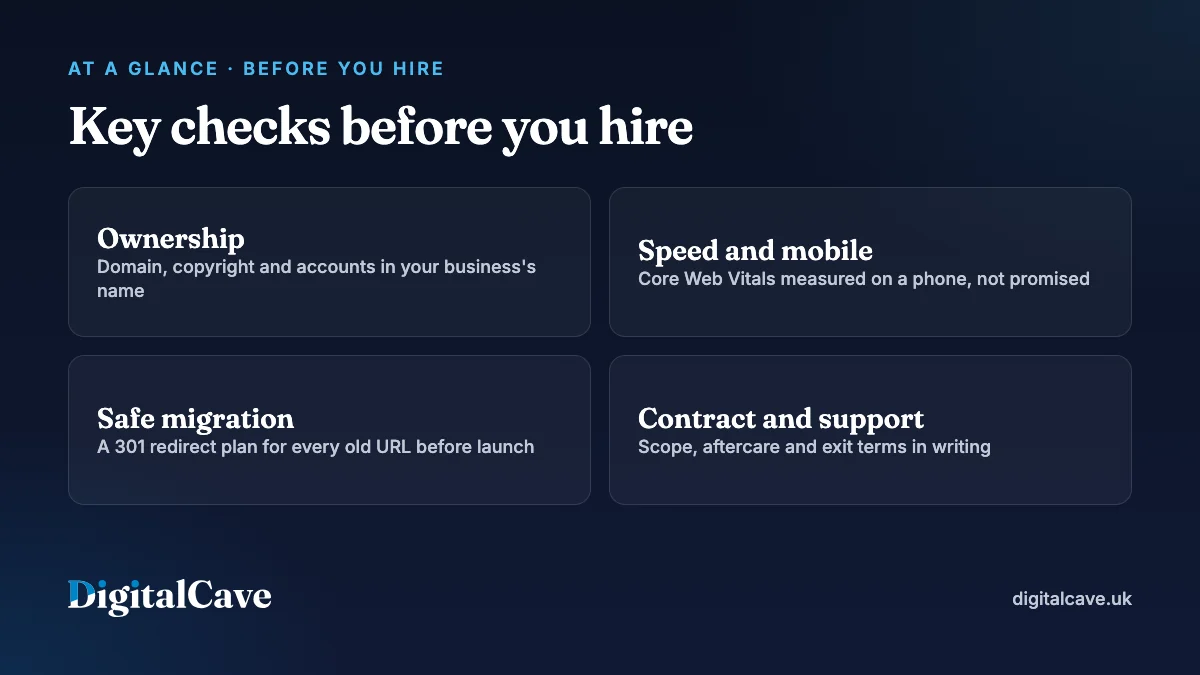
3. You own the domain, the site and the accounts
This check is easy to skip and expensive to fix later.
- Domain. It should be registered to your business. For .uk domains, Nominet calls this person or company the “registrant”, and it can only be changed later through a registrant transfer.
- Design, code and content. When you commission work, the first legal owner of copyright is whoever created it, not you, unless you agree otherwise in writing. So the contract should give you the copyright in the design, custom code and content made for you. Themes, plugins and stock images are usually licensed, so ask which licences pass to you.
- Accounts. Your business should be the verified owner in Google Search Console, an Administrator in Google Analytics 4 and the primary owner of your Google Business Profile, with the agency added as a user.
- Hosting. Ideally in your name. If the company hosts the site, get a written promise of a full export of files and database whenever you ask.
4. Fast on a phone, measured not promised
Google uses the mobile version of a site’s content for indexing and ranking, so the phone version is your real website.
The benchmark is Google’s Core Web Vitals: Largest Contentful Paint (loading) within 2.5 seconds, Interaction to Next Paint (response to a tap) under 200 milliseconds, and Cumulative Layout Shift (how much the layout jumps) under 0.1.
Keep it in proportion. Google says Search “always seeks to show the most relevant content, even if the page experience is sub-par”. Speed will not rescue a weak page, but a slow one wastes the visitors you do get.
5. SEO basics, and a safe move from your old site
If you already have a website, the riskiest moment of a redesign is the switch. Google’s guidance on site moves sets out the basics: map every old URL to its new one, use permanent server-side redirects such as 301s, keep them “generally at least 1 year”, and expect temporary ranking fluctuation.
Ask to see the redirect plan before launch. The new site should also have sensible page titles and descriptions, a clean heading structure, an XML sitemap and Search Console connected from day one. Our guide to whether your website needs a redesign explains how to tell a refresh from a rebuild.
6. Accessibility from the start
An accessible site works with screen readers, keyboards and zoomed text. The usual benchmark is the Web Content Accessibility Guidelines (WCAG) 2.2 at level AA, the standard public sector websites must meet.
For private businesses the law is less specific, so be wary of claims that WCAG is legally required for every UK business. The Equality Act 2010 says a service provider must not discriminate against disabled people, and the duty to make reasonable adjustments can include making sure information is “provided in an accessible format”.
The statutory Code of Practice for services, in force since 5 August 2026, gives the example of a website with all its text embedded in graphics. It says this gives rise to an obligation to make a reasonable adjustment, and will be indirect disability discrimination unless the provider can justify it (Example 5.45).
It matters commercially too: in 2024 to 2025, one in four people in the UK (16.7 million) were disabled.
7. Privacy and security basics
Your website collects personal data as soon as someone fills in a form, so these basics matter.
- Cookie consent. You need consent for non-essential cookies, but the ICO lists five exceptions. They include cookies strictly necessary for a service the user asked for, and some analytics and preference cookies, provided people get a simple, free way to object.
- Privacy information. You must provide privacy information when you collect personal data, so every form should link to your privacy notice.
- A data-processing contract. If the company hosts your site or handles enquiry data, it is likely to be your processor, and the ICO says there must be a written contract whenever a controller uses a processor.
- Updates. WordPress says older versions are not maintained with security updates, so ask who updates the core, theme and plugins, and how often.
- Backups. Ask where backups are stored and when a restore was last tested.
8. Support and contract terms
Get these in writing: what maintenance covers and costs, response times when something breaks, the notice period, what you receive at exit (files, logins and the domain), and payment stages tied to milestones.
In business contracts in England, Wales and Northern Ireland, the law implies that a supplier acting in the course of a business will carry out the service with reasonable care and skill. That is a floor, not a substitute for a written scope. For what a sensible plan includes, see our guide to website maintenance costs in the UK.
Red flags to walk away from
- “Guaranteed page one”, or a cold email promising rankings. Google’s own guidance says to “Beware of SEOs that claim to guarantee rankings” or allege a “special relationship” with Google, and to be wary of agencies “that email you out of the blue”.
- The domain stays in their name, or they host the site with no written right to a full export of files and database.
- A quote before anyone asks about your goals.
- A screenshot-only portfolio, or live sites that are slow or broken on a phone.
- Nothing in writing: no scope, no contract, no payment schedule.
- Nobody can say who builds the site.
- “Best in Birmingham” or “No.1” with nothing to back it up. UK advertising guidance allows obvious exaggeration, but a measurable “best” claim has to be backed up.
Questions to ask before you sign
Each question asks for proof, not a promise. For questions about the build process, see what a good web design service should include.
- Whose name will the domain and hosting be in, and can you show me?
- Will the contract give us the copyright in the design, code and content?
- Which parts of the work are subcontracted, and to whom?
- How will you measure speed, and what targets will you hit?
- Will you sign a written data-processing contract with us?
- Which theme, plugin, font and image licences are included, and in whose name?
- Which WCAG level do you build to, and how do you test it?
- If we part ways after launch, what do we get, and how quickly?
Good answers come with evidence. If you hear “don’t worry about that”, worry about it.
How to compare quotes from Birmingham web design companies
- Send everyone the same brief: your goals, the pages you need, who supplies the content, any integrations and your deadline.
- Compare scope line by line: bespoke design or a template, copywriting, SEO setup, migration and redirects, accessibility testing, training and aftercare.
- Compare the three-year cost, not just the build price: hosting, maintenance, licences and changes.
- Check the pricing model: fixed or time-based, how changes are charged, and the payment stages.
- Ask to see the contract before you choose, not after.
Agency, freelancer or DIY?
Each route suits a different stage of business, and the same checks apply to all of them.
| Option | Typical UK cost* | Best for | Strengths | Watch out for |
|---|---|---|---|---|
| DIY builder | Low setup, then a monthly plan | Trying out an idea before you spend much | Cheap, quick, in your control | Your time, limits on SEO and design, moving platform later usually means a rebuild |
| Freelancer | £800 to £2,500 | One-person businesses that need a few clear pages | Lower cost, direct contact | One person: holiday and illness cover, range of skills |
| Small agency | £2,500 to £7,500 | Businesses whose website has to win work every week | Design, build, SEO and support in one team | Check who actually does the work, and the contract terms |
| Large agency | Usually higher | Large organisations with complex systems | Capacity, specialist roles | Account-management layers you pay for |
*Cost ranges for the first three rows are our own estimates from our UK website cost guide, which explains what moves the price.
Does a Birmingham-based company matter?
Local is a bonus, not a qualification. Meeting in person makes workshops easier, and if your customers are in, say, Selly Oak or Kings Norton, a local team may already know those areas. But a local company that fails these checks is a worse choice than a remote one that passes them. Choose on evidence first and postcode second.
Where DigitalCave fits
We are a small studio in the Jewellery Quarter. You deal directly with the people who build your site, with no account managers in between. We build custom WordPress and Shopify sites with written quotes and no lock-in. Every site in our case studies is owned by the client, and we are rated 5.0 from six Google reviews.
We are not the right fit for enterprise app teams, or for anyone wanting a website for a few hundred pounds. If you want to know who builds your site and to own it outright, see our page on web design in Birmingham, or request a free quote. We usually reply within 2 working hours.
Frequently asked questions
How much does a web design company in Birmingham charge?
Our UK website cost guide puts a small-agency business site at roughly £2,500 to £7,500 and a freelancer brochure site at £800 to £2,500. Ecommerce and custom builds cost more. Ask for a written quote and compare three-year costs.
How do I know if a web design company is any good?
Test three of its live sites on your phone and in PageSpeed Insights, speak to a past client, check Companies House if it is a limited company and read recent, detailed reviews. Then check that you will own the domain and the site, and get the scope in writing. A good company answers with evidence.
Who owns my website if a web design company builds it?
By default, copyright in commissioned work belongs to whoever created it unless you agree otherwise in writing, so your contract should transfer it to you. Also make sure the domain is registered to your business and you have owner or admin access to hosting and your Google accounts.
Should I hire a freelancer or a web design agency?
A freelancer often suits a sole trader or a simple brochure site and usually costs less. An agency suits businesses that rely on enquiries or sales and want design, build, SEO and support in one team. Check ownership, who builds it and the contract terms either way.
Can a web design company guarantee first page on Google?
No. Google warns against anyone who claims to guarantee rankings, and says no one can guarantee a #1 ranking. Ask instead how the company will protect the rankings you already have and measure progress after launch.
What should a web design contract include?
The scope, price and payment stages, timeline, how changes are charged, copyright ownership, whose name the domain and hosting are in, the accessibility standard, data-processing terms, support and response times, and what you get at exit, including files, logins and the domain.
In one line
The best web design company in Birmingham for you is the one whose work you can test, whose contract you understand, and whose site you will own.