
Website Maintenance Cost in the UK: What Small Businesses Should Pay (and What You Get)
 9 Oct 2026
10 min read
9 Oct 2026
10 min read

The short answer: the typical website maintenance cost for a UK small business is £50 to £250 a month, roughly £600 to £3,000 a year. Brochure sites sit at the low end, sites with forms or bookings in the middle, and online shops usually cost £150 to £500 or more. Hosting is often a separate £5 to £50 a month. These are typical market ranges, not our price list.
This guide follows on from our breakdown of how much a website costs to build in the UK and covers keeping it secure and working afterwards. We have been building websites since 2013. Neglected sites tend to fail in predictable ways: a plugin left unpatched for years, a contact form that stops sending, or a domain that lapses unnoticed.
Table of Contents
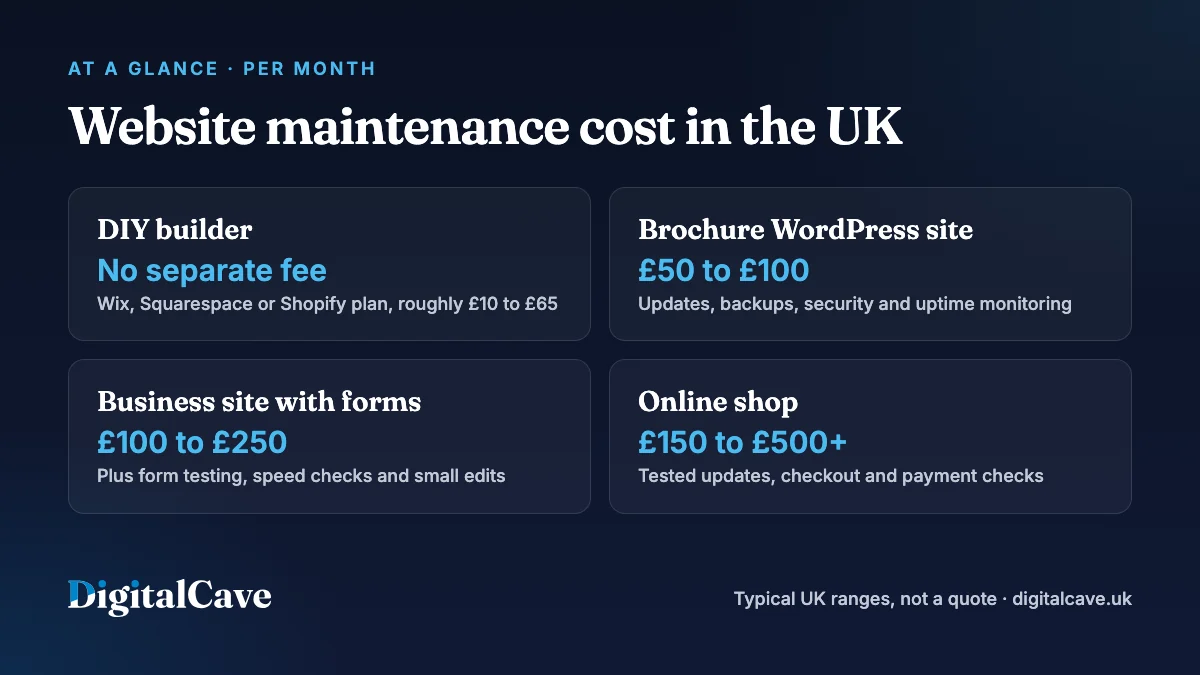
Website maintenance cost in the UK at a glance
| Type of site | Typical monthly cost | What it usually covers | Best for |
|---|---|---|---|
| DIY builder (Wix, Squarespace, Shopify) | No separate fee: the plan, roughly £10 to £65, plus Shopify app or transaction fees and your time | The platform patches its own software. You handle content, apps and checks | Owners happy to run a simple site |
| Budget WordPress plan, mostly automated | About £20 to £50 | Automatic updates, backups and scans, with no manual testing or edit time | Simple sites with a hands-on owner |
| Brochure WordPress site, basic care | £50 to £100 | Updates, backups, security and uptime monitoring | Small service sites that rarely change |
| Business site with forms and bookings | £100 to £250 | The above, plus form testing, speed checks and time for small edits | Businesses that rely on the site for enquiries |
| Ecommerce (WooCommerce, or Shopify with apps) | £150 to £500+ | Tested updates, checkout and payment checks, faster response times | Shops where downtime means lost sales |
Typical UK ranges from published provider pricing, October 2026, not a quote. If a quote is ex-VAT and you are not VAT-registered, add 20%.
For a yearly website maintenance cost, multiply by 12: most small business sites need £600 to £3,000 a year, plus hosting if separate.
What does website maintenance include?
Core, theme and plugin updates, tested first
WordPress, your theme and your plugins all release updates to fix bugs and close security holes. A good plan applies them regularly, checks the site and rolls back anything that breaks. The National Cyber Security Centre’s guide for small organisations calls keeping devices, software and apps up to date the best way to protect against viruses, because updates fix bugs criminals could use to get in. The same applies to your website’s plugins.
Security monitoring and malware scanning
Regular scans for malware, unfamiliar files and new admin users, plus login protection against brute-force attempts. The plan should also say who cleans up a hack and whether that costs extra.
Off-site backups and a tested restore
Daily backups for active sites, stored away from the site’s server and kept for several weeks. A backup nobody has ever restored is a hope, not a plan. The same NCSC guide says to back up all the data your business needs to operate, and names your website in that list.
Uptime monitoring and form testing
Alerts within minutes if the site goes down, and regular test submissions of your contact form, booking form or checkout. A broken enquiry form is one of the costliest faults a site can have, because nothing looks wrong. The leads simply stop.
Speed and Core Web Vitals checks
Sites slow down as plugins and scripts pile up. Google says it highly recommends site owners achieve good Core Web Vitals for success with Search, so a monthly mobile speed check, with fixes when things slip, belongs in any serious plan. PageSpeed Insights lab scores are a useful guide; Search Console shows real-user data once a site has enough traffic.
Small content changes
Many mid-range plans include a small monthly allowance, often 30 to 60 minutes, for jobs like updating prices or swapping photos. Entry-level plans often include none, so check, and ask whether unused time rolls over.
Domain, SSL and email renewals
Set your domain to auto-renew. If it expires, your website and any email on that domain go offline together. SSL certificates now last 200 days at most, falling to 100 days in March 2027 and 47 days by 2029 under the CA/Browser Forum’s schedule, so renewal must be automatic, with an uptime monitor that warns you if it fails. Track email plans such as Google Workspace or Microsoft 365 too.
A plain-English monthly report
What was updated, backup status, uptime, speed and any issues found: your proof the work is being done.
What makes website maintenance cost more (or less)?
- Your platform. Wix, Squarespace and Shopify patch their own core software, so there is less to do. WordPress gives you full ownership, but someone has to run the updates. Our comparison of WordPress vs Shopify vs Wix vs Squarespace covers the trade-offs.
- Plugins, apps and integrations. Every plugin can break or need patching, so a lean site costs less to look after, and links to CRMs or booking tools add testing time.
- Ecommerce and customer accounts. Payments, stock and logins raise the stakes, and updates need testing on a staging copy first.
Hosting vs maintenance: what is the difference?
Hosting is where your website lives: the server, storage and usually the SSL certificate, from around £5 a month for basic shared hosting to £50 or so for good managed hosting. Maintenance is the work of keeping the site updated, secure, backed up and working. A host keeps the server running, but will not usually test your plugins or notice a broken form. If a provider bundles the two, check what is included: “hosting with maintenance” can mean anything from full care to an automatic update switch.
Monthly plan, pay-as-you-go or DIY?
| Option | Typical cost | Pros | Cons |
|---|---|---|---|
| Monthly plan | £50 to £250+ a month | Proactive care; predictable cost; someone accountable | You pay in quiet months too; quality varies |
| Pay-as-you-go | Roughly £30 to £125 an hour | You only pay when you need help | Nothing proactive; emergency call-outs often carry a minimum charge |
| DIY | Your time, plus any backup or security tools | Cheapest in cash | Easy to skip; you are the support team |
A DIY website maintenance checklist
If you look after the site yourself, check for updates weekly and apply security releases straight away, or switch on automatic updates for minor releases and trusted plugins. Then block out half an hour a month for this:
- Take a backup, apply any remaining updates and check nothing broke.
- Confirm the backup is saved off the server, such as in cloud storage.
- Submit your own contact form and check the email arrives.
- Check Google Search Console for errors and security issues.
- Spot-check your homepage speed on mobile with PageSpeed Insights.
- Remove old admin users and make sure everyone uses a strong, unique password and two-factor authentication.
- Check your domain is set to auto-renew and your SSL certificate has renewed automatically.
Is website maintenance worth it for a small business?
For most businesses that rely on their site for enquiries or sales, yes. The UK government’s Cyber Security Breaches Survey 2025/2026 found that 43% of UK businesses, roughly 612,000, identified a cyber security breach or attack in the previous 12 months, including 42% of micro businesses and 46% of small ones. Most were phishing emails (reported by 38% of all businesses), not website hacks. More telling for website owners: only 34% had a policy to apply software security updates within 14 days.
There is a legal angle too. If your site collects personal data through forms, bookings or a checkout, the UK GDPR security principle requires you to protect it with appropriate technical and organisational measures, as the ICO’s guide to data security explains. No law says you must buy a maintenance plan, but patching and backups are part of that.
Then weigh the website maintenance cost against an emergency malware clean-up, days of downtime and the enquiries lost while browsers warn visitors away. For a site that brings in even a few leads a month, basic care is usually the cheaper option.
It is not worth it for everyone. A three-page Wix or Squarespace site you update yourself has very little to maintain. Put that money into content or marketing instead.
Red flags in a website maintenance package
- You do not own your domain or site files, or cannot get a full copy of your site. Leaving becomes painful or impossible.
- Long minimum terms or exit fees. They protect the provider, not you.
- “Unlimited changes” with no definition. Unlimited usually means slow, or capped without telling you.
- Backups kept only on the same server. If the server fails or is hacked, the backups go with it.
- Updates pushed live with no testing. Clicking “update all” is not maintenance.
- No reports and no proof of work. If you cannot see what was done, assume nothing was.
We work the opposite way: you own your domain, your site files and your data, plans run month to month with no lock-in, and if you leave our hosting, you take a full copy of your site.
How to compare website maintenance quotes
Put the same questions to every provider and compare the answers, not just the monthly website maintenance cost:
- How often are updates applied, and how are they tested?
- Where are backups stored, how long are they kept, and when was a restore last tested?
- How quickly do you respond if the site goes down, including at weekends?
- How many hours of changes are included each month, and what happens to unused time?
- Is hosting included, and what does it cover?
- Who owns the domain and the website files, and do you get a full copy if you leave?
- What is the notice period, and are there any exit fees?
- Are prices quoted with or without VAT?
When maintenance is not enough: repair or rebuild?
Sometimes a site costs more to keep patching than to replace: an abandoned theme or page builder, updates that keep breaking the layout, an outdated PHP version, or a site that stays slow on mobile whatever you do. If that sounds familiar, read our guide to the signs your website needs a redesign before paying for another year of patching.
What DigitalCave charges for website maintenance
Our own prices sit within the market ranges above:
- UK managed hosting from £30 a month, with daily backups, free SSL and malware scanning.
- WordPress maintenance plans at £80 to £250 a month, depending on how complex the site is. That covers security patches, plugin updates, backups, uptime monitoring and a monthly health report.
- Fixed-price quotes and month-to-month plans with no lock-in. You own your domain, site files and data.
Ask us, as you would any provider, what your plan includes and whether prices include VAT. We are rated 5.0 on Google. Read more about our WordPress development, hosting and maintenance or our Birmingham web design service, or get a fixed-price maintenance quote for your site.
Frequently asked questions
How much does website maintenance cost per month in the UK?
The typical website maintenance cost for a UK small business is £50 to £250 a month, with online shops typically £150 to £500 or more. Budget, mostly automated plans start at around £20 a month but include little human checking.
How much does website maintenance cost per year?
A yearly website maintenance cost of £600 to £3,000 is typical for a small business website, plus any separate hosting. Ecommerce sites with lots of apps or integrations can cost more.
Do Wix, Squarespace or Shopify websites need maintenance?
Less than WordPress, because the platform updates its own software. You still need to keep content current, review apps, test forms or checkout, and watch renewal dates.
How often should a WordPress website be updated?
Check for updates at least weekly and apply security releases promptly. WordPress can install minor and security releases automatically, and plugins can auto-update too, but someone should still check nothing has broken.
Can I cancel a maintenance plan and keep my website?
You should be able to, as long as you own the domain and site files and can take a full copy if the site sits on the provider’s hosting. Check before you sign. With a no lock-in provider, the care stops and the website stays yours.
What happens if I do not maintain my website?
Usually nothing at first, then several things at once: outdated plugins become a security risk, forms stop working without anyone noticing, speed drops, and eventually something breaks or gets hacked. Fixing a neglected site almost always costs more than maintaining it would have.
In one line
A fair website maintenance cost for most UK small businesses is £50 to £250 a month: whoever you choose, us included, ask for tested updates, off-site backups, uptime monitoring and form testing, avoid any plan that locks you in, and request a free quote or get in touch if you want it handled properly.