
Is Checkatrade Worth It? A Tradesperson’s Honest Maths (vs Rated People, MyBuilder and Your Own Website)
 6 Nov 2026
15 min read

The short answer: Checkatrade pays for itself when the fee you are actually quoted costs less than the profit on the jobs it brings. Answering “is Checkatrade worth it” is arithmetic, not opinion: divide your monthly fee by your average gross profit per job to get the jobs a month it must produce. That number is usually small, so the real question is what you own at the end.
Table of Contents
Key takeaways
- Checkatrade publishes three plans, checked on 6 November 2026: Free at £0, Approved at £30 and Growth from £59 a month. Lead plans are quoted by trade and area, so only your own quote counts.
- Break-even: monthly fee divided by gross profit per job equals jobs needed a month. Divide again by your win rate to get leads needed.
- Companies House lists Rated People Limited as in liquidation, and the brand is now part of Checkatrade Group, so the old two-horse comparison no longer holds.
- MyBuilder charges a shortlist fee when contact details are exchanged, so you pay for the introduction, not the win. Google Local Services Ads charge per valid lead. TrustATrader publishes no price.
- Reviews collected on a platform stay there. Your Google Business Profile is free and stays with you.
- Rent then own: keep the directory for a year while you build your own site and profile, then decide at renewal.
How much does Checkatrade cost in 2026?
Checkatrade costs £0, £30 or from £59 a month, depending on the plan. Checked on 6 November 2026, the Checkatrade pricing page showed those three tiers, with lead plans quoted individually.
| Plan | Published price | What it is for |
|---|---|---|
| Free | £0/month | A business profile page, plus collecting and showing reviews. |
| Approved | £30/month | Everything in Free, plus the verification tick, one-click review requests, job management tools and member discounts. |
| Growth | From £59/month | Everything in Approved, plus a lead volume plan, direct booking, £100 to £200 of search credit, Checkatrade Pay fees from 1.29% to 1.79% and profile insights. |
Three things that page does not tell you, each of which decides your bill:
- Your lead plan price. Growth is a “from” price: you choose how many enquiries you want a year, and Checkatrade Group quotes lead plans by trade and area rather than publishing a rate. An electrician in Birmingham and a landscaper in rural Shropshire pay different amounts.
- VAT. The pricing page does not state VAT treatment, so ask and get it in writing. If you are registered you reclaim it; if you are under the £90,000 VAT registration threshold and not registered, it is 20% on top.
- The term. The pricing page says fixed plan memberships are for 12 months, and Checkatrade’s support pages say membership renews automatically every 12 months. Treat it as an annual commitment.
So the honest answer to “how much is Checkatrade a month” is: whatever you are quoted. Run the sums below on that figure.
Is Checkatrade worth it? The break-even worksheet
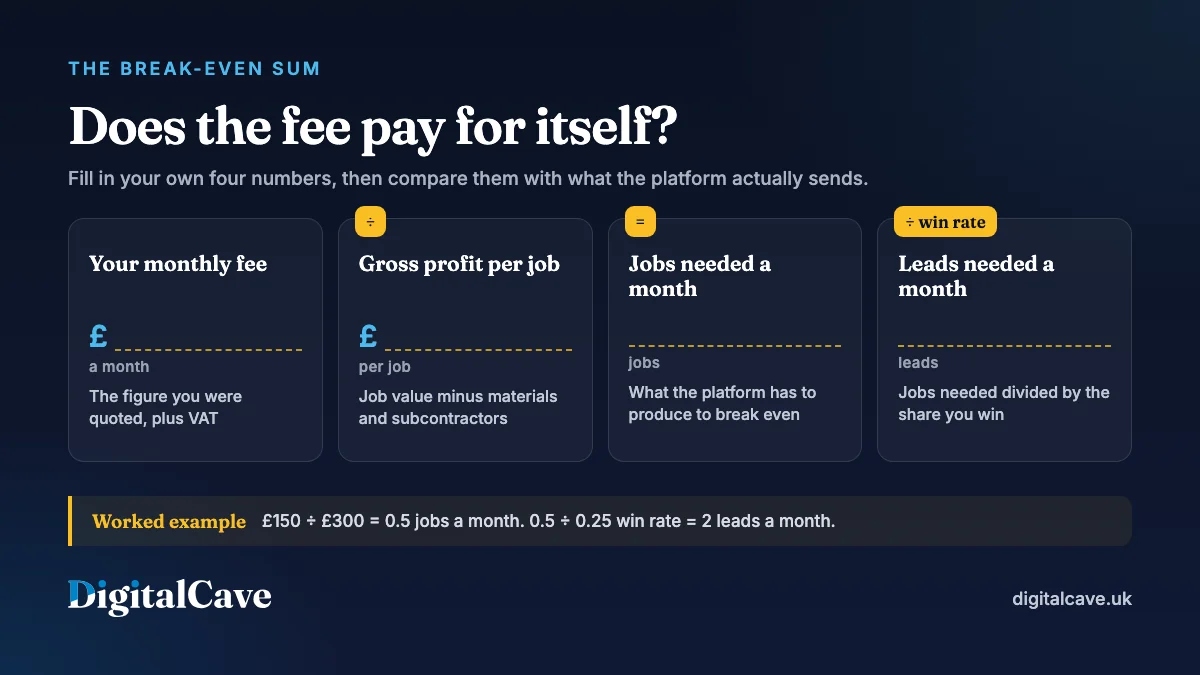
The whole decision fits in one line: jobs needed per month = monthly fee divided by your average gross profit per job. Gross profit is the job value minus materials and subcontractors, before your own overheads. If the platform can realistically send that many, it can pay. If not, nothing else matters.
A worked example, with the assumptions labelled
Illustrative figures, not Checkatrade prices. Use your own.
- Assumption 1: you are quoted £150 a month plus VAT on a lead plan.
- Assumption 2: you are VAT registered, so you reclaim the VAT and the real cost is £150.
- Assumption 3: your average job is £480, with £180 of materials, so gross profit is £300.
- Assumption 4: you win one job in four of the enquiries you quote for.
Break-even in jobs: £150 divided by £300 is 0.5 jobs a month. Break-even in leads: 0.5 divided by 0.25 is 2 leads a month. So it has to send two quotable enquiries a month before it costs you anything. One and you are paying for a listing, not for work.
Your break-even at a glance
Jobs a month needed to cover the fee.
| Monthly fee | £150 gross profit per job | £300 gross profit per job | £600 gross profit per job |
|---|---|---|---|
| £30 | 0.2 jobs | 0.1 jobs | Under 0.1 jobs |
| £59 | 0.4 jobs | 0.2 jobs | 0.1 jobs |
| £150 | 1.0 job | 0.5 jobs | 0.3 jobs |
| £300 | 2.0 jobs | 1.0 job | 0.5 jobs |
| £500 | 3.3 jobs | 1.7 jobs | 0.8 jobs |
Two footnotes. Directory fees are normally advertising, and GOV.UK lists advertising and marketing among the allowable expenses for the self-employed, so the after-tax cost is lower than the invoice; check your own position with your accountant.
And the fee is not the only cost: if each enquiry takes 30 minutes of admin plus a drive to price the job, ten enquiries a month is most of an unbilled working day. Put a figure on that too.
Checkatrade pros and cons at a glance
A balanced view, based on what Checkatrade publishes and how lead directories work in general. Your trade and postcode will shift the weighting.
| Pros | Cons |
|---|---|
| A recognised name. The tick on paid plans and a page of reviews reassure homeowners who have never heard of you. | An annual commitment. Fixed plan memberships are for 12 months and renew automatically, so a poor fit can cost you a year unless you diarise the renewal. |
| A free tier. The Free plan gives you a profile and reviews at no monthly cost, so you can test the platform before paying. | Quoted, not published. Lead plan prices depend on trade and area, which makes comparison hard before you speak to sales. |
| Leads without a marketing system. On Growth the platform supplies enquiries, so your time goes on quoting rather than on marketing. | Side-by-side competition. Customers can compare several members, so response speed, reviews and price decide who gets the job. |
| Useful tools. One-step review requests and job management, plus direct booking and Checkatrade Pay on Growth. | Rented proof. Reviews stay on the platform. If you leave, the reputation you built there does not come with you. |
| A fast start. If you are new, or new to an area, a directory can bridge the gap while you build reviews and a site of your own. | Less of a hedge than it looks. With Rated People now in the same group, two big lead sources sit under one owner. |
Most of the cons are about control: what you keep when you stop paying. The comparison below shows how the alternatives differ on exactly that.
Checkatrade vs Rated People, MyBuilder, TrustATrader and your own website
Checkatrade, MyBuilder, TrustATrader and other sites like Checkatrade differ on three things: how you pay, who holds the reviews, and what survives when you stop paying. All checked on 6 November 2026.
| Option | How you pay | Who holds the reviews | What you keep if you stop paying |
|---|---|---|---|
| Checkatrade | Membership: free, £30 or from £59 a month, with fixed plans on a 12-month term and lead plans quoted by trade and area. | Checkatrade | A free profile tier exists, but the tick, lead plan and paid placement go. Confirm what happens to your profile before you join. |
| Rated People | Now part of Checkatrade Group: a fixed plan on a 12-month commitment, or a free account where you pay only for leads you take. | Checkatrade Group | Nothing you control. The company behind the old memberships is in liquidation. |
| MyBuilder | Pay per lead: a shortlist fee owed when contact details are exchanged after you are shortlisted. Check the fee and VAT before you shortlist. | MyBuilder | Nothing. You stop paying by not taking leads. |
| TrustATrader | Membership quoted individually, no published price. States no commission and no per-lead charges. | TrustATrader | Nothing. |
| Google Local Services Ads | Pay per valid lead. Offered in the UK for some trades, such as plumbers, electricians and roofers; eligibility varies by trade and area. | Google, on your Business Profile | Your Google reviews and profile stay. The ad placement stops. |
| Your own site and Google Business Profile | Build cost, then hosting and care. The Business Profile is free. | You and Google | Everything: the site, the Google reviews and the rankings you have earned. |
On the per-lead options, read the mechanics. MyBuilder’s terms define the shortlist fee as “the agreed amount owed by you to MyBuilder when contact details are exchanged as a result of you being Shortlisted for a Job”. In other words, the fee is triggered by the introduction, not by winning the work, so your win rate on MyBuilder leads matters as much as the fee itself.
Google’s Local Services Ads documentation says “you’re charged for each valid lead that you receive”, with prices varying by location, job type and lead type, and a missed call can count if the customer stays on the line long enough. Neither is a bad deal, just a different one from a flat membership.
What happened to Rated People, and why it changes the comparison
Rated People is no longer an independent rival, so asking which is better, Rated People or Checkatrade, no longer makes sense. As of 6 November 2026, Companies House lists Rated People Limited (company number 05540422) with the status “Liquidation”, and Rated People’s own site states that “in 2026, Rated People became part of Checkatrade Group”. The site still takes homeowner jobs, but they are matched through Checkatrade.
Two practical lessons. Spreading your budget across lead sites is less of a hedge than it looks: if two of three belong to one group, you have one source. And anything you rent can end on someone else’s timetable.
Who actually owns your reviews?
Reviews collected on a directory live on that directory. They are strong proof while you pay, and they do not move with you. Reviews on your Google Business Profile sit on a profile you own, and it is free: Google’s Business Profile documentation says you can manage how your business shows up on Maps and Search “at no charge”.
That is not an argument against directories, but for asking every happy customer for a Google review too. Our guide to asking for Google reviews without breaking the rules has the scripts and the red lines: incentivised reviews that hide the incentive are unlawful in the UK.
The ‘rent then own’ 12-month plan
You do not have to choose between a directory and your own marketing. Do both for a year, then let the numbers choose.
- Months 1 to 3: measure. Keep the membership and log every enquiry, its source, whether you quoted and whether you won. Claim your Google Business Profile, add real photos and service areas, and start asking for reviews.
- Months 4 to 6: build the owned asset. Get a site with one page per service and one per main town you cover, a gallery of your own jobs and a quote form that accepts photos. A website built for tradespeople and builders is mostly that: proof, coverage and an easy way in.
- Months 7 to 9: get found without paying per lead. Work through a local SEO checklist: consistent business details everywhere, the right categories and real service area pages. If your profile vanishes, our guide on a suspended Google Business Profile covers the fix.
- Months 10 to 12: compare like for like. Put platform enquiries next to direct enquiries from Google, and compare cost per won job, not cost per lead.
- At renewal: decide with evidence. Keep it, cut the plan down, or stop. The term is annual, so diarise the decision a month before renewal.
How to get trade leads without a paid directory
Directories are one source of work, not the only one. These channels cost time rather than a monthly fee, and most of what you build stays yours.
- A complete Google Business Profile. It is free. Choose the most accurate primary category, list your services and the areas you cover, add photos of real jobs and keep your hours current. For “near me” searches it is often the first thing a customer sees.
- A review habit. Text every customer your review link the day the job is finished, the same way every time, with no reward attached. A steady run of recent reviews beats a burst once a year.
- Repeat and reminder work. Annual boiler services, landlord gas safety checks (required every year) and electrical safety reports for private rentals (required at least every five years in England) come round on a timetable. With the customer’s permission, a reminder turns one job into a recurring one.
- Referral partners. Complementary trades send each other work: kitchen fitters need electricians and plasterers, roofers get asked about guttering, and letting agents and property managers need reliable people for repairs and certificates. Agree who you recommend and make it easy to pass on your details.
- Free listings you already qualify for. Bing Places and Apple Business Connect are free, and registers such as Gas Safe and NICEIC let customers search for registered businesses. Keep your name, address and phone number identical everywhere.
- Local community groups. Neighbourhood Facebook groups and Nextdoor are full of people asking for recommendations. Follow each group’s rules, be helpful rather than salesy, and let happy customers do the recommending.
- Vans, boards and paperwork. Sign-written vans, site boards (with the homeowner’s permission) and quotes that carry your web address all send people to your site and profile.
- Your own website. One page per service and per main town you cover, photos of your own work and a quote form that accepts pictures. It is the place every other channel points to.
None of this is instant, which is why the plan above keeps a directory running while it builds. For the errors that most often hold local businesses back in search, see our list of common local SEO mistakes.
Is Checkatrade worth it for tradesmen? Notes by trade
For most tradesmen the published tiers break even under one job a month, so the lead plan price you are quoted decides it.
Plumbers and heating engineers. High enquiry volume, lower average job value, so per-lead pricing bites hardest and speed of response decides everything. A single £90 call-out will not clear a £150 fee, so check how many the plan would have to send.
Electricians. Most of the money is in planned work, EV chargers, consumer units, rewires and landlord certificates, where buyers check credentials. Put your qualifications on your own site and Google profile, not only a rented one.
Builders and multi-trades. Fewer, larger jobs make a membership look cheap. The limit is enquiry quality and the time spent pricing jobs you will not win, so photographs of finished work beat extra lead volume.
When Checkatrade is probably worth it, and when it is not
Worth a trial if: you are new, or new to an area, with no reviews; your gross profit per job is comfortably above the fee; you answer the phone in the working day; and you will still build your own site and profile.
Probably not if: your quoted plan needs more jobs a month than the platform realistically sends in your trade and postcode; you already get steady work from Google and referrals; your margins are thin; or you cannot keep up with the leads you get. Paying for leads you never answer is the costliest mistake.
Where DigitalCave fits
DigitalCave is a digital marketing agency at 47 Jewel Court, 29 Legge Lane, Jewellery Quarter, Birmingham B1 3LE. We do not sell directory memberships, and no platform named here pays us. Our case studies show the work this means. We build the “own” half of the plan above: a fast site with real service and area pages, a quote form that takes photos, and the local SEO work that puts you in the map pack.
For the monthly side, see what local SEO costs in the UK.
We quote a fixed price up front, with no lock-in, and reply to enquiries within two working hours. To compare a year of platform fees against owning the same work, ask us for a fixed-price quote.
Frequently asked questions
How much is Checkatrade per month?
Checked on 6 November 2026, Checkatrade publishes three plans: Free at £0 a month, Approved at £30 a month and Growth from £59 a month. Growth is a “from” price: Checkatrade Group quotes lead plans by trade, area and the enquiries you want, rather than publishing a rate. The page does not state VAT treatment, so confirm that in writing before you sign.
Is Checkatrade worth it for plumbers?
That depends on your job mix, not on the platform. Divide your quoted monthly fee by your gross profit per job to get the jobs a month it must produce, then divide by your win rate to get the leads. Plumbing enquiries are plentiful but small, so check the plan sends installs, not only call-outs.
Is Checkatrade worth it for electricians?
The arithmetic often works, because planned electrical jobs carry enough gross profit that break-even sits under one job a month at the published prices. The bigger question is where your credentials live: a buyer checking a qualification should find it on your own website and Google Business Profile, not only on a rented one.
What are the best Checkatrade alternatives in the UK?
The realistic options are MyBuilder (pay per shortlist fee), TrustATrader (membership, price on application), Google Local Services Ads (pay per valid lead, offered in the UK for some trades such as plumbers, electricians and roofers) and your own website with a Google Business Profile. Rated People is now part of Checkatrade Group, so not an independent alternative.
Can you cancel a Checkatrade membership early?
Checkatrade’s pricing page says fixed plan memberships are for 12 months, so they are not designed to be cancelled mid-term, and its support pages say membership renews automatically every 12 months. Ask for the cancellation and renewal terms in writing before you join, and diarise the renewal date a month early so the decision stays yours.
Do you keep your reviews if you leave Checkatrade?
Reviews collected on Checkatrade stay on Checkatrade, attached to a profile you no longer pay for. The same is true of every directory. The fix is to ask every happy customer for a Google review too, because your Google Business Profile is free and stays with you at renewal.
Is Checkatrade free to join?
There is a free plan. Checked in November 2026, Checkatrade’s pricing page listed a Free plan at £0 a month with a business profile and reviews. The verification tick, lead plans, direct booking and search credit sit on the paid Approved and Growth plans.
How can a tradesperson get work without paying for leads?
Start with a complete Google Business Profile, a habit of asking every customer for a review, reminders for repeat work such as annual services and landlord certificates, referral partnerships with complementary trades and letting agents, free listings such as Bing Places and Apple Business Connect, and a simple website with a page per service and area. It takes longer to build than a lead plan, but you keep what you build.
In one line
Checkatrade is worth it only when the fee you are quoted costs less than the profit on the jobs it brings, so run the sums on your own numbers and spend the year building something you keep.