
Paid Social Marketing Explained: Facebook, Instagram, LinkedIn and TikTok Ads for UK Businesses
 20 Nov 2026
12 min read
The short answer: Paid social marketing is paying a social platform such as Facebook, Instagram, LinkedIn or TikTok to show your ads to a chosen audience, rather than relying on the people who already follow you. It reaches people who are not yet searching for you, so it works best for awareness, launches, offers and retargeting. Google Ads is still the better buy for people searching right now.
Table of Contents
Key takeaways
- Paid social marketing buys reach and targeting from a platform. Organic social earns reach from the people who already follow you.
- Facebook and Messenger are used by 93% of UK adults, according to Ofcom’s Online Nation 2025 report, whether or not they follow you.
- Meta suits local consumer businesses, LinkedIn suits business-to-business firms, and TikTok suits visual products for younger buyers.
- Install the Meta Pixel and the Conversions API before you spend, or you cannot measure anything.
- Start with one platform, one audience and one offer, run it for two weeks, then judge it on cost per lead, not likes.
What is paid social marketing?
Paid social marketing, also called paid social media marketing, is advertising on social media platforms where you pay the platform to place your content in front of people you choose, based on their location, interests, job or past behaviour. The space is sold by auction: you set a budget, the platform shows your ad to the people most likely to act, and you pay per click, per thousand views or per result.
The important word is “choose”. An organic post goes to a slice of your existing followers. A paid social ad goes to whoever you define, whether they follow you or not: homeowners within ten miles of Solihull, say, or finance directors at firms with 50 to 200 staff.
It includes boosted posts, Sponsored posts on Facebook and Instagram, Sponsored Content on LinkedIn and In-Feed ads on TikTok. Paying an influencer to post is influencer marketing, which has its own labelling rules.
Paid social vs organic social: what is the difference?
Organic social is free posting to your own followers, with reach decided by the platform’s algorithm. Paid social is buying reach to a defined audience. Most small businesses need both: organic builds trust with people who know you, paid finds the people who do not.
| Question | Organic social | Paid social |
|---|---|---|
| Who sees it | A share of your followers, plus anyone they share it with | An audience you define by location, interests, job or behaviour |
| Cost | Your time, or a management fee | Ad spend plus your time or a management fee |
| Speed | Slow. Months to build an audience | Fast. Reach starts the day the ad is approved |
| Best for | Trust, reviews, culture, repeat customers | New customers, launches, offers, retargeting |
Boosting an ordinary post reaches more people but rarely sends them anywhere useful. A campaign built in Ads Manager with an objective, a landing page and tracking is the version that produces leads. Our guide to social media management in Birmingham covers the organic side.
How is paid social different from Google Ads?
Google Ads reaches people who are searching for what you sell right now. Paid social reaches people who match your customer profile but are not searching yet. Search captures existing demand. Social creates it and brings people back later.
A Google Ads click for “emergency plumber Birmingham” is close to a sale. A Facebook ad shown to homeowners in B13 interrupts someone scrolling. The social click is usually cheaper, but fewer of those clicks become enquiries straight away. The full comparison is in our post on Google Ads versus Meta ads, and how much Google Ads costs in the UK covers the search side.
A simple rule: if people already search for your service, start with search. If your product is new, visual or sold to a tightly defined group, start with paid social. If you can afford both, use search to capture demand and social to retarget visitors who did not convert.
Which paid social platform is right for your business?
Pick the platform where your customers already spend time and where the targeting matches how you describe a good customer. For most UK consumer businesses that is Meta. For business-to-business firms it is LinkedIn. For visual products aimed at under-35s it is TikTok.
Ofcom’s Online Nation 2025 report (published 10 December 2025) found that UK adults spend an average of four and a half hours a day online, and that Facebook and Messenger together are used by 93% of adults.
| Platform | Best for | Targeting strengths | Typical first campaign | Watch out for |
|---|---|---|---|---|
| Facebook and Instagram (Meta) | Local consumer services, retail, hospitality, trades, ecommerce | Location radius, interests, lookalikes, website visitors | Lead campaign to a 10 to 15 mile radius | Broad targeting wastes budget outside your area |
| Business-to-business services, recruitment, professional firms | Job title, seniority, company size, industry, skills | Sponsored Content offering a guide to a named job role | Higher cost per click, so only sensible when one client is worth thousands | |
| TikTok | Visual products, food, beauty, fashion, events, buyers aged 16 to 34 | Interests, video engagement, lookalikes | Short native-looking video with a landing page link | Needs new video every few weeks |
Two platform facts to know. LinkedIn’s ad targeting help page states that an ad set needs an audience of at least 300 member accounts. TikTok’s budgeting page recommends a minimum daily ad group budget of 30 US dollars (roughly £23 as of November 2026) for web conversion campaigns for brands in Europe, the Middle East and Africa.
How does paid social targeting work?
Targeting tells the platform who should see your ad. There are three types: cold audiences built from location and interests, warm audiences of people who already engaged with you, and lookalike audiences modelled on your best customers.
- Cold audiences. Location plus age plus interests or job data. On Meta, a radius around your premises is the most effective filter for a local business. For a city-centre firm, a 10 mile radius covers Birmingham, Solihull and Sutton Coldfield without paying to reach Coventry.
- Warm audiences (retargeting). People who visited your website, watched your video or are on your customer list. These are often the cheapest leads, because they already know you.
- Lookalike audiences. You give the platform a seed list and it finds people with similar characteristics. This is how a small business scales beyond its postcode.
The platforms have removed many detailed interest categories in recent years, so the real targeting power now sits in your own data: your pixel events and your customer list.
What are the Meta Pixel and the Conversions API, and do you need them?
Yes, both, before you spend. The Meta Pixel is a piece of code on your website that records what visitors do, such as submitting a form. The Conversions API sends the same events from your server to Meta directly, so results are still counted when browsers block cookies.
Meta’s About Conversions API page says it creates “a direct and more reliable connection” between your marketing data and Meta’s ad systems, to improve targeting, lower cost per result and measure outcomes. A UK small business needs four things tested in Meta Events Manager before the first campaign:
- The Meta Pixel on every page, through a plugin on WordPress or the Facebook and Instagram app on Shopify.
- The Conversions API connected (the Shopify app and most WordPress pixel plugins do this without a developer).
- A “Lead” or “Purchase” event that fires only on the thank-you page, so one enquiry counts once.
- A cookie banner that asks for consent before the pixel fires. The ICO’s guidance under the Privacy and Electronic Communications Regulations is that non-essential cookies need active consent.
LinkedIn has its Insight Tag and TikTok its Pixel. The principle is identical: tag first, test the event, then spend.
How much does paid social marketing cost in the UK?
Paid social has two costs: the money paid to the platform (ad spend) and the cost of planning, creative and management, whether your own time or an agency fee. Ad spend is set by auction, so there is no price list.
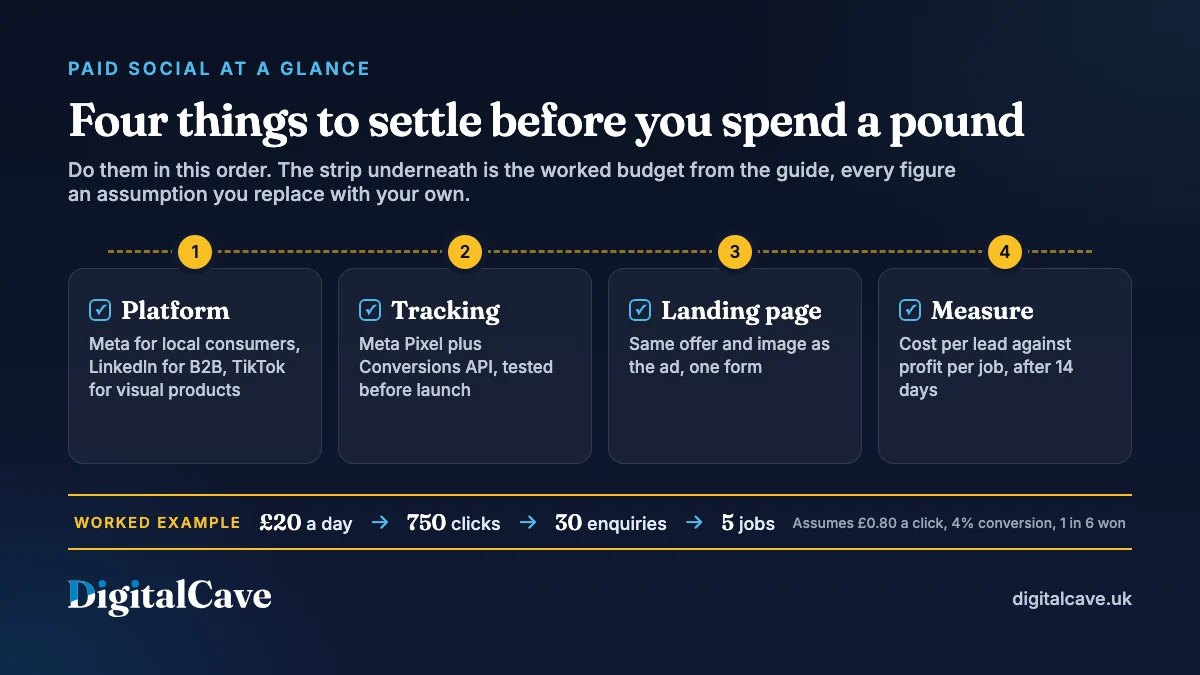
Rather than quote industry averages that change monthly, here is a worked example you can copy. Every number is an assumption. Replace it with your own once you have two weeks of data.
| Worked example: local kitchen fitter, Meta lead campaign | Assumption |
|---|---|
| Monthly ad spend | £600 (£20 a day) |
| Cost per link click (assumed) | £0.80 |
| Clicks in the month | 750 |
| Landing page conversion rate (assumed) | 4% |
| Enquiries | 30 |
| Cost per enquiry | £20 |
| Quote-to-job win rate (assumed) | 1 in 6 |
| Jobs won | 5 |
| Cost per job from ad spend alone | £120 |
If an average kitchen job carries £2,000 of gross profit, £120 of ad cost per job is comfortable. If you sell £40 haircuts, the same structure needs a cheaper lead or a repeat-visit model. Run the arithmetic for your own margin first, and allow for VAT on the spend.
Management is the second cost. UK agencies charge either a flat monthly fee or a percentage of spend. DigitalCave quotes a flat monthly fee up front with no lock-in, described on our PPC management service page.
What makes a paid social ad work?
The creative does most of the work. With targeting now largely automated, the ad itself usually makes a bigger difference to cost per result than the audience settings.
- Lead with the customer’s problem, not your logo. “Kitchen looking tired?” beats “Smith and Sons Kitchens, est. 1998”.
- Use video or real photos. A 15-second phone video of a finished job usually beats a stock image.
- Match the landing page to the ad. Same offer, same image, one form. See what makes a high-converting website.
- Keep claims provable. Every paid social ad is covered by the CAP Code (see the rules section below).
How do you measure paid social results?
Measure cost per lead and cost per sale, not reach or likes. Set the objective to Leads or Sales and compare the cost per result against the profit on a typical job. Check these five lines every Monday:
- Spend and cost per result (from Ads Manager).
- Real enquiries that arrived (from your inbox or CRM), to check the platform’s count against reality.
- Lead quality: how many were in your area and wanted a service you offer.
- Frequency: above three, refresh the creative.
- Landing page conversion rate from GA4. Cheap clicks and rare enquiries mean the page is the problem.
Give a new campaign at least 14 days. Meta’s guidance on its learning phase says an ad set needs about 50 results in the week after its last significant edit to leave learning. Switching a campaign off after three days is a common way small businesses waste money.
What are the UK rules for paid social advertising?
Paid social ads, like all social media advertising in the UK, are covered by the UK Code of Non-broadcast Advertising (the CAP Code), administered by the Advertising Standards Authority (ASA). Ads must be obviously identifiable, and the rules on misleading claims and prices apply in full.
The ASA’s advice on brand-owned and paid social media confirms that the CAP Code applies to “Sponsored” posts on Facebook and Instagram, “Ad” content on TikTok, “Promoted” posts on X, Promoted Pins on Pinterest and pre-roll ads on YouTube. The platform’s “Sponsored” label covers identification for a standard ad. The parts that catch small businesses are elsewhere:
- Prices must include VAT for consumers, and “from” prices must be genuinely available.
- “Sale” and “offer” claims need a real previous price and a genuine closing date where one is stated.
- Influencer content is different. If you pay a creator to post, the post needs a clear “Ad” label at the top.
- Data rules apply to targeting. Uploading a customer list to build a custom audience is processing personal data under UK GDPR, so your privacy notice must say so.
Where DigitalCave fits
DigitalCave is an all-in-one web design, SEO and digital marketing agency based in the West Midlands, serving Birmingham, Coventry and the UK. We build the landing page, test the pixel and Conversions API, and run Facebook and Instagram ads for small business clients as one piece of work, because a campaign that lands on a slow page wastes its budget.
Our social media marketing service covers the organic side when a client wants both. Every job is a fixed-price quote with no lock-in, we reply within two working hours, and our case studies show the work. For a second opinion on an ad account that is already running, request a quote and we will say honestly whether paid social is the right next step.
Frequently asked questions
What does paid social mean in marketing?
Paid social means paying a social media platform such as Facebook, Instagram, LinkedIn or TikTok to show your content to a chosen audience. You set a budget and targeting, the platform runs an auction, and you pay for clicks, views or results.
Is paid social the same as social media marketing?
No. Social media marketing is the whole activity of promoting a business on social platforms, including organic posting, community management and paid ads. Paid social is only the advertising part.
Which platform is best for paid social for a small business?
For a local consumer business, Facebook and Instagram, because Ofcom reports that Facebook and Messenger are used by 93% of UK adults and the location targeting is precise. For business-to-business services, LinkedIn, because you can target by job title and company size. For visual products aimed at younger buyers, TikTok.
How much should a small business spend on paid social?
Work backwards from your profit per sale and an assumed cost per lead, then start at a level you can hold for at least a month so the platform gets enough data to optimise. In the worked example in this guide, £20 a day produces 30 enquiries a month at £20 each, with every assumption listed.
Do I need the Meta Pixel and the Conversions API?
Yes, both. The Meta Pixel records what visitors do on your website from their browser. The Conversions API sends the same events from your server, so results are still counted when browsers block cookies. Meta describes it as a more reliable connection between your data and its ad systems.
Do UK advertising rules apply to Facebook and Instagram ads?
Yes. The ASA’s guidance states that the CAP Code applies to Sponsored posts on Facebook and Instagram, Ad content on TikTok and other paid social placements. Claims must be truthful, prices to consumers must include VAT and offers must be genuine.
In one line
Paid social marketing buys targeted reach to people who are not yet searching for you, and it pays off when you pick one platform, track every enquiry, send clicks to a matching landing page and judge it on cost per lead.