
Google Ad Grants for UK Charities and Places of Worship: Eligibility, Website Requirements and How to Keep the Grant
 20 Oct 2026
14 min read
The short answer: Google Ad Grants gives eligible UK charities up to $10,000 US dollars a month in free Google Search text ads. You need registration with the Charity Commission, OSCR or CCNI (or charitable tax status with HMRC), verification by Goodstack (Google’s charity validation partner), and a website on your own domain that is fully HTTPS and clearly states your mission. The website requirements are usually the slow part.
Table of Contents
Key takeaways
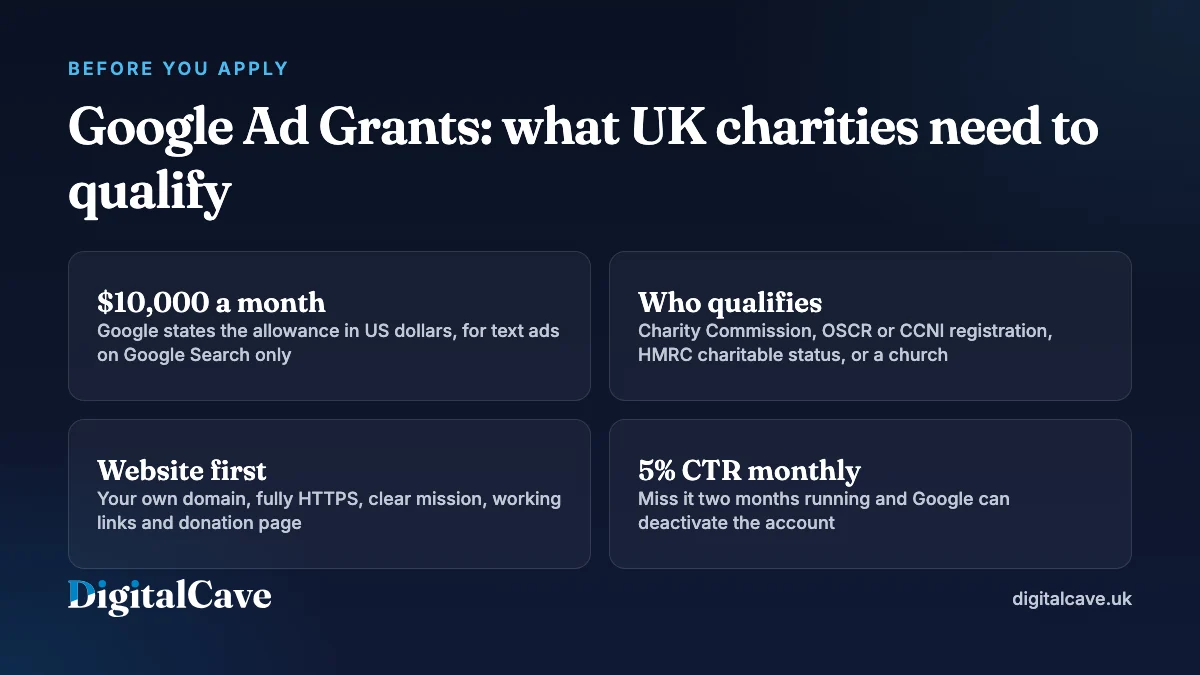
- Google states the grant as up to $10,000 US dollars a month, described as a daily budget of $329, for text ads on Google Search only.
- UK eligibility runs through charity registration (Charity Commission, OSCR or CCNI), charitable tax status with HMRC, exempt charities, or church status, then verification by Goodstack.
- Community interest companies, councils, NHS trusts, schools and universities are not on Google’s eligible list. Google does allow the charitable arms and foundations of healthcare organisations and the philanthropic arms of educational organisations.
- Your site must be on a domain you control, fully HTTPS, free of excessive third-party ads, not primarily sending traffic out via affiliate links, with working links and a working donation page.
- Keeping the grant means a 5% account clickthrough rate every month, mission-based keywords, conversion tracking and an annual programme survey.
- In our experience, two to four hours a month of real attention is enough once the website is in order. The money is free; the management is not.
Every policy point below was checked against Google’s and GOV.UK’s own guidance on 20 October 2026. Google updates its help pages without notice, so re-read the linked policy pages before you apply.
What is a Google Ad Grant and what do you actually get?
A Google Ad Grant is in-kind advertising, not a cash grant. Google gives approved charities an allowance they can spend on text ads in Google Search results, and nothing else.
Google’s Ad Grants product page states that the programme “provides access to $10,000 USD of in-kind advertising every month for text ads”, and Google’s “Understanding budgets and bidding” help page adds that accounts are limited to that figure, “which equates to a daily budget of $329 USD”. Both are quoted in US dollars, so treat any sterling equivalent you see elsewhere as an exchange-rate estimate.
Three restrictions to know before you apply. The grant does not include:
- No YouTube, Display or Shopping ads. Those need a separate, paid Google Ads account.
- No management. Google gives you the allowance and the policies. Building the account and keeping it compliant is yours.
- No guarantee you will spend it. Grant ads compete in the same auctions as paying advertisers, so in practice a small charity uses only part of the allowance. That is normal.
Who is eligible for Google Ad Grants for charities in the UK?
You qualify if you are a registered or recognised UK charity and Goodstack can verify you. Google’s eligibility guidelines set three conditions: be registered as a charitable organisation in a listed country and “verified as a nonprofit organisation by Goodstack, Google for Nonprofits’ validation partner”, meet the requirements for your own country, and agree to the Google for Nonprofits Additional Terms of Service.
For the United Kingdom, Google’s list names the Charity Commission for England and Wales, the Charity Commission for Northern Ireland (listed by Google as NICC), OSCR for Scotland, tax exemption with HMRC as a charity, exempt charities, and churches.
| Organisation type | Eligible? | What to note |
|---|---|---|
| Charity registered with the Charity Commission, OSCR or CCNI | Yes | Goodstack verifies your details against official charity records |
| Church, chapel, temple, gurdwara or mosque | Yes | Churches are named on Google’s UK list; others qualify via registration or HMRC status |
| Exempt charity | Yes | Named on Google’s UK list |
| HMRC charitable tax status, no regulator registration | Yes | Have your HMRC charity reference ready |
| Community interest company (CIC) | No, unless also charitable | CICs are not on the UK list, so a CIC that is neither a registered charity nor HMRC-recognised will fail verification |
| Council, NHS trust or other public body | No | Google excludes “a governmental entity or organisation” |
| Hospital or healthcare provider | No | Excluded, but charitable arms and foundations are eligible |
| School, college or university | No | Excluded, but philanthropic arms are eligible |
What if your place of worship is not registered with the Charity Commission?
You can still get an Ad Grant. Use your HMRC charity reference instead, because recognition by HMRC as a charity is on Google’s UK eligibility list in its own right. UK guides tend to skip this, and it matters: not every place of worship appears on the Charity Commission register, and Goodstack needs something it can match.
Two UK rules explain the gap. Registration with the Charity Commission for England and Wales is compulsory where annual income will be at least £5,000, or where the charity is a charitable incorporated organisation, according to GOV.UK.
Separately, GOV.UK’s guidance on excepted charities lists churches and chapels of some Christian denominations, Scout and Guide groups, armed forces service funds and student unions as excepted where income is £100,000 or less. Excepted charities need not register or file annual returns, and GOV.UK notes the church exception ends on 31 March 2031.
So an excepted church with income under £100,000 may have no registration number at all. Three practical routes:
- Use your HMRC charity reference. If you already claim Gift Aid, you have this.
- Register voluntarily with the Charity Commission ahead of the 2031 end date. A number makes every future verification and grant application easier.
- Submit your organisation to Goodstack anyway and supply the governing document, accounts and HMRC correspondence it asks for.
If you have neither, sort that out before touching the Google application. For most congregations, Gift Aid is the more dependable income and the simpler thing to set up: GOV.UK states you can “claim back 25p every time an individual donates £1”, and you may also be able to claim on cash donations of £30 or less without a declaration under the Gift Aid Small Donations Scheme, subject to its own limits.
What does your website need before you apply?
Your website must be on a domain you own, served entirely over HTTPS, state your mission clearly, carry substantial original content, have working links and a working donation page, and host no excessive third-party advertising. Those points are Google’s Ad Grants website policy, and in our experience this is where volunteer-run charities most often get stuck. Work through the table before you start the application, not after.
| Requirement | What Google asks for | How to check it |
|---|---|---|
| Own domain | “Your nonprofit must own the domain(s) that your ads point to” | Confirm who holds the domain and hosting logins. A free subdomain or a Facebook page will not do. |
| HTTPS everywhere | “Your entire website must be served over HTTPS” | Load five pages including the donation page. Every one needs the padlock, with no mixed-content warning. |
| Clear mission | Must “clearly state your nonprofit’s mission and describe its activities or services” | Read your homepage as a stranger. Is it obvious what you do and who you help? |
| Substantial original content | Content related to your mission, not thin pages or link lists | Give every activity its own page: worship times, classes, youth groups, food bank, hall hire, volunteering. |
| No commercial clutter | Cannot host “excessive third-party ads (e.g. Google AdSense)” or mainly send traffic out via affiliate links | Remove AdSense and affiliate banners. Mission-related sales can stay if you say where the money goes. |
| Working links | “All links should work correctly” | Click every menu and footer item. Placeholder social icons that go nowhere are a classic fail. |
| Fast pages | Pages “should load quickly for users on various devices” | Run the homepage and donation page through PageSpeed Insights on mobile. |
| Working donation page | “Donation links must work and go to a secure page dedicated to donations” | Make a £1 test donation yourself and check the receipt arrives. |
If that reads like a rebuild rather than a tidy-up, price it honestly first. Our guide to how much a website costs in the UK sets out realistic ranges, and we cover the charity version on our page for websites for charities and places of worship.
How do you apply for a Google Ad Grant in the UK?
It is two applications, not one: you join Google for Nonprofits, then activate Ad Grants from inside it.
- Fix the website first. Everything in the table above. Doing this last means reapplying.
- Get an email address on your own domain. Apply as the organisation, not from a volunteer’s personal Gmail.
- Gather your identifiers. The UK IDs Google lists are your Charity Commission, OSCR or CCNI number, or your HMRC charity reference. A registration number appears on the regulator’s public register.
- Apply to Google for Nonprofits at google.com/nonprofits and accept the additional terms of service.
- Complete Goodstack verification. It checks your details against official charity records, and will ask for documents if it cannot find you.
- Activate Ad Grants from the portal: your website address, how you currently market the charity, and confirmation you have read the policies.
- Build the account to the policy: two ad groups per campaign minimum, two sitelink assets, conversion tracking, and conversion-based Smart Bidding, which is Google’s automated bidding that sets each bid to win conversions rather than clicks.
Allow weeks rather than days. Verification and activation are separate reviews, and a website problem sends you back to the start.
How do you keep the Google Ad Grant once you have it?
Compliance is monthly, not one-off. Google’s account management policy and Ad Grants policy compliance guide set the rules, and accounts that break them get deactivated.
| Policy | What Google requires | Check |
|---|---|---|
| Clickthrough rate | 5% each month at account level, for accounts not running only Smart campaigns; two consecutive months below it can mean temporary deactivation | Monthly |
| Mission-based keywords | Every ad and keyword must “reflect your organisation’s primary mission” | Monthly |
| Banned keyword types | No single words (limited exceptions, such as your own brand), no overly generic terms such as “e-books” | Quarterly |
| Quality Score | Quality Score is Google’s 1 to 10 rating of how relevant a keyword is to your ad and landing page. Keywords scoring 1 or 2 must be paused or removed. | Monthly |
| Geo-targeting | Target where your services are useful. Google’s example: a food bank or house of worship should target only its local area. | At build |
| Conversion tracking | Accounts created since January 2018 must have valid conversion tracking and accrue at least one conversion a month; those created on or after 22 April 2019 must use one of Google’s listed meaningful conversion types | Monthly |
| Bidding | Those same accounts must use conversion-based Smart Bidding, such as Maximise conversions or Target CPA | At build |
| Account structure | At least two ad groups per campaign and two unique sitelink assets | At build |
| Annual survey | All grantees must complete the annual programme survey when prompted | Watch the inbox |
The 5% clickthrough rate is the rule that bites volunteer-run accounts, because it is measured monthly and it punishes broad keywords. A small account of tightly relevant terms beats a sprawling one every time.
A starter campaign plan for a place of worship
Here is a structure you can copy. It is built to satisfy the policy rules above, not to spend the whole allowance.
Assumptions, stated plainly: a gurdwara, temple, mosque or church in one UK city; a website with a page for each activity below; geo-targeting set to that city plus roughly 15 miles; Maximise conversions bidding; conversions for donation complete, contact form submitted and venue-hire enquiry. No spend or traffic forecast is implied, because that depends on local search demand.
| Campaign | Example keyword themes (two to four words, never single words) | Landing page | Conversion |
|---|---|---|---|
| Visit and services | sikh temple in [city], friday prayer times [city], sunday service near me | Times and visiting | Directions click |
| Classes and youth | punjabi classes for children [city], quran classes [city], youth group [city] | Classes | Enquiry form |
| Volunteering | volunteer at a food bank [city], community volunteering [city] | Volunteer | Volunteer sign-up |
| Venue and hall hire | community hall hire [city], wedding venue hire [city] | Hall hire | Hire enquiry |
| Donations and appeals | donate to [cause] charity, [festival] appeal donation | Donation | Donation complete |
Two ad groups per campaign and two sitelinks as the policy requires, plus two responsive search ads per ad group so Google has something to test, and a negative keyword list that excludes jobs, free downloads and anything commercial you do not do. Review the search terms report monthly and add negatives. That one habit protects the clickthrough rate better than anything else.
Are Google Ad Grants worth it for a small charity?
A Google Ad Grant is worth it if you have a real website and someone who will spend a couple of hours a month on it. Not worth it as a way to avoid fixing the website, and not worth it if nobody owns the account.
Apply if: you have activities people actively search for (classes, hall hire, support services, volunteering), a site that already meets the website policy, and a named person who will log in monthly.
Wait if: your site is on a free platform you do not control, there is no HTTPS, there is no working donation page, or your one marketing volunteer is already stretched. Fix the site, then apply.
Be realistic about search demand. If almost nobody in your town searches for what you do, free search ads will not create that demand. For broad awareness work, paid social will often reach more people for the same effort, which is the trade-off we set out in Google Ads vs Meta Ads. And before any ads at all, claim and fill in your Google Business Profile: it is free, faster to set up, and for many local organisations it produces enquiries sooner than a grant account will.
Where DigitalCave fits
DigitalCave is a digital marketing studio in Birmingham’s Jewellery Quarter. We build custom WordPress and Shopify websites, and we run Google Ads and PPC management for UK businesses and organisations.
For a charity or place of worship, the useful work is usually the website: a domain you control, fully HTTPS, a page for every activity and a donation page that works. That is the part the application tests, and it is what our page on websites for charities and places of worship covers.
Builds run from £3,500 to £15,000 and above depending on scope, PPC management starts at £600 a month plus ad spend, and every quote is fixed-price with no lock-in.
Running the grant account yourself is a sensible choice for a small congregation. Our guide on choosing a Google Ads agency shows what good looks like either way. If you want the website side handled, request a quote and we will reply within two working hours.
Frequently asked questions
How much is a Google Ad Grant worth?
Google states the grant as up to $10,000 US dollars a month of in-kind advertising for text ads, which its budgets guidance describes as a daily budget of $329 US dollars. Google publishes the figure in US dollars, not sterling. In practice most small charities spend only part of the allowance, because grant ads compete in the same auctions as paying advertisers and local search demand is finite.
Can a church, temple, gurdwara or mosque get a Google Ad Grant?
Yes. Churches are named directly on Google’s UK eligibility list, and other places of worship normally qualify through registration with the Charity Commission, OSCR or CCNI, or through charitable tax status with HMRC. If you are an excepted church with income of £100,000 or less and have no registration number, use your HMRC charity reference or register with the Charity Commission voluntarily.
How long does a Google Ad Grant application take?
Plan for weeks rather than days. There are two reviews: Goodstack verifies your charity status, then Google reviews your Ad Grants activation and your website. A website that fails the policy sends you back to the start, which is why fixing the site first saves the most time. Google does not publish a guaranteed turnaround.
Can you use a Google Ad Grant for YouTube or display ads?
No. The grant covers text ads in Google Search results only. YouTube, Display, Performance Max and Shopping campaigns need a separate paid Google Ads account, which you are allowed to run alongside the grant account. Keep the two separate so a paid campaign cannot affect your grant compliance.
Why do Google Ad Grant accounts get suspended?
The clickthrough rate requirement is the one most accounts have to watch. Google requires 5% at account level each month and says two consecutive months below it can lead to temporary deactivation. Other common causes are single-word or overly generic keywords, keywords with a Quality Score of 1 or 2, missing conversion tracking, a website that stops meeting the policy, and not completing the annual programme survey.
Do you need an agency to run a Google Ad Grant?
No. A volunteer who is comfortable with Google Ads can run a compliant grant account on a few hours a month, and a small, tightly focused account usually performs better than a large one. An agency is worth paying for when the website needs rebuilding, when conversion tracking has to be set up properly, or when nobody internally can commit to the monthly checks.
In one line
Get your website onto your own domain, fully on HTTPS and honest about your mission, then apply: the grant rewards charities that have already done the basics, and quietly punishes those that have not.