
Marketing for Accountants in the UK: How Small Practices Win Better Clients (Making Tax Digital Edition)
 27 Oct 2026
11 min read
The short answer: marketing for accountants in the UK works best as a short stack: one clear niche, a website with a page for each client type, a well kept Google Business Profile, a referral circle of solicitors and IFAs, and one timely campaign hook. Right now that hook is Making Tax Digital for Income Tax, which pulls sole traders and landlords into quarterly digital reporting in stages from 6 April 2026.
Table of Contents
Key takeaways
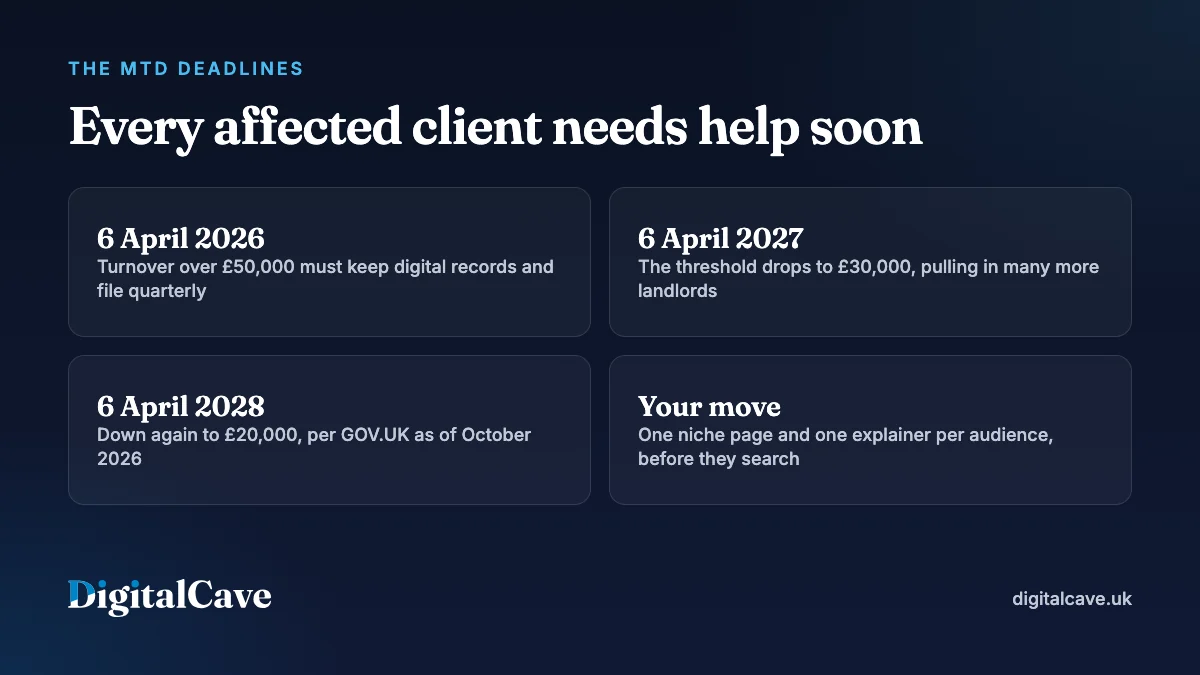
- Making Tax Digital for Income Tax began on 6 April 2026 for qualifying income over £50,000; the threshold drops to £30,000 from 6 April 2027 and £20,000 from 6 April 2028, so every affected sole trader and landlord needs help in the next 18 months.
- One niche landing page per client type (contractors, landlords, online sellers, trades) beats a single services page, because it matches what people actually search for.
- Your Google Business Profile and reviews decide whether you appear when someone searches “accountant near me”, and they cost nothing but attention.
- ICAEW and ACCA both allow advertising, including fees, as long as nothing is misleading; the description “Chartered Accountants” has strict eligibility rules.
- Referral partners (solicitors, IFAs, business bank managers) remain the cheapest source of good clients; treat them as a channel with its own monthly routine.
- A 90-day plan that fits around client work does more than a grand strategy nobody starts during Self Assessment season.
Every date, threshold and rule below was checked against GOV.UK, ICAEW and ACCA pages on 27 October 2026. Rules change, so open the linked sources before you build a campaign on them.
Why is Making Tax Digital your best client-winning hook for 2026 and 2027?
Because it creates a deadline your prospects cannot ignore, and most small practices are still marketing as if it were optional. Making Tax Digital for Income Tax is HMRC’s requirement for sole traders and landlords to keep digital records and send quarterly updates using compatible software. Qualifying income means total income from self-employment and property before expenses, in other words turnover, based on the previous tax return.
The timetable on GOV.UK’s eligibility checker, as of October 2026:
| Tax return HMRC looks at | Qualifying income (turnover) | Must use Making Tax Digital from |
|---|---|---|
| 2024 to 2025 return | More than £50,000 | 6 April 2026 |
| 2025 to 2026 return | More than £30,000 | 6 April 2027 |
| 2026 to 2027 return | More than £20,000 | 6 April 2028 |
Turning that into marketing is straightforward:
- Segment your own prospect list by the table. A landlord with £35,000 of rent is a 2027 client who needs to hear from you in 2026, while a £55,000 plumber needed software yesterday.
- Write one plain-English explainer per audience. “Making Tax Digital for landlords” and “Making Tax Digital for sole traders” answer different worries. Link each to GOV.UK so readers can verify the dates themselves.
- Offer a fixed-scope starter. A named, priced “MTD readiness check” is easier to say yes to than “get in touch”.
- Mention software by category, not loyalty. Point readers at HMRC’s software finder on GOV.UK; helping a client choose is a billable conversation.
The practices that win this work will not be the biggest. They will be the ones whose website says “we handle Making Tax Digital for landlords in plain English” when a worried landlord searches at 9pm.
Which niches should a small practice market to?
Pick two or three client types you already serve well and give each its own landing page. One generic “our services” page cannot rank for, or convince, a contractor, a landlord and an online seller at the same time, and this is where most marketing for accountants goes wrong: it describes the practice instead of the client.
A niche landing page needs five things:
- The client type in the headline and URL, for example /accountants-for-landlords.
- The three problems that type actually has (for landlords in 2026: Making Tax Digital, section 24 interest relief, incorporation questions).
- What you do about each, in sentences a non-accountant understands.
- Proof: qualifications, professional body membership, anonymised examples with permission.
- One next step, such as a fixed-fee review or a 20-minute call.
Niches that map cleanly onto searches UK practices can rank for include contractors and freelancers, landlords, ecommerce and online sellers, trades, and hospitality. If your site is too old to add pages easily, that is a web problem before it is a marketing problem; our web design for solicitors and accountants page shows what a practice site needs to do this job.
How do accountants get found on Google and in AI assistants?
Locally, through your Google Business Profile and reviews; nationally, through pages that answer one question each. Both are slow to start and compound for years, which suits marketing for accountants built on steady enquiries rather than a flood.
The local basics, in priority order:
- Complete your Google Business Profile: correct category (“Accountant”), services listed, opening hours, photos of real people and premises.
- Build reviews steadily. Ask at natural moments, such as after a tax return is filed, and reply to every review. Our guide on how to get more Google reviews covers the rules and ready-to-use scripts.
- Match your website to your area. A page per office location, consistent name, address and details everywhere. The approach in our local SEO service applies to any UK town.
- Write for questions, not keywords. “Do landlords need an accountant for Making Tax Digital?” is a blog post, a FAQ and a LinkedIn post in one.
Increasingly, prospects also ask ChatGPT, Perplexity or Copilot to recommend an accountant. Those assistants lean on the same signals: consistent facts about your firm across the web, reviews on more than one platform, and pages that state plainly who you serve and where. We cover the specifics in how to get your business recommended by ChatGPT.
If you want a sense of what professional SEO help costs before you commit, see how much SEO costs in the UK.
Does LinkedIn still win clients for accountants?
Yes, but as a referral and reputation channel rather than a lead tap. Business owners rarely hire an accountant from a cold post; they hire the one a trusted contact mentioned, and LinkedIn is where that mention gets reinforced.
A sustainable LinkedIn routine for a small practice is 30 minutes twice a week: one short post in plain English about something clients are asking (Making Tax Digital dates are endless material), and ten minutes of genuine comments on posts by local business owners and potential referral partners. Skip the stock-photo motivational content; a two-paragraph answer to a real question outperforms it.
Treat referral partners as their own channel with a routine:
- Solicitors: property and family lawyers constantly meet people who need tax advice, and you meet clients who need wills and leases. A quarterly coffee each way keeps it live.
- Independent financial advisers: pensions and tax planning overlap; agree what a good referral looks like in both directions.
- Business bank managers and brokers: they see every new business in town before anyone else does.
Email ties this together: a short monthly note to clients and contacts with one useful update (a date, a threshold, a deadline) keeps you the obvious answer when someone asks “do you know a good accountant?”. If you have never built one, our email marketing page explains the moving parts.
Should accountants publish their prices?
Publish at least a starting price or a worked example, because silence costs you the comparison. A prospect with three tabs open will shortlist the two firms that gave them a number.
Options, from easiest to strongest:
- “From” prices per service: self assessment from £X, limited company accounts from £Y, with a line on what moves the price.
- Three named packages for your main niche, each listing exactly what is included.
- A quote calculator: a short form (business type, turnover band, payroll, VAT) that returns a range. It filters out price-only shoppers and starts real conversations.
The rules here are friendlier than many practitioners assume. ACCA’s guidance on obtaining professional work (July 2025 edition) lets members advertise as they see fit, provided nothing is misleading and any fee reference clearly states the basis of calculation and the services it covers. Vague “everything from £20 a month” claims are a compliance risk as well as a source of bad-fit clients.
What do ICAEW and ACCA rules say about marketing for accountants?
Both bodies allow advertising and both draw the same two lines: do not mislead, and do not discredit the profession or other firms. According to ICAEW’s marketing guidance, members may promote their qualification, training, continuing professional development and Practice Assurance membership. ACCA’s factsheet adds that promotional material must not fall short of local advertising rules, which in the UK means the ASA’s advertising codes apply to your website and ads like anyone else’s.
One trap deserves its own paragraph: the description “Chartered Accountants”. Under ICAEW’s use-of-description rules, a firm may only use it if it qualifies as a member firm, broadly meaning a sole practitioner who is a member, or a partnership where more than half the voting rights are held by chartered accountants, with non-chartered principals registered as ICAEW affiliates.
If your firm does not qualify, keep the phrase out of your branding, your Google Business Profile and your ads, however good it looks. “Chartered Certified Accountants” is the ACCA equivalent with its own rules.
None of this restricts honest, specific marketing: who you help, what it costs, what changes for them, by when.
What does a 90-day marketing plan look like for a small practice?
Ninety days is enough to build the foundations without hiring anyone, if the work is scheduled like client work. Marketing for accountants in the UK is a routine rather than a project, so this plan assumes roughly three hours a week, every week:
| Weeks | Focus | What gets done |
|---|---|---|
| 1 to 2 | Foundations | Pick two niches. Complete the Google Business Profile. Fix your homepage so it names who you serve. |
| 3 to 5 | Niche pages | Write and publish one landing page per niche, each with a fixed-scope offer and a price or range. |
| 6 to 8 | Making Tax Digital campaign | One explainer per audience with the GOV.UK dates, an email to affected clients, a LinkedIn post per week. |
| 9 to 10 | Reviews and referrals | Ask ten happy clients for a Google review. Book coffees with two solicitors, one IFA and one bank manager. |
| 11 to 13 | Rhythm | Start the monthly client email. Set a repeating diary slot for one post and one review ask per week. Measure enquiries, not likes. |
The measurement that matters at this size is embarrassingly simple: how many enquiries came in this month, from where, and how many became clients. A spreadsheet beats a dashboard until you are spending real money on ads.
Where DigitalCave fits
DigitalCave is a digital marketing agency in Birmingham’s Jewellery Quarter that builds websites and runs SEO and content for small UK firms, including practices that need the niche pages, local visibility and plain-English content this guide describes.
Website builds run from £3,500 to £15,000+ and SEO retainers start at £750 a month, all on fixed-price quotes with no lock-in, and we reply within 2 working hours. If you would rather spend your time on clients than on WordPress, request a quote and tell us which niches you want to own.
Frequently asked questions
What is the best marketing channel for a small accounting firm in the UK?
Referrals plus local search, in that order. A complete Google Business Profile with steady reviews captures people already looking for an accountant, while a monthly routine with referral partners such as solicitors and IFAs generates warm introductions. Paid ads only make sense once those foundations convert reliably.
When does Making Tax Digital for Income Tax start?
It began on 6 April 2026 for sole traders and landlords with qualifying income over £50,000 on their 2024 to 2025 tax return. It extends from 6 April 2027 to income over £30,000, and from 6 April 2028 to income over £20,000. Qualifying income is turnover from self-employment and property before expenses, per GOV.UK as of October 2026.
Can accountants advertise their fees in the UK?
Yes. ACCA guidance allows fee references in promotional material provided the basis of calculation is clearly stated and the reference does not mislead about the services or time covered. ICAEW similarly permits advertising that is not misleading. Publishing honest “from” prices or packages is allowed and usually wins more enquiries.
Can any firm call itself “Chartered Accountants”?
No. Under ICAEW rules the description is restricted to member firms, broadly a sole practitioner who is an ICAEW member or a partnership where chartered accountants hold more than half the voting rights, with non-chartered principals registered as affiliates. Firms that do not qualify should avoid the phrase in all marketing.
How long does it take for accountant marketing to bring in clients?
Referral and review work can produce enquiries within weeks because it reaches people already close to deciding. New landing pages and local SEO typically take months to rank and compound from there. The 90-day plan in this guide is designed to produce early referral enquiries while the search foundations build.
Do accountants need a new website to market themselves?
Only if the current one cannot do the job. The test is practical: can you add a niche landing page yourself, does it load quickly on a phone, and does it state who you serve, your prices and your credentials? If yes, invest in pages and reviews first. If no, fix the website before spending on any channel.
In one line
Pick a niche, publish a page and a price for it, keep your Google profile and referral partners warm, and let Making Tax Digital’s dates do the urgency for you.