
Bespoke Web Design in the UK: What It Is, What It Costs and When You Need It
 13 Nov 2026
11 min read
The short answer: Bespoke web design means a site designed and built around one business, with its own layout system, components and often its own code, rather than a bought theme filled in. In the UK it runs from about £2,500 for a small custom build to £15,000 and up for a complex one. It is worth paying for when your website has to do a job a template cannot.
Table of Contents
Key takeaways
- “Bespoke” is not a protected word. Ask what is actually custom: the design system (the reusable components, type scale and spacing rules), the theme, or the code.
- Most UK small business sites sit in the middle: a custom design on a standard platform, typically £2,500 to £7,500.
- Paying for a website does not give you the copyright. In practice only a written assignment, signed by the agency, transfers it.
- Bespoke does not rank better by itself. Google says Core Web Vitals are used by its ranking systems, and a well-built template can pass them.
- Compare quotes over three years, not on build price, and remember a good template is a reasonable decision, not a failure.
What is bespoke web design?
Bespoke web design means designing and building a website from a blank page for one organisation, instead of adapting a pre-made theme. The design decisions, page structure, components and often the code exist only for that business.
Nobody polices the word. A freelancer selling a £1,200 site and an agency selling a £30,000 site both use it. There are three honest levels, and knowing which one you are being quoted for is the most useful thing you can do.
| Level | What is actually made for you | What is reused | Typical UK build price |
|---|---|---|---|
| Template | Colours, fonts, logo, your words and images | Layout, components, code | £0 to £2,500 |
| Semi-custom | Page designs, key sections, conversion flow | Platform, parent theme or builder, plugins | £2,500 to £7,500 |
| Fully bespoke | Design system, custom theme or code, content model, integrations | The CMS or framework only | £7,500 to £50,000 and up |
A useful test: ask the agency to name one thing on the site that could not be rebuilt in a weekend with a premium theme. If they cannot, you are buying semi-custom work.
Is a custom WordPress theme bespoke?
Yes, if the theme is written for you: your templates, your blocks, your field structure, with no builder bloat to strip out later. A premium theme plus a page builder plus twenty plugins is not bespoke, even when the pages look nothing like the demo. Both can be good websites. They are not the same purchase.
How much does bespoke web design cost in the UK?
Expect £2,500 to £10,000 for a custom brochure or lead-generation site, and £15,000 to £50,000 or more for a bespoke enterprise build. Fully bespoke work starts lower, from about £7,500. Add 20% VAT if the agency is VAT registered.
Those bands come from Design Box’s website cost guide, checked in November 2026. Other UK guides frame it more widely: Bark’s 2026 guide puts general web design at £500 to £5,000, and ExpertSure’s puts a small business brochure site at £2,000 to £8,000.
The ranges are wide because the word covers very different work. Our UK website cost breakdown for 2026 splits the bands by site type rather than by label, a more honest way to budget.
What actually drives the price?
Six things move the number: unique page designs, integrations, ecommerce, content, the content model and accessibility. Page count barely matters.
- Unique page designs, not page count. Ten pages from four designs is a small job. Four pages that each need a design is not.
- Integrations. A booking system, CRM or payment flow adds build and testing time, and risk when the third party changes.
- Ecommerce. Products, variants, shipping rules, tax and returns turn a brochure build into a product build.
- Content. Copywriting and photography are a separate workstream, and missing content is the most common reason our builds run late.
- The content model. Fields that let you add a case study or location page yourself cost more up front and save thousands later.
- Accessibility. Building to WCAG 2.2, first published as a W3C Recommendation on 5 October 2023 and revised on 12 December 2024, is design and build work, not a switch.
Bespoke or template: which do you need?
Choose bespoke when the website has to do something specific, carry a differentiated brand, or beat competitors who already invest. Choose a template when you mainly need to look credible and be found.
| Your situation | Template | Semi-custom | Fully bespoke |
|---|---|---|---|
| Under five pages, no integrations, new business | Best fit | Overkill | No |
| Lead generation in a competitive local market | Workable | Best fit | Possible |
| Brand is the product (design, hospitality, premium) | No | Workable | Best fit |
| Booking, quoting or a customer portal | No | Workable | Best fit |
| Hundreds of products or locations | No | Possible | Best fit |
| You add pages yourself every month | Workable | Best fit | Best fit |
The platform decision usually settles the rest, and our comparison of WordPress, Shopify, Wix and Squarespace covers the trade-offs.
Does a bespoke website rank better on Google?
Not on its own. Google’s page experience documentation states that Core Web Vitals are used by its ranking systems, while also saying there is no single page experience signal and that relevance comes first. A bespoke build makes good scores easier to hit, because you are not carrying code you never asked for. It does not hand you rankings.
The thresholds, per Google’s web.dev documentation, are Largest Contentful Paint within 2.5 seconds, Interaction to Next Paint of 200 milliseconds or less, and Cumulative Layout Shift of 0.1 or less. INP replaced First Input Delay in 2024. A clean template can pass all three; a bespoke build loaded with tracking scripts and uncompressed hero images can fail all three.
Where bespoke helps search is structure: URL design, internal linking, content types that let you publish service and location pages consistently, and markup you control. That is also what gets you quoted by AI assistants, as our guide to Google’s AI Overviews explains.
Who owns a bespoke website? The clause most quotes skip
By default the agency or freelancer who built it owns the copyright, not you. Under section 11 of the Copyright, Designs and Patents Act 1988, the author of a work is the first owner of the copyright in it.
The exception is a literary, dramatic, musical or artistic work or a film made by an employee in the course of employment, and even that is subject to any agreement to the contrary.
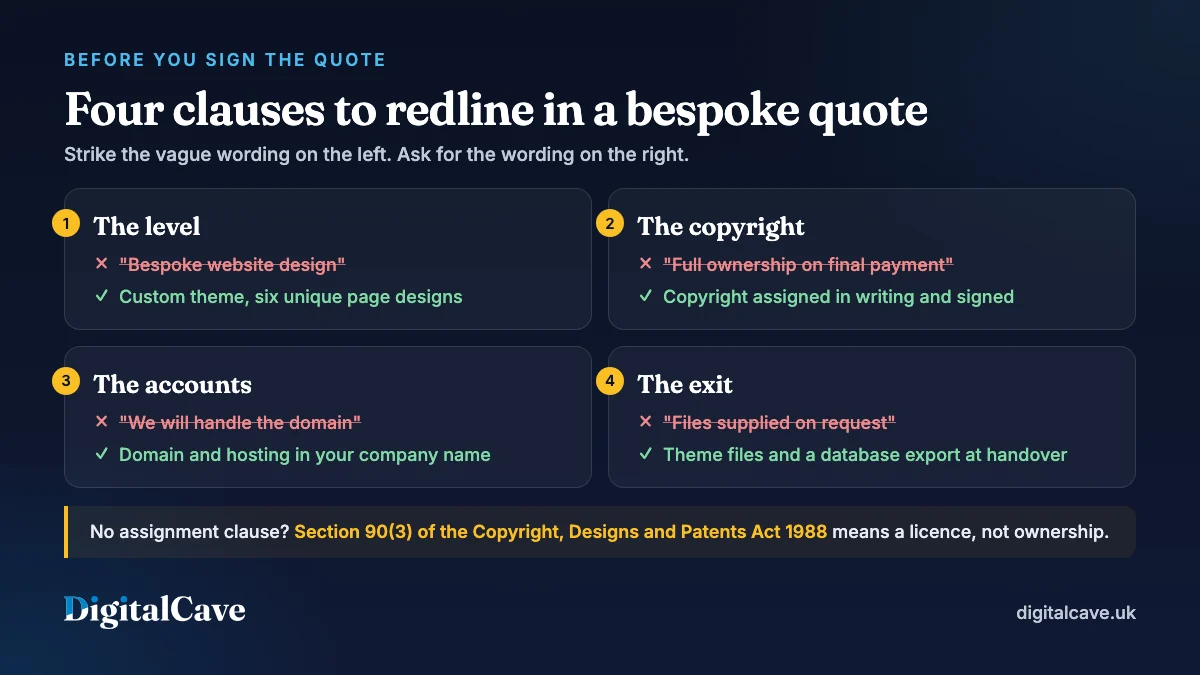
An agency or freelancer you commission is not your employee, so paying the invoice does not transfer copyright. That requires an assignment, and section 90(3) of the same Act says an assignment is not effective unless it is in writing signed by or on behalf of the assignor.
In plain terms: without a written assignment signed by the agency, you are usually relying on an implied licence to use your website, not ownership of it. For most small businesses a clear, perpetual, transferable licence is fine. What is not fine is nobody writing down which you bought.
The five ownership items to confirm in writing
- Copyright in the design and code, assigned or licensed, stated explicitly.
- The domain name, with your company as the registrant.
- Hosting and DNS, in an account where you are an administrator.
- Source code and repository access, with a copy handed over at launch.
- Third-party licences, listing which plugins or fonts sit on the agency’s account.
Check the finished site also meets regulation 25 of the Company, Limited Liability Partnership and Business (Names and Trading Disclosures) Regulations 2015: a company must disclose on its websites the part of the UK where it is registered, its registered number and its registered office address. It is a footer job, and it is missing from plenty of new builds.
A three-year cost comparison you can copy
Build price is the wrong comparison. This worked example uses assumptions, not research, so replace every number with your own.
Assumptions: template £1,500 build, £25 a month platform, £400 a year of changes. Semi-custom £4,000 build, £15 a month hosting, £600 a year care plan. Bespoke £12,000 build, £25 a month hosting, £1,200 a year care plan. All exclude VAT.
| Route | Build | 36 months hosting | 3 years of changes | 3-year total |
|---|---|---|---|---|
| Template | £1,500 | £900 | £1,200 | £3,600 |
| Semi-custom | £4,000 | £540 | £1,800 | £6,340 |
| Fully bespoke | £12,000 | £900 | £3,600 | £16,500 |
Now turn it into a decision. The gap between the template and fully bespoke routes is £12,900 over three years. If an average new customer is worth £900 in gross profit, the bespoke site has to win 15 extra customers across those three years to break even: roughly one every ten weeks.
For a solicitor, a private clinic or a commercial fit-out firm, that is a low bar. For a local service business charging £60 a job, it is not. That one sum beats any list of bespoke benefits, and it is why our guide to UK website maintenance costs matters as much as the build quote.
Seven questions to ask before you sign
Copy these into your reply to any quote. They tell you more than the portfolio.
- Which parts of this build are custom, and which are a theme, builder or plugin?
- Does the contract assign copyright in the design and code to us, or licence it? Point to the clause.
- Will the domain be in our company name, and will we be hosting administrators from day one?
- Which pages or content types can we add ourselves after launch?
- What accessibility level are you building to, and how will you test it?
- What are the Core Web Vitals targets at launch, measured on mobile?
- If we leave, what do we take with us, and in what format?
Red flags in a bespoke web design quote
- A fixed price with no page list, integration list or content split.
- “Bespoke” on the quote, a named premium theme in the small print.
- Monthly payments where the site switches off if you stop paying.
- No staging site, no revisions limit and no launch checklist.
- Guaranteed rankings, which nobody can promise. Our list of signs your website needs a redesign covers what to measure.
How long does a bespoke website take?
A realistic small business bespoke build runs seven to twelve weeks. Content, not design or code, is the bottleneck.
| Stage | Typical time | What you have to supply |
|---|---|---|
| Discovery and sitemap | 1 week | Goals, services, competitors |
| Wireframes and content plan | 1 to 2 weeks | Sign-off, and who writes what |
| Design | 2 to 3 weeks | Brand assets, one consolidated round of feedback |
| Build and integrations | 2 to 4 weeks | Logins for CRM or booking tools |
| Content load and testing | 1 to 2 weeks | Final copy, images, legal pages |
| Launch and handover | 2 to 3 days | DNS access, a training slot |
When you should not pay for bespoke
Honest answer, and it costs us work to say it. Skip bespoke if you are pre-revenue and testing an idea, if you have under five pages and no integrations, if the build would leave nothing for content and marketing, or if your last site failed because nobody updated it.
In all four cases, a good template now and a bespoke build in eighteen months is the better sequence.
Where DigitalCave fits
DigitalCave is an all-in-one web design, SEO and digital marketing agency at 47 Jewel Court, 29 Legge Lane, Jewellery Quarter, Birmingham B1 3LE. We build custom WordPress and Shopify sites, we are open every day from 9:00 to 17:00, we reply within two working hours, and we have seven five-star Google reviews.
We quote a fixed price up front with no lock-in, and we will tell you when a template is the right call. Our web design service in Birmingham page lists what is included, our web design overview covers the wider options, and the case studies show finished work. Request a fixed-price quote and you get a page list, a timeline and an ownership clause.
Frequently asked questions
What is the difference between bespoke and custom web design?
There is no difference in practice. UK agencies tend to say bespoke and US agencies say custom, and both mean a site designed for one business rather than adapted from a template. What matters is which layer is custom: the visual design, the theme, or the underlying code.
How much does a bespoke website cost in the UK?
UK price guides put custom brochure and lead-generation builds at roughly £2,500 to £10,000 as of November 2026, and bespoke enterprise builds at £15,000 to £50,000 and above. Add 20% VAT if the agency is VAT registered, and compare quotes over three years.
Do I own my website if an agency builds it?
Not automatically. Section 11 of the Copyright, Designs and Patents Act 1988 makes the author the first owner of copyright, and the employee exception does not cover an agency you commission. Section 90(3) requires an assignment to be in writing and signed, so ask for that clause before paying a deposit.
Is a bespoke website better for SEO than a template?
Only indirectly. Google confirms Core Web Vitals are used by its ranking systems but says relevance comes first. A bespoke build makes speed, structure and markup easier to control, while a clean template can pass the same thresholds. Content and links still decide most rankings.
How long does a bespoke website take to build?
Seven to twelve weeks is realistic: a week for discovery, one to two for wireframes, two to three for design, two to four for build, one to two for content and testing. Delays almost always come from unfinished copy and images, not from design or development.
Can I edit a bespoke website myself?
You should be able to, and it is worth putting in the brief. Ask which page types you can edit without a developer, and ask for training at handover. A bespoke build with a well-designed content model is usually easier to update than a template stretched with a page builder.
In one line
Buy bespoke when the website has a job a template cannot do, compare quotes over three years rather than on build price, and get the copyright clause in writing before you pay a deposit.