
Web Design vs Web Development: What Is the Difference (and Why Your Business Needs Both)?
 13 Nov 2026
9 min read
The short answer: The difference between web design and web development is design versus build. Web design is how a website looks, reads and works for visitors: layout, structure, visuals and the journey to an enquiry. Web development is the code, content management system, hosting, speed and security that make it work. Most business websites need both.
Table of Contents
Key takeaways
- Design answers “what should visitors see and do?” Development answers “how do we build it so it works, loads fast and stays secure?”
- Development splits into front-end (what runs in the browser) and back-end (servers, databases, the content management system).
- The two overlap on responsive layouts, accessibility, speed and SEO, which is where most website problems start.
- A template site may only need light design and setup. A custom site, integrations or ecommerce need real development.
- Separate suppliers can work, but the hand-off between design and build needs managing, or a design that looks great in a mock-up ends up slow or hard to edit.
What is the difference between web design and web development?
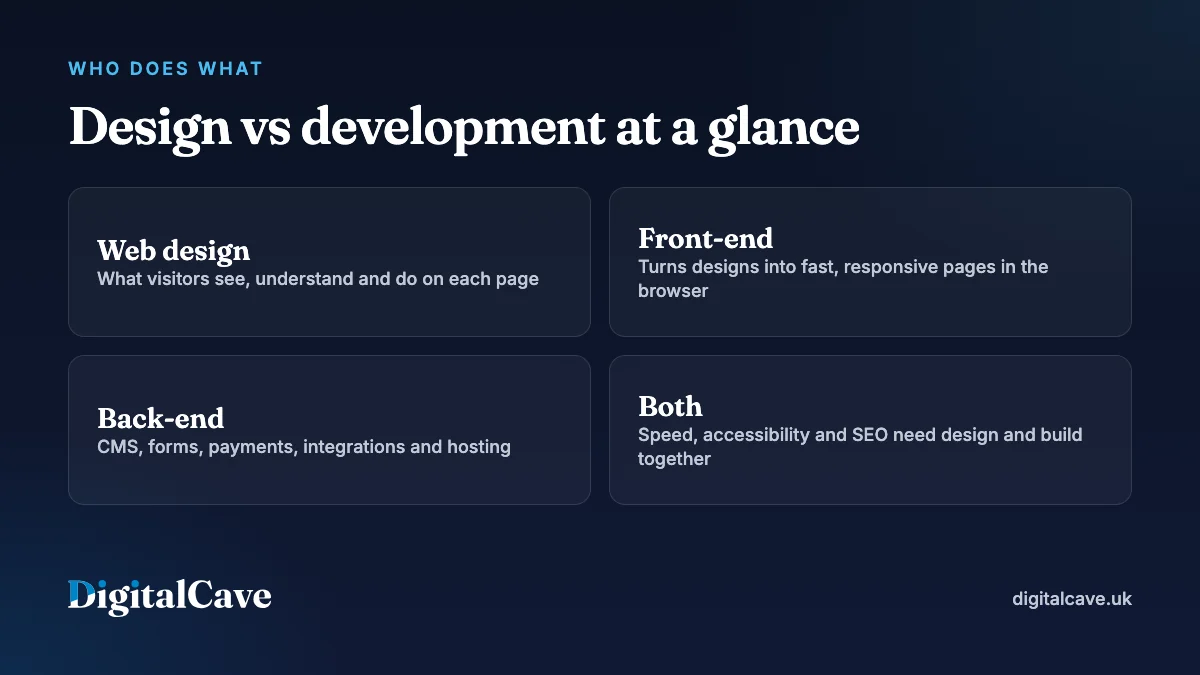
The difference is the job each one does. Web design plans the experience: what goes on each page, in what order, how it looks and how a visitor gets from landing to getting in touch. Web development turns that plan into a working website and keeps it running.
Think of building a shop. The designer decides the layout, the shelving, the signs and the route to the till. The developer builds the walls, wiring and plumbing, and makes sure the doors open and the lights stay on. A beautiful plan with poor building work fails, and so does solid building work with a confusing layout.
| Web design | Web development | |
|---|---|---|
| Main question | What should visitors see, understand and do? | How do we build it so it works on every device? |
| Focus | User experience, layout, visual identity, content structure | Code, content management system, database, hosting, performance, security |
| Typical skills | UX research, wireframing, typography, colour, accessibility, copy layout | HTML, CSS, JavaScript, PHP or other server languages, databases, version control |
| Typical tools | Figma or similar design tools, prototyping, analytics and heatmaps | Code editors, WordPress or Shopify themes, Git, staging servers, browser developer tools |
| Deliverables | Sitemap, wireframes, page designs, a design system | A working, editable, fast and secure website |
| Done well, you notice | Clear pages and more enquiries | Nothing goes wrong: it is fast, stable and easy to update |
What does a web designer do?
A web designer plans how a website works for its visitors and how it looks. The job starts long before colours and fonts.
- Information architecture: deciding which pages exist and how they are grouped in the navigation.
- User experience (UX): mapping how a visitor moves from arriving to enquiring or buying, and removing anything in the way.
- Wireframes: simple layouts of each page type, agreed before any visual design.
- Visual design (UI): typography, colour, imagery, buttons and spacing, applied consistently across a design system.
- Accessibility: designing so people with disabilities can use the site, following the W3C’s Web Content Accessibility Guidelines (WCAG) 2.2, which set three conformance levels: A, AA and AAA.
Good design is mostly invisible. Visitors do not notice the spacing or the order of sections; they just find what they need and get in touch.
What does a web developer do?
A web developer builds the website and the systems behind it, then keeps it fast, secure and up to date. Development usually splits into two halves.
| Front-end development | Back-end development | |
|---|---|---|
| Where it runs | In the visitor’s browser | On the web server |
| Languages | HTML, CSS, JavaScript | PHP, Python, JavaScript (Node.js) and others, plus SQL databases |
| Responsible for | Turning designs into responsive pages, interactions, loading speed in the browser | The content management system, forms, user accounts, payments, integrations, hosting |
| Example task | Making the menu work on a phone without slowing the page | Sending an enquiry form to your CRM and inbox |
A full-stack developer works on both. On a WordPress site, development means building or customising the theme, setting up custom fields so you can edit content safely, connecting forms and tools, and handling updates. That is the work behind our WordPress development in Birmingham and, for bespoke systems, our PHP development service.
Where do web design and development overlap?
They overlap wherever a design decision changes how hard the site is to build, or a build decision changes what visitors experience. Four areas matter most.
- Responsive layouts. A design must work from a small phone to a wide monitor. Designers plan the breakpoints; developers make them work.
- Speed. A full-screen video looks impressive in a mock-up and can wreck load times. web.dev’s Core Web Vitals guidance says the main content should load within 2.5 seconds and the page should respond to taps within 200 milliseconds.
- Accessibility. Colour contrast and clear labels are design decisions; keyboard navigation and correct HTML are development decisions. Both are needed to meet WCAG.
- SEO. Page structure and headings come from design. Clean code, indexable content, redirects and structured data come from development. Our technical SEO guide covers the build side in detail.
How do design and development work together on a real project?
On a well-run project, design and development work in sequence, with overlap at each hand-off. A typical small business website runs like this:
| Stage | Led by | What happens |
|---|---|---|
| 1. Discovery | Both | Goals, audience, services, competitors, technical needs |
| 2. Sitemap and wireframes | Design | Page list and layouts agreed, with a developer checking feasibility |
| 3. Visual design | Design | Page designs and a design system for buttons, forms and type |
| 4. Build | Development | Theme, content management, forms, integrations, on a staging site |
| 5. Content and testing | Both | Real copy and images, device testing, speed and accessibility checks |
| 6. Launch | Development | Go-live, redirects from old URLs, analytics and Search Console |
| 7. Maintenance | Development | Updates, backups, security and small improvements |
The weak point is the hand-off between stages 3 and 4. When design and development are separate suppliers, the developer may simplify a design to fit a template, or build it in a way that is hard for you to edit. Maintenance is often forgotten too; our guide to website maintenance in the UK explains what ongoing care involves.
Why do both matter for your business?
Both matter because a website has two jobs: persuade people and work reliably. Design drives the first. Clear pages, honest proof and an obvious next step turn visitors into enquiries. Development drives the second. A slow, broken or insecure site loses those enquiries before the design gets a chance.
There is a legal angle too. GOV.UK’s accessibility guidance says public sector websites must meet WCAG 2.2 AA, and that all UK service providers have a legal obligation to make reasonable adjustments under the Equality Act 2010 (the Disability Discrimination Act 1995 in Northern Ireland). Accessible design and accessible code work together to support that.
Web design vs web development: do you need a designer, a developer, or both?
It depends on what you are building. Use this as a starting point.
| Your situation | What you mainly need |
|---|---|
| A simple brochure site on a good template | Design-led setup, light development |
| A site that looks dated but works | A redesign: mostly design, some front-end development |
| A site that looks fine but is slow or breaks | Development: performance, hosting and code fixes |
| A custom website built around your brand | Both, working as one team |
| Online shop, bookings, logins or integrations | Both, with strong back-end development |
| A web app or bespoke system | Development-led, with UX design |
If you are weighing a template against a custom build, our guide to bespoke web design explains what each level really includes.
One team or two suppliers?
Two suppliers can work if you have someone to manage the hand-off and both sides talk early. One team that does both is usually simpler for a small business: one brief, one point of contact, and nobody to blame the other when something does not work.
Where DigitalCave fits
DigitalCave is an all-in-one web design, SEO and digital marketing agency, based in the West Midlands and serving Birmingham, Coventry and the UK. Our designers and developers work as one team on custom WordPress and Shopify websites, so what you approve in the design is what gets built, with SEO planned in from the start.
See how we work on our web design and development services page, or visit our web design service in Birmingham if you are local. When you are ready, request a fixed-price quote.
Frequently asked questions
Is web design the same as web development?
No. Web design plans how a website looks and works for visitors: layout, structure, visuals and user journeys. Web development builds it with code and a content management system, then keeps it fast and secure. Some people do both, and many agencies offer them together, but they are different skills.
Do web designers need to know how to code?
Not always, but it helps. Many web designers work in design tools and hand over to developers. Designers who understand HTML, CSS and how content management systems work tend to produce designs that are faster to build, easier to edit and work better on phones.
Do I need a developer for a WordPress website?
For a simple site on a well-made theme, possibly not. You will want a developer for a custom theme, custom fields, integrations, ecommerce, speed problems or security issues. A developer also makes sure updates do not break the site and that you can edit content safely.
What is the difference between front-end and back-end development?
Front-end development is what runs in the visitor’s browser: HTML, CSS and JavaScript that turn designs into working pages. Back-end development runs on the server: the content management system, database, forms, payments and integrations. A full-stack developer works on both.
Should I hire a web designer or a web developer first?
For a new website, start with design, but involve a developer early so the plan is realistic for your budget and platform. For an existing site that works but performs badly, start with development. For most small businesses, one team that covers both is simplest.
Does web design or web development matter more for SEO?
Both matter. Development makes pages crawlable, fast and correctly indexed. Design shapes page structure, headings and how easily people find and read content. Neither replaces useful content, but weak design or weak development can each hold back rankings and enquiries.
In one line
Web design decides what your website should do for visitors and web development makes it work, fast and securely, so plan both together from the first brief.