
SEO for Dentists in the UK: How Dental Practices Win More Local Patients
 24 Nov 2026
12 min read
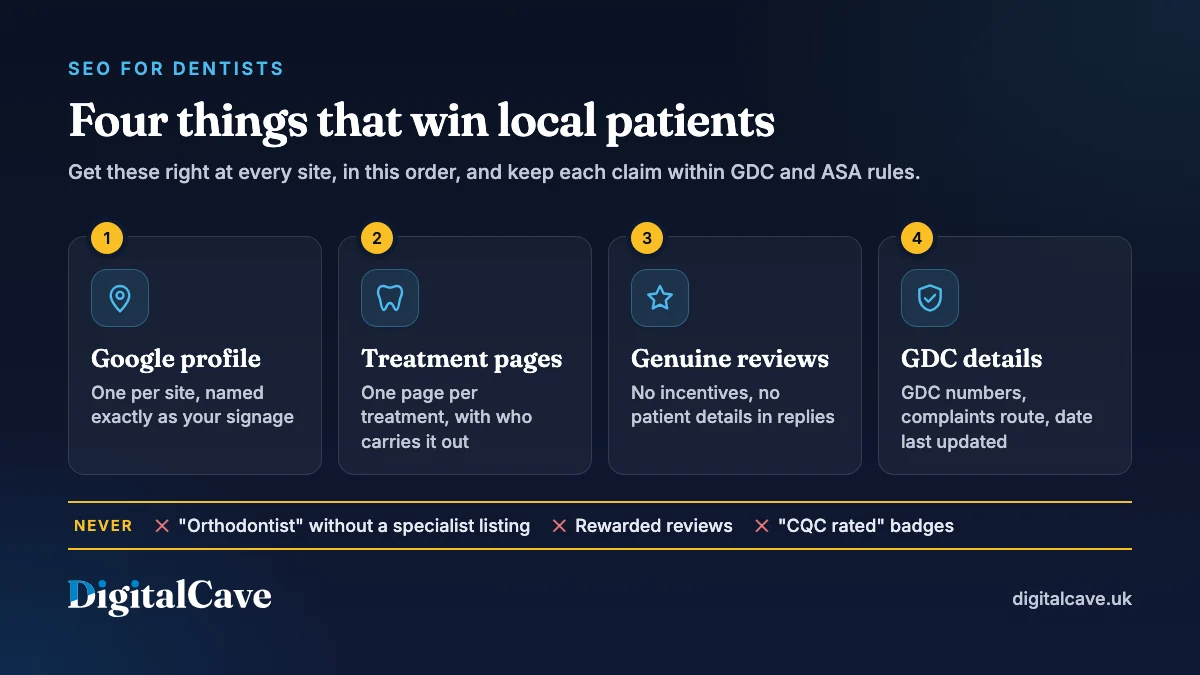
The short answer: SEO for dentists means making sure that when someone nearby searches for a dentist, an emergency appointment or a treatment such as implants, your practice appears and looks trustworthy. In the UK that comes down to four things: one Google Business Profile per site, a page for each treatment, genuine reviews, and a website that meets General Dental Council (GDC) advertising rules.
Table of Contents
Key takeaways
- Patients search by need (“emergency dentist”, “dental implants near me”), so build one page per need.
- Each practice site needs its own Google Business Profile. Individual dentists can have one too, but only under Google’s practitioner rules.
- Do not target “orthodontist” unless the dentist is on the GDC orthodontics specialist list, and never “implant specialist” (there is no GDC implant specialty). Target the treatment instead.
- GDC guidance says your website must show each clinician’s GDC number and the date the site was last updated, among other details.
- Fake and concealed incentivised reviews have been banned under UK law since 6 April 2025, and a public review reply must never confirm that someone is a patient.
- Measure dentist SEO by new patient enquiries by source, not rankings alone.
What is SEO for dentists, and how is it different?
SEO for dentists is local search optimisation for a regulated healthcare business: your Google listing, website and reviews, with every claim made under GDC and advertising rules. A misleading title or edited photo is a professional conduct issue, not just bad marketing.
Search engine optimisation (SEO) is the work of helping a website and its Google listing appear for relevant searches without paying for each click. For a practice, most of that value is local: the “map pack”, the block of three Google Maps results, often decides who gets the call.
What keywords should a dental practice target?
Target the treatment and the need, not specialist titles. Most patient searches fall into five types, and each needs its own page, because one services page cannot rank for all five.
| What the patient wants | Typical search | Page that should answer it | What usually wins |
|---|---|---|---|
| Urgent help | emergency dentist near me | Emergency appointments page | Accurate Google hours, same-day process, a phone link at the top |
| NHS access | NHS dentist accepting new patients | NHS page plus your NHS website profile | An up-to-date NHS profile that says whether you are taking NHS patients |
| A treatment | dental implants, clear aligners | One page per treatment | Plain explanation, who it suits, steps, the clinician’s qualifications, “from” prices |
| Cost | how much are dental implants | Fees page and treatment page | Published private fees and NHS bands explained |
| Reassurance | [practice name] reviews | Google profile and team page | Steady genuine reviews, polite replies, named clinicians with GDC numbers |
How should a dental practice set up Google Business Profile?
Create one Google Business Profile for each site patients visit, named exactly as your signage, with “Dentist” as the primary category. Google lets individual dentists have their own profiles only if they are public facing and can be contacted at that location during stated hours.
Google’s guidelines for representing your business on Google say, as of November 2026:
- Where several dentists work at one site, the practice keeps its own profile and each practitioner’s profile uses only their own name.
- A solo dentist at a branded practice should share one profile, named “[Practice]: [Dentist name]”.
- Support staff should not have profiles, nor should anyone have one per specialism.
- The business name must be your real-world name. Adding “Implants Birmingham” to it is keyword stuffing and risks suspension.
Do not forget your NHS website profile
If you hold an NHS contract in England, your NHS website profile is a listing in its own right. NHS Business Services Authority guidance says practices must confirm their profile information every quarter (by 30 June, 30 September, 31 December and 31 March) in the NHS Profile Manager, including whether they are accepting new NHS patients, opening times and services.
Your Google profile, NHS profile and website should agree on every detail. In Wales, Scotland and Northern Ireland, keep your nation’s NHS directory listing just as current.
Which pages does a dental website need to rank?
A dental website needs a separate page for each treatment you want enquiries for, an emergency page, a fees page that separates NHS and private care, and a page for each site.
Each treatment page should answer what a patient asks at a consultation: what it is, who it suits, the steps, risks, a “from” price, and who carries it out, with their qualifications and GDC number.
GDC guidance says that when you promote treatment on social media you must make clear it “may not be appropriate for every patient” and is conditional on a satisfactory assessment. Saying the same on treatment pages is sensible.
On the fees page, set NHS charges out exactly. According to the NHS Business Services Authority, from 1 April 2026 NHS dental charges in England are £27.90 for Band 1, £76.60 for Band 2 and £332.10 for Band 3. Charges differ in Wales, Scotland and Northern Ireland. The GDC also says your publicity must make clear whether the practice is NHS, mixed or wholly private.
The specialist title trap
Some of the most searched dental terms are specialist titles: orthodontist, periodontist, endodontist. The GDC’s guidance on advertising says a dentist who is not on a GDC specialist list must not use titles that imply specialist status, or say they are “specialising in” a treatment.
There is no specialist list for implant dentistry, and none for dental care professionals, so “implant specialist” and invented titles such as “smile specialist” are out too.
The same guidance allows “special interest in”, “experienced in” or “practice limited to”. In SEO terms, target the treatment (“orthodontic treatment”, “braces for adults”, “root canal treatment”) rather than the title.
Worked example: a page plan for a two-site practice
Assumptions, invented for illustration: a mixed NHS and private practice with two West Midlands sites, no clinician on a specialist list, offering implants, clear aligners, whitening and emergency appointments.
| Page | Main search to target | Compliance note |
|---|---|---|
| /emergency-dentist | emergency dentist [town] | Promise same-day care only if it is true |
| /nhs-dentist | NHS dentist [town] | Say whether you accept new NHS patients; match the NHS profile |
| /dental-implants | dental implants [town] | “Experienced in implant dentistry”, never “implant specialist” |
| /clear-aligners | clear aligners [town] | Brand names only if you are a provider; “orthodontic treatment”, not “orthodontist” |
| /teeth-whitening | teeth whitening [town] | Genuine, representative photos with signed, dated proof and the patient’s written consent |
| /[site-a], /[site-b] | dentist [area] | Address, hours, team and directions for that site only |
Link each location page to the treatment pages and back, so Google and AI assistants can see which site offers what.
What must a UK dental website show?
GDC guidance says a practice website must display its name and address, contact details, GDC contact details or a link, the complaints procedure, and the date it was last updated. Every clinician named needs their qualification, its country of origin and their GDC number.
- Practice name and the address where care is provided.
- Contact details, including email address and phone number.
- The GDC’s contact details, or a link to the GDC website.
- Your complaints procedure, plus who patients can go to next: the relevant NHS body for NHS care, the Dental Complaints Service for private care.
- For every dental professional named: qualification, country it comes from, GDC registration number.
- The date the website was last updated, kept current as staff and services change.
- No comparisons between clinicians, and no abbreviated memberships, fellowships or honorary degrees after names.
Building these details into page templates makes them easier to keep accurate as staff change, a point we cover in web design for clinics and healthcare.
Do not claim a CQC rating. The Care Quality Commission says it does not give ratings to dentist services; it inspects around 10% of dentists in England each year and highlights whether a service meets expected standards. A “CQC rated Good” badge on a dental site is therefore misleading; if you have an inspection report, linking to it is fine.
Can dentists use reviews, testimonials and before and after photos?
Yes, if they are genuine and you can prove it. Never write, buy or reward reviews, and never confirm in a public reply that a reviewer is your patient.
- Consumer law. The Competition and Markets Authority’s fake reviews guidance (CMA208) explains the ban, in force since 6 April 2025, on fake reviews and concealed incentivised reviews.
- Google’s policy. Its contribution policy bans offering discounts or free services for reviews, discouraging negative reviews, and selectively asking only happy patients.
- Advertising rules. The CAP Code covers claims on your own website and social media. The ASA’s dental advice says before and after photos must be genuine and representative, with signed and dated proof, and that Botox is prescription-only and cannot be advertised to the public. So no “Botox [town]” page.
Our guide on how to get more Google reviews has compliant request scripts.
A review reply template you can copy
GDC Standard 4.2.3, in the current Standards for the Dental Team, says you must not post any information or comments about patients on social networking or blogging sites. Treat review replies the same way: no names, no treatment details, no confirmation that the person attended.
Positive: “Thank you for taking the time to leave a review. The whole team will be pleased to read it.”
Negative: “Thank you for your feedback. We cannot discuss anyone’s care in a public reply, but we take every concern seriously. Please contact our practice manager at [email] so we can look into this properly.”
What technical SEO does a dental website need?
A dental website needs a fast, mobile-friendly site that Google can crawl, Dentist structured data on each location page, and a booking or call route that works in a couple of taps.
- Structured data is code that labels facts for search engines. Schema.org has a Dentist type, and Google’s documentation recommends the most specific type. Add name, address, phone and opening hours.
- Unique location pages, not the same text with a different town name.
- Light images and measurable booking. Compress before and after photos, and make sure online booking works on mobile and records completed bookings.
See our technical SEO guide for crawling and speed, and our guide to getting your business on ChatGPT for AI assistants.
How do you measure whether dental practice SEO is working?
Count new patient enquiries by source each month: calls, online bookings and forms from Google search, Google Maps and the NHS website.
| Measure | Where to find it | Why it matters |
|---|---|---|
| Calls, website clicks, direction requests | Google Business Profile performance, per site | Shows whether the map listing turns searches into contact |
| Visits from the profile | Analytics, via a UTM link (a tracking code) on the profile’s website button | Separates map traffic from other search traffic |
| Completed bookings and forms | Analytics key events or your booking system | The nearest thing to “new patients from SEO” |
| Enquiries by treatment | Reception log: “How did you find us?” | Shows which treatment pages pay for themselves |
Is SEO worth it for a dental practice?
Usually yes, if you have capacity for new patients and offer treatments worth ranking for, because good pages keep bringing enquiries without a cost per click. It is not the priority if your books are full or you are about to move or rebuild the website: fix your Google and NHS profiles first.
Google Ads is faster for a new treatment or a quiet diary, but it stops when the budget does. Whoever does the work, keep your Google Business Profile, domain and analytics accounts in the practice’s name.
Where DigitalCave fits
DigitalCave is a web design, SEO and digital marketing agency based in the West Midlands, serving Birmingham, Coventry and the UK. We build custom WordPress and Shopify sites, and for a dental practice we can build the GDC website details into your page templates. We work to a fixed-price quote, with no lock-in, and reply within 2 working hours.
Our guide to how much local SEO costs explains how pricing works, and our local SEO service and SEO services pages explain how we work. Start with a free SEO audit of your practice website, or request a fixed-price quote.
Frequently asked questions
How long does SEO take for a dental practice?
Fixes to a Google Business Profile and NHS profile can show within weeks. New treatment pages usually take several months to rank, depending on local competition and the current website. Treat SEO for dentists as an ongoing routine, not a one-off project.
How much does SEO for dentists cost?
It depends on the number of sites, how many treatment pages you need and how competitive your area is. Ask for a fixed monthly fee quoted up front, a written list of what is included and no long lock-in, then compare quotes on what is delivered each month.
Can a dentist call themselves an orthodontist on their website?
Only if they are on the GDC orthodontics specialist list. GDC guidance says dentists not on a specialist list must not use titles that imply specialist status. They may say “special interest in”, “experienced in” or “practice limited to” instead.
Can I do SEO for my dental practice myself?
Yes, much of it. Claiming and maintaining your Google Business Profile and NHS profile is free, and a practice manager can ask patients for reviews. Treatment pages, structured data and enquiry tracking usually need a web developer or agency.
Should each dentist have their own Google Business Profile?
Google allows it for public-facing dentists who can be contacted at the practice during stated hours, using only their own name. For most small practices, one strong profile per site is simpler and keeps reviews in one place.
Do dental practices need to show a CQC rating on their website?
No, because the CQC does not give ratings to dentist services in England. It inspects around 10% of dentists each year and highlights whether a service meets expected standards. Do not display a rating badge; if you have an inspection report, linking to it is fine.
In one line
SEO for dentists works when every site has an accurate Google and NHS profile, every treatment has an honest page, and every claim would satisfy the GDC.