
Ecommerce Website Designer: How to Hire the Right One in the UK (Shopify or WooCommerce)
 23 Nov 2026
11 min read

The short answer: An ecommerce website designer plans and builds an online shop that turns visitors into paying customers: product pages, search, basket, checkout, payments, delivery and returns. For most UK small businesses the choice is Shopify or WooCommerce. Hire someone who has built shops on your chosen platform, understands UK consumer law and will hand you full ownership.
Table of Contents
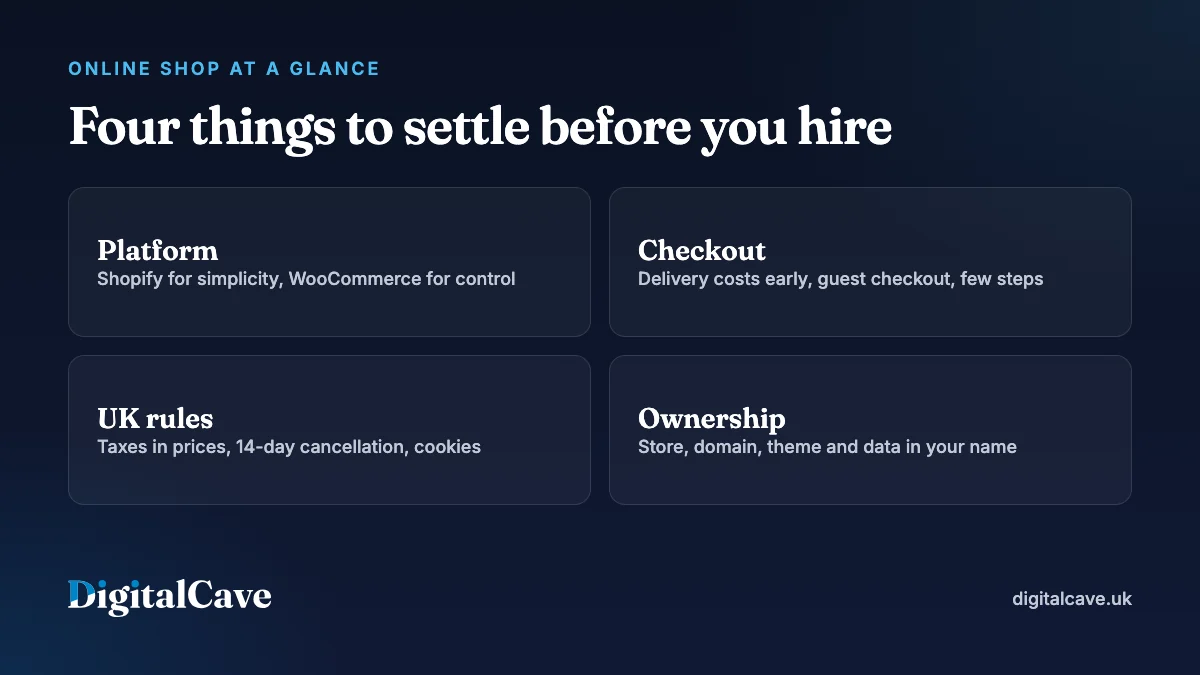
Key takeaways
- Online sales were 29.2% of all UK retail sales by value in October 2026, according to the Office for National Statistics, so the checkout has to be as good as the shop floor.
- Shopify suits product businesses that want a hosted platform with little upkeep. WooCommerce suits businesses that want full control on WordPress and already rely on content and SEO.
- A good ecommerce designer designs the buying journey, not only the look: search, filters, product detail, delivery costs and a short checkout.
- UK rules apply from day one: prices including taxes, clear delivery and cancellation terms, a 14-day cancellation right for most goods, and consent for non-essential cookies.
- Get ownership of the store account, domain, theme and product data in writing before you sign.
What does an ecommerce website designer do?
An ecommerce website designer creates the structure, look and buying journey of an online shop, then builds or oversees the build on a platform such as Shopify or WooCommerce. The job goes well beyond a brochure website, because every page has to help someone choose, trust and pay.
A typical ecommerce project covers:
- Catalogue structure: categories, collections, product types, variants such as size and colour, and filters that match how customers shop.
- Product pages: photography layout, descriptions, prices, stock messages, delivery information and reviews.
- Basket and checkout: as few steps as possible, guest checkout, clear delivery costs before payment, and trusted payment options.
- Payments and shipping setup: payment provider, delivery zones and rates, tax settings and order emails.
- Legal and trust pages: terms, delivery, returns, privacy and cookie notices, and business contact details.
- Tracking: analytics and ecommerce events so you can see which products and channels make money.
- Launch and migration: moving products, customers and old URLs from an existing shop without losing search traffic.
Some designers only design and pass the work to a developer. Others, including most small agencies, design and build. Ask which you are getting, because a beautiful design that is hard to build on your platform costs more and launches later. Our guide on what makes a high-converting website covers the design principles that apply to shops as well as service sites.
Shopify or WooCommerce: which should your designer build on?
Choose Shopify if you want a hosted shop that is quick to run with little technical upkeep. Choose WooCommerce if you want full control, already run a WordPress site, or rely heavily on content and SEO. A good designer recommends the platform that fits your business, not the one they happen to prefer.
| Question | Shopify | WooCommerce |
|---|---|---|
| What it is | A hosted ecommerce platform you subscribe to | A free, open-source plugin that turns WordPress into a shop |
| Hosting and security updates | Handled by Shopify | Your responsibility, or your web team’s |
| Running costs | Monthly plan, plus card fees and paid apps | Hosting, domain, paid extensions and maintenance |
| Design freedom | High, within Shopify’s theme system | Very high, with full access to the code |
| Content and blogging | Adequate | Strong, because it is WordPress |
| Best for | Product-led shops that want simplicity | Content-led businesses that want control and flexibility |
| Main risk | Monthly app costs creep up | Updates and plugins need regular care |
As of November 2026, Shopify’s UK pricing page lists the Basic plan at £19 a month billed yearly (£25 billed monthly), Grow at £49 (£65) and Advanced at £259 (£344). On Basic, Shopify Payments charges 2% plus 25p for standard online card payments, and Shopify adds a 2% fee if you use a third-party payment provider instead.
WooCommerce describes itself as open source with no monthly platform fees. The software is free, but you pay for hosting, any paid extensions such as subscriptions or advanced shipping, and someone to keep WordPress, plugins and security up to date. Our WordPress vs Shopify vs Wix vs Squarespace comparison covers the wider platform choice, including the three-year running costs.
A quick decision rule
- Selling mainly physical products, with no in-house technical help: Shopify.
- Already on WordPress with good organic traffic, selling alongside services, courses or bookings: WooCommerce.
- Unusual product rules, custom pricing or integrations with your own systems: either can work, so ask for a scoping session before choosing.
What should a UK ecommerce website include?
At minimum: clear product pages, easy search and filters, delivery costs shown before checkout, a short checkout with guest option, trusted payments, full legal pages and working analytics. Use this checklist when you brief a designer or review a quote.
- Mobile-first product pages with large images, price including VAT for consumers, stock status and delivery estimate near the buy button.
- Search and filters that use the words customers use, such as size, colour, price and occasion.
- Delivery and returns information on every product page, not only in the footer.
- Guest checkout, with account creation offered after the order rather than forced before it.
- Payment options your customers expect, such as cards, Apple Pay and Google Pay.
- Order and dispatch emails that match your brand and include cancellation information.
- Legal pages: terms and conditions, delivery, returns and cancellations, privacy notice and cookie notice.
- Ecommerce tracking in analytics, so you can see revenue by product, page and channel.
- SEO foundations: unique product and category descriptions, clean URLs, structured data for products and fast pages.
- An editing guide or training, so your team can add products and run offers without calling the designer.
Which UK rules does an online shop have to follow?
An online shop selling to consumers must give clear business, price, delivery and cancellation information before the order, honour a 14-day cancellation right for most goods, and get consent for non-essential cookies. Your designer should build these into the pages and checkout, not leave them to a footer link.
- Information before the order. GOV.UK’s guide to online and distance selling for businesses says you must give your business name, contact details and address, the price including all taxes, delivery arrangements, costs and timings, and how customers can cancel.
- The right to cancel. The same guide says customers can cancel up to 14 days after their order is delivered. If you do not tell them about this right, they can cancel up to 12 months after purchase.
- Cookies. The ICO’s guidance on cookies and similar technologies says you must tell people cookies are there, explain what they do and get consent, unless a cookie is strictly necessary for the service the person asked for. Basket and checkout cookies are usually strictly necessary. Advertising pixels are not.
- Privacy. You will collect names, addresses and order histories, so you need a privacy notice and a lawful basis for any marketing emails.
This is a design job as much as a legal one. A checkout that hides delivery costs until the last step is poor practice and loses sales. A cookie banner that blocks the buy button on a phone costs orders every day.
How much does an ecommerce website cost to run?
The build is a one-off cost, but the running costs decide whether the shop is profitable. Budget for the platform or hosting, payment fees on every order, paid apps or extensions, and ongoing maintenance or support.
Ask any designer for a written list of every recurring cost their build creates: platform plan, apps, extensions, hosting, licences and their own support fee. A design that relies on six paid apps can cost more each year than a slightly more expensive build that needs none. Our guides on how much a website costs in the UK and website maintenance costs explain the cost factors with sourced market ranges.
How do you choose the right ecommerce website designer?
Look for shops they have built on your platform, a clear process, honest advice on platform choice and full ownership for you. Then test them with specific questions about checkout, migration and SEO.
Questions to ask before you sign
- Can I see two or three live shops you built? Place a test basket on each. Is it fast on a phone? Is delivery cost clear?
- Which platform would you recommend for us, and why? A good answer refers to your products, team and budget, not their habit.
- Who owns the store, theme, domain and product data? You should, in writing, from day one.
- Which paid apps or extensions will this build need? Ask for the monthly total.
- How will you migrate our existing products, customers and URLs? Ask how old URLs will redirect to new ones.
- How will we track sales? Ask which analytics events will be set up and tested before launch.
- What training and support do we get after launch? Get the support terms and response times in writing.
Red flags
- The designer will not tell you which platform or theme they use.
- The store or domain is registered in the designer’s name.
- No plan for redirects when replacing an existing shop.
- Product descriptions copied from the manufacturer for every item, with no plan to make them unique.
- A quote with no mention of legal pages, delivery settings or tax.
Our guide to bespoke web design in the UK lists the ownership clauses to confirm for any custom build, and they apply to shops as well.
Will a new ecommerce website hurt your Google rankings?
It does not have to. Rankings usually drop after a redesign because URLs change without redirects, content is removed or pages slow down. A designer who plans redirects, keeps your best content and tests speed before launch protects what you have built.
Before launch, export every current URL that gets traffic or links, map each one to its new address and set up permanent (301) redirects. Keep category and product descriptions that already rank. After launch, watch Search Console for crawl errors for at least a month. Our technical SEO guide has the full checklist.
The same discipline applies beyond retail. When we rebuilt the website for The Teacher Trainer, an Ofqual-regulated online course provider, the new site added course pages with online enrolment and kept every course URL, so years of search visibility were protected.
Where DigitalCave fits
DigitalCave is an all-in-one web design, SEO and digital marketing agency based in the West Midlands, serving Birmingham, Coventry and the UK. We design and build custom WordPress and WooCommerce sites and Shopify stores, so we can recommend the platform that fits your products rather than the one we prefer. Our web design services page explains how we work, our web design in Birmingham page shows recent builds, and our WordPress development team handles WooCommerce builds and integrations.
Every project is a fixed-price quote with no lock-in, you own the shop, domain and content, and we reply within two working hours. If you are planning a new shop or a move between platforms, request a quote and we will tell you honestly which platform we would choose and why.
Frequently asked questions
What is the difference between a web designer and an ecommerce website designer?
A web designer plans how a website looks and works. An ecommerce website designer specialises in online shops, so they also design catalogue structure, filters, product pages, basket, checkout, payments and delivery settings, and know the platforms that run them, such as Shopify and WooCommerce.
Is Shopify or WooCommerce better for a small UK business?
Shopify is usually better for product businesses that want a hosted shop with little technical upkeep. WooCommerce is usually better for businesses already on WordPress, or those that rely on content and SEO and want full control. Both can run a successful UK shop.
How long does it take to build an ecommerce website?
It depends on the number of products, the amount of custom design and any migration from an old shop. A small shop on a well-built theme can launch in a few weeks. A custom design with integrations or a large catalogue takes longer, so ask for a written timeline.
What legal pages does a UK online shop need?
Most UK shops need terms and conditions, a delivery policy, a returns and cancellations policy, a privacy notice and a cookie notice. Before an order is placed, customers must see your business details, prices including taxes, delivery arrangements and how to cancel.
Do I own my ecommerce website if a designer builds it?
You should, but only a written contract makes sure of it. Confirm that the store account, domain, theme files, product data and customer data are registered to your business, and that you can take everything with you if you change designer.
In one line
Hire an ecommerce website designer who has built shops on the platform that suits your products, designs the whole buying journey, follows UK consumer rules and puts the store, domain and data in your name.